






For billions of years, the carbon cycle has been nature’s solution to removing excess carbon from the atmosphere.
In nature, volcanic eruptions and life forms vent carbon dioxide (CO2) into the atmosphere. Plants and trees then draw in and store this CO2 during photosynthesis.
Of late, the carbon cycle has been a focus area in climate mitigation. Plants’ ability to lock away carbon produced by burning fossil fuels can offer respite. Both fossil-fuel corporations and governments have subscribed to this idea as they look for ways to offset their still-rising carbon footprints.
But a study recently published in the journal Science by an international team of researchers suggests plants absorb more CO2 from the atmosphere than expected and also store it for a shorter duration than expected, before releasing it into their surroundings.
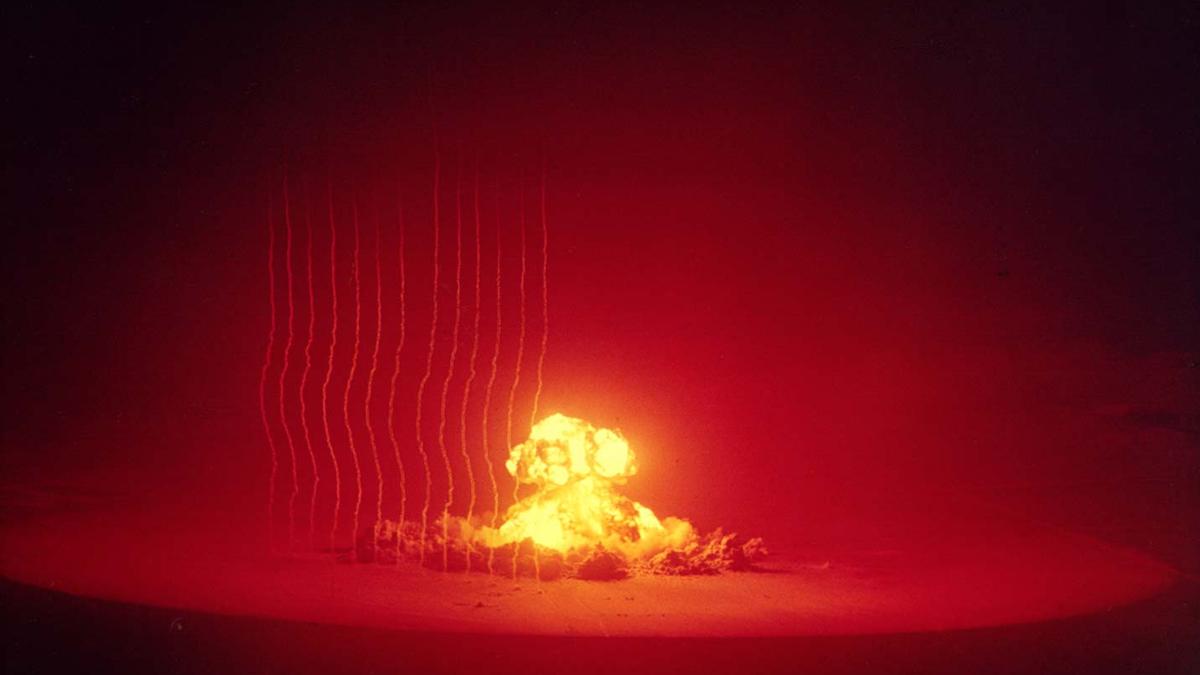
To establish their findings, the researchers investigated the remains of nuclear bomb tests the U.S. and the Soviet Union conducted in the 1960s using climate models.
Relics of the Cold War
The dozens of nuclear bomb tests during the Cold War in the second half of the 20th century maintained an atmosphere of trepidation worldwide and, scientists later found, an opportunity for climate research.
“As terrible as they were, they’ve been quite useful to scientists,” Heather Graven, a climate physicist at Imperial College London and the study’s lead author, said.
The explosions sprayed radioactive material around the planet, including a lot of it in the atmosphere. One of them was carbon-14, an isotope also called radiocarbon. Its atom’s nucleus has two neutrons more than in the nucleus of the more common carbon-12. Radiocarbon is naturally found in minute quantities but the nuclear bomb tests steadily deposited more and more of it in the atmosphere.
In 1963, Cold War powers signed the Limited Test Ban Treaty (LTBT) that prohibited nuclear testing over land, air, and under water. The atmospheric radiocarbon concentration stopped increasing beyond this year. Dr. Graven and her team used models to track the change in this level between 1963 and 1967 and found that it dropped steadily.
Often, radiocarbon bonds with oxygen to form CO2. Plants, trees, and other vegetation absorb this CO2 during photosynthesis to produce food and ultimately energy. The researchers found that the models suggested the radiocarbon was moving into vegetation from the atmosphere.
‘The whole system is cycling faster’
Plants need food to survive and they make it themselves. They absorb CO2 from the atmosphere during photosynthesis and use it to make glucose. A plant consumes some of the glucose and some it stores as starch in its leaves. In this process, some carbon is also lost when the plant exhales CO2 as it respirates.
Scientists don’t have a direct way to measure the rates at which vegetation loses and gains carbon. But they have been able to use satellite data to estimate how much carbon vegetation around the world hosts.
The researchers behind the new study used climate models to estimate the amount of carbon stored in vegetation around the planet in a year. Previous studies had shown this value to be at least 43-76 billion tonnes of carbon per year worldwide. But the study team said it could be around 80 billion tonnes per year, with most of the carbon being stored in leaves and finer roots, i.e. the non-woody parts of the plant.

If the higher value is accurate, plants must also be shedding their carbon sooner than thought. Otherwise, the researchers figured, they would have more carbon than estimated based on satellite data.
The findings also shed light on how quickly carbon is exchanged between vegetation and the atmosphere. “The whole system is kind of cycling faster than what we thought before,” Dr. Graven said.
But Raghu Murtugudde, a climate scientist at IIT Bombay who wasn’t involved in the study, advised caution. “To say what the actual impact on the carbon cycle is would be a challenge,” he told The Hindu. “Theoretically you want to include all the details [in the models] but there are missing understandings and lack of data and irreducible uncertainties.”
He said the models simulating carbon stored in vegetation in the study make assumptions that, if tweaked, could change the results significantly.
The study’s co-author Will Wieder, a climate scientist with the U.S. National Center for Atmospheric Research, said Dr. Murtugudde’s statement was “accurate” but also “short-sighted”.
Radioactive representation
In 1995, the World Climate Research Program set up the Coupled Model Intercomparison Project (CMIP), which prepares climate projections that inform the U.N.’s climate reports.
For the CMIP, scientific institutions in several countries pool their individual climate models together to produce better projections. But most of these models haven’t been tested with radiocarbon data.
It’s not difficult to input this data, according to Dr. Graven. “Some of them haven’t really bothered to do so.”
In fact, only one model, the ‘Community Earth System Model 2’ developed by the U.S. University Corporation for Atmospheric Research, accounted for radiocarbon in its simulations — but it also predicted plants had absorbed much less radiocarbon than Dr Graven & co. found they should.
Climate models have always had uncertainties.
“They are not wrong. They are imperfect,” Dr. Murtugudde said. “It’s like a car that pulls to one side but it can be driven. So it needs to be looked at by a mechanic to make sure it eventually drives straight.”
The CMIP models used in the study included some of the latest versions (5 and 6). The short-falls highlighted in the study are more of a stepping stone for future research into climate modelling, according to Dr. Wieder. “This kind of information is critical as we work to improve the models for CMIP 7 and beyond.”

This said, all these climate scientists agreed radiocarbon needs to be represented better in climate predictions. So far, radiocarbon inclusion has been plagued by “limited resources, both funding and effort, available for model development and observational research,” Govindasamy Bala, a climate physicist at the Indian Institute of Science, Bengaluru not involved in the study, told The Hindu.
“Representation of isotopes, ice sheet dynamics, permafrost, etc. in models is likely to gain momentum in the future,” he added.
Karthik Vinod is a freelance science journalist and co-founder of Ed Publica. He has masters’ degrees in astrophysics and science, technology and society.