
Mathematics always interested 18-year-old Ananda Bhaduri. Growing up in Guwahati, he spent his formative years learning topics not generally covered in school curricula. Last year, he dove into the expansive archives of mathematics problems on the internet, carefully curating the hardest ones and solving them — sometimes in solitude, at others over online meetings with his friends.
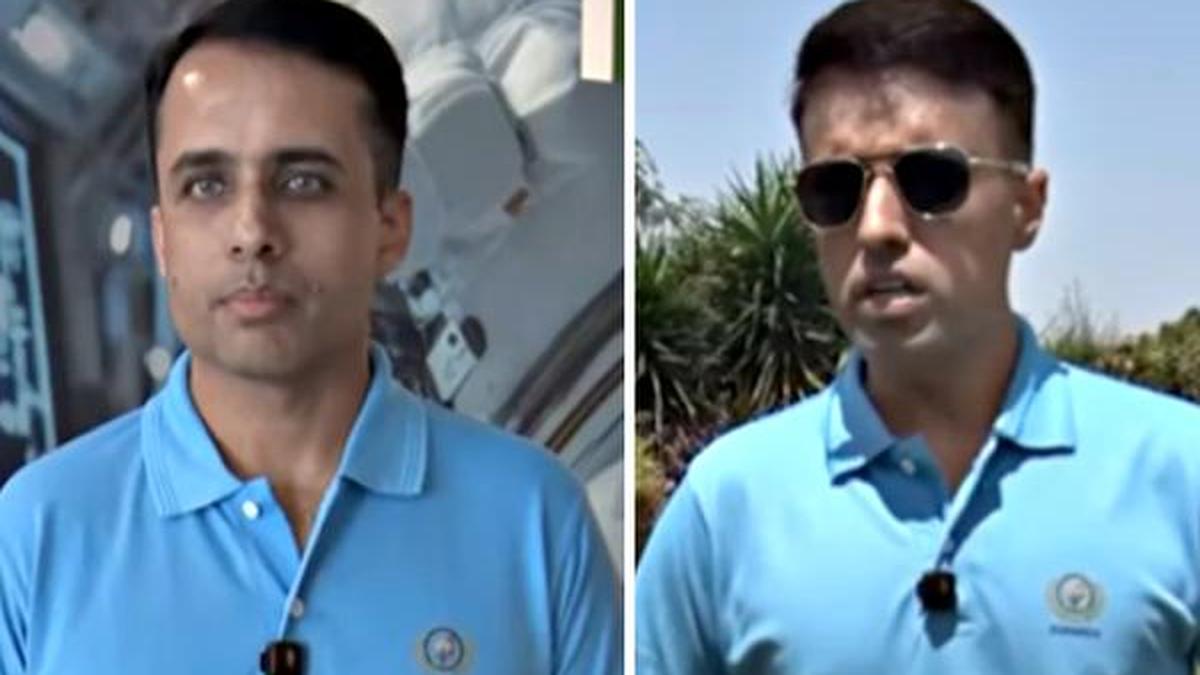
When the results of the International Mathematics Olympiad (IMO) were declared earlier this year in July, Mr. Bhaduri was overjoyed when he found he had won a gold medal.
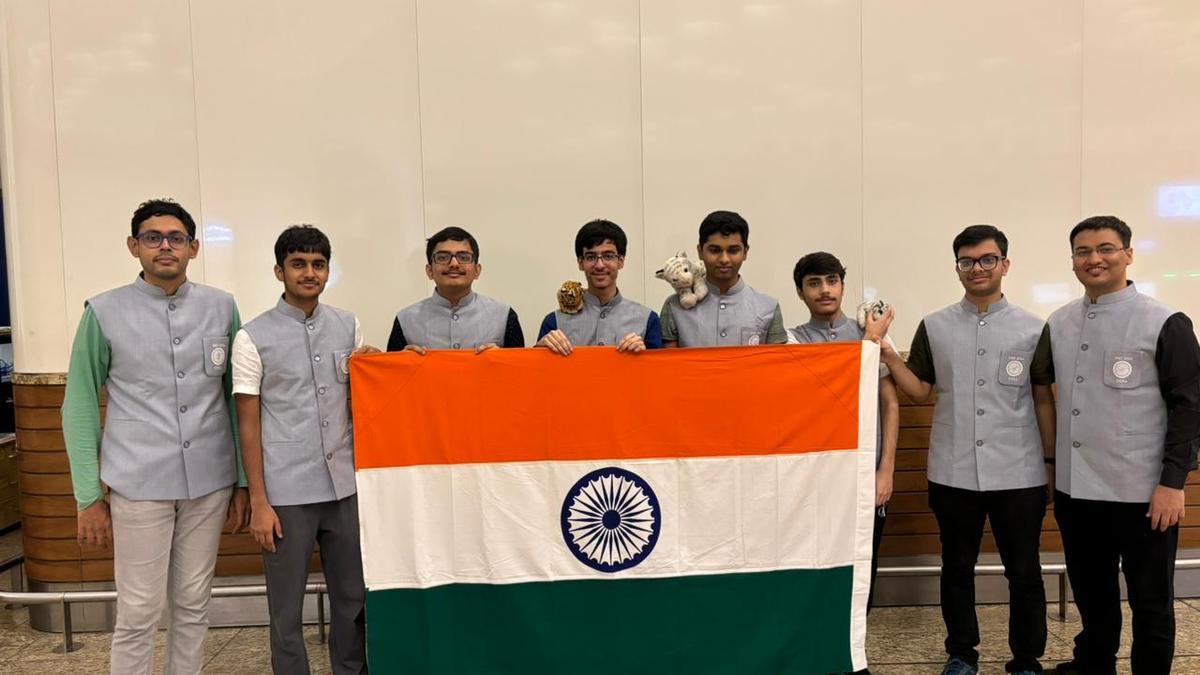
Mr. Bhaduri was a part of a six-member Indian team that created history at the IMO this year. He and three other members of the team won gold medals, one bagged a silver, and one received an honourable mention. Together, the Indian team ranked fourth among teams from 108 participating countries — the country’s highest rank in the olympiad since its debut participation in 1989.
Tales of mathematical prowess often rely on tropes of prodigious talent. But in this case, the success story banks on meticulous practice and a cross-cultural collaboration.
The olympiad
The IMO is the oldest of the international science olympiads — annual international science competitions that attract pre-university students from around the world. Since 1959, when the first edition of the IMO was held in Romania, the olympiad has acquired a somewhat mythical status. Many of its medallists have eventually become notable mathematicians, with some even winning the Fields Medal, mathematics’ equivalent of the Nobel Prize.
Terence Tao, widely regarded as one of the greatest mathematicians alive and a Fields Medallist, and the late Maryam Mirzakhani, the first woman to win the medal, were both IMO medallists.
Every year, more than a hundred countries send a team of six contestants to the IMO. Accompanying them is a team leader, a deputy leader, and a group of observers. This year, the IMO was held in Bath in the U.K.
The Indian team this year consisted of Adhitya Mangudy Venkata Ganesh (from Pune), Bhaduri (Guwahati), Kanav Talwar (Noida), Rushil Mathur (Mumbai), Arjun Gupta (Delhi), and Siddharth Choppara (Pune). The first four won gold medals, while Gupta won the silver; Choppara received the honourable mention for his performance.
Krishnan Sivasubramanian, professor of mathematics at IIT Bombay, and Rijul Saini, a visitor at the Homi Bhabha Centre for Science Education, Mumbai, were the leader and deputy leader of the team respectively. The two observers were Rohan Goyal, an undergraduate student at the Chennai Mathematical Institute, and Mainak Ghosh, a postdoctoral fellow at the Indian Statistical Institute, Bengaluru.
A different exam
While competitive examinations are not new for science students in India, the IMO sets itself apart both in its format and its syllabus. Unlike competitive examinations like the IIT-Joint Entrance Examination (JEE), where the focus is on solving a large number of problems in a limited amount of time, the IMO has only six problems of increasing difficulty that participants solve over two days. Successfully solving a problem counts for 7 marks, giving every participant a maximum of 42 marks to score in the olympiad.
The problems come from topics that are typically covered in school (e.g. algebra and combinatorics) as well as those that are not, like number theory.
Algebra is the study of variables of unspecified values (typically x and y) and their manipulation through mathematical operations (like x2 + y). Number theory is the branch of mathematics concerned with the properties of whole numbers (1, 2, 3, 4, …) and arithmetic operations on them. Combinatorics — including permutations and combinations — deals with the ways objects can be counted, selected, and arranged.
Notably, the IMO’s contestants are not required to have knowledge of calculus. The idea behind the problems, as the Wikipedia entry on the IMO states, is to create “an incentive to find elegant, deceptively simple-looking solutions which nevertheless require a certain level of ingenuity”.
Making the cut
Mr. Bhaduri’s tryst with the mathematics olympiad happened four years ago when he appeared for the first time in the Indian Olympiad Qualifier for Mathematics (IOQM). Passing the IOQM is the first step in making it to the eventual team of six that will represent the country at the IMO.
The next step is the Regional Math Olympiad (RMO), a three-hour exam in which participants solve six problems of “high level of difficulty and sophistication”, per the Homi Bhabha Centre for Science Education (HBCSE), the Mumbai-based institution that coordinates the selection and training of olympiad participants in India. Those selected from the RMO finally appear for the Indian National Math Olympiad (INMO).

Around 65 top performers of the INMO are selected to attend the International Mathematics Olympiad Training Camp (IMOTC). Here, several established mathematicians gather to strengthen students’ understanding of mathematical concepts and to train them in problem-solving.
While Mr. Bhaduri’s first attempt in 2020 got him selected to attend the IMOTC, the COVID-19 pandemic threw a spanner in the plans. When he was selected once again to attend the camp at the Chennai Mathematical Institute earlier this year, he was expectedly excited.
When he attended the camp, his excitement soared. “It was the best experience of my life,” he told this reporter.
In their time at the IMOTC, participants take several selection tests and the six top performers are selected to represent the country at the IMO. Before the team departs for the IMO venue, the HBCSE holds another training programme for the team for 8-10 days.
The secret to success
Prithwijit De, associate professor at the HBCSE and the national coordinator of the mathematics olympiad programme, said that when students arrive at the IMOTC, they often already have a strong grasp on foundational concepts in mathematics. “This is probably because they have access to multiple sources on the internet,” he said.
So the training camp trains students in topics they generally don’t encounter in their school syllabi, and places them in a regimen of practicing difficult problems of the type expected in the IMO.
What about this year’s preparation made team India’s historic success possible? According to Dr. De, this is explained — at least partly — by the collaborative efforts between the Indian and Iranian olympiad teams while preparing the candidates.
For the first time, trainers from the two countries jointly prepared questions for practice tests that the two countries’ IMO candidates then took together. This “cross-cultural collaboration”, as Dr. De put it, was inspired by collaborative efforts between other olympiad teams. He gave the example of teams from the U.K. and Hungary, who he said “have been training together for a long time now”.
That said, Dr. De said it might not be possible to delineate which individual aspects of the training contributed to the candidates’ performance. This is because many of the candidates at the IMOTC have already independently trained for olympiads before coming to the camp.
For instance, Mr. Venkata Ganesh, another IMO gold medallist this year, has attributed his success to his training under M. Prakash, the founder of the Pune-based M. Prakash Institute that trains students for both competitive exams like the IIT-JEE and the olympiads.
“I don’t know what percentage of our training helped them and what percentage of this cross-cultural training helped them. It’s very hard to distinguish between the effects of all these factors,” Dr. De said. “But this year, we tried something different.”
Keeping it up
Other countries have shown interest in collaborating with the olympiad programme in India to train their candidates jointly, according to Dr. De. As a result the Indian team is planning to both continue its existing collaboration with the Iranian team as well as to expand the repertoire of collaborations.
A detailed training plan for this year is also being charted out by a “dynamic group full of young people,” Dr. De said.
The HBCSE also plans to increase the participation of girls in the IMO. The lack of women in this year’s team reflects a larger trend at the olympiad where less than 10% of participants between 2000 and 2021 were women.

In response, the U.K. launched the European Girls Mathematical Olympiad (EGMO) in 2012, opening it up eventually to more than 50 countries around the world. Each country can send a four-member team to participate in the EGMO.
India debuted at the EGMO in 2015 and struggled to send a four-member team to the competition. It is only in the last “three or four editions”, Dr. De said, “that we have had a full-strength team.”
A group of 16 girls has already been selected for the EGMO training camp slated for December this year at the Chennai Mathematical Institute. From this group, a team of four will be selected to represent the country in EGMO 2025. “We hope that this will inspire more girls to come forward and take interest in the IMO,” Dr. De added.
The author thanks inputs by Vivek Tewary.
Sayantan Datta is a science journalist and a faculty member at Krea University. They tweet at @queersprings.