

Skip to content
  • Facebook
  • X
  • Linkedin
  • WhatsApp
  • Associate Journalism
  • About Us
  • Privacy Policy
  • 033-46046046
  • editor@artifex.news
Artifex.News

Artifex.News

Stay Connected. Stay Informed.

  • Breaking News
  • World
  • Nation
  • Sports
  • Business
  • Science
  • Entertainment
  • Lifestyle
  • Toggle search form
  • Congress To Promise ‘Right To Employment’ To Youth In 2024 Lok Sabha Poll Manifesto Nation
  • Centre approves appointments of new Chairman, Managing Director of SBI Business
  • Top Pakistan court issues notice to former Army Chief, ex-ISI head for distorting facts during interviews World
  • 2024 T20 World Cup Final | A World Cup final has its own pressures and hard to predict who will rise to the occasion Sports
  • Market Capitalisation of nine of top-10 most valued firms jumps ₹2.89 lakh crore; Reliance biggest winner Business
  • Advantages Of B2B Digital Marketing Over Traditional Marketing With BrandingExperts.com Business
  • Hope Pakistan gets a leader like Narendra Modi, says Pakistani American businessman Sajid Tara World
  • Sea Trials Begin Of China’s New Aircraft Carrier Fujian. What It Means For India World

NASA Smacked A Spacecraft Into An Asteroid

Posted on July 31, 2024 By admin


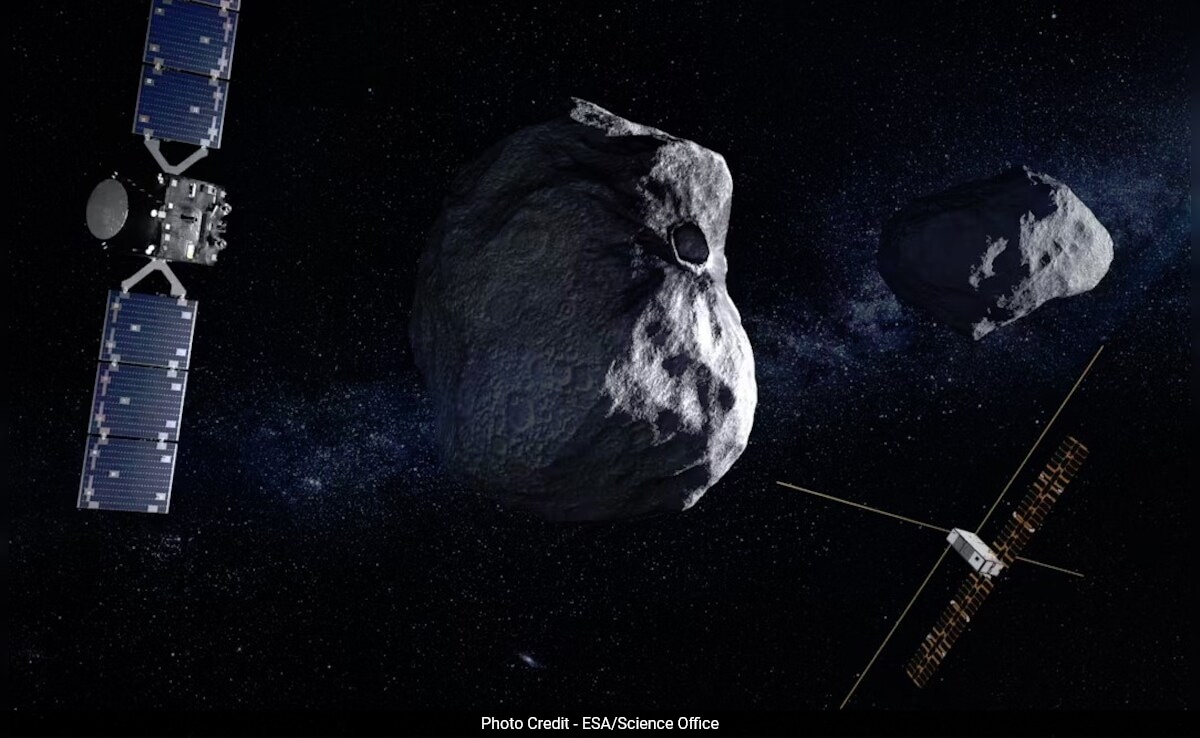
Artist impression of ESA’s Hera mission to Didymos and Dimorphos. ESA/Science Office.

Perth, Australia:

NASA’s DART mission – Double Asteroid Redirection Test – was humanity’s first real-world planetary defence mission.

In September 2022, the DART spacecraft smashed into the companion “moon” of a small asteroid 11 million kilometres from Earth. One goal was to find out if we can give such things a shove if one were headed our way.

By gathering lots of data on approach and after the impact, we would also get a better idea of what we’d be in for if such an asteroid were to hit Earth.

Five new studies published in Nature Communications today have used the images sent back from DART and its travel buddy LICIACube to unravel the origins of the Didymos-Dimorphos dual asteroid system. They’ve also put that data in context for other asteroids out there.
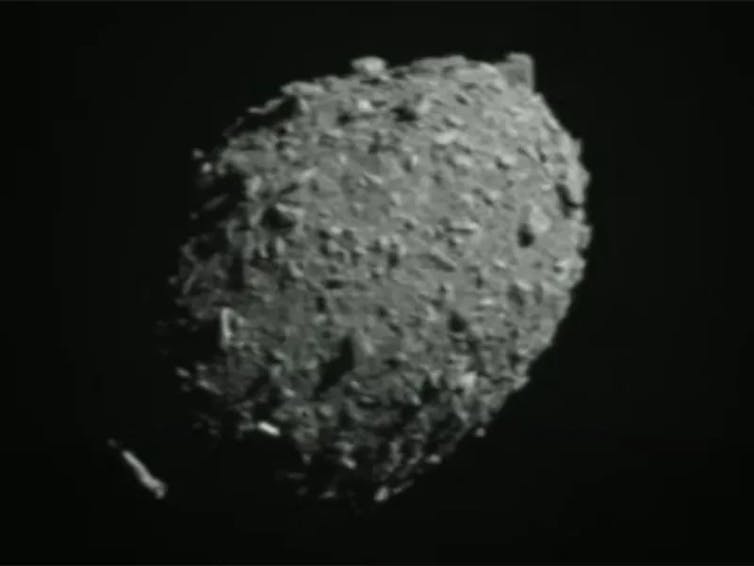
A slightly blurry image of a grey rock that looks a bit like a potato on a black background.
DART’s last complete image of Dimorphos, about 12km from the asteroid and 2 seconds before impact.NASA/Johns Hopkins APL

Asteroids are natural hazards

Our Solar System is full of small asteroids – debris that never made it into planets. Those that come close to Earth’s orbit around the Sun are called Near Earth Objects (NEOs). These pose the biggest risk to us, but are also the most accessible.

Planetary defence from these natural hazards really depends on knowing their composition – not just what they’re made of, but how they’re put together. Are they solid objects that will punch through our atmosphere if given the chance, or are they more like rubble piles, barely held together?

The Didymos asteroid, and its tiny moon Dimorphos, are what’s known as a binary asteroid system. They were the perfect target for the DART mission, because the effects of the impact could be easily measured in changes to Dimorphos’ orbit.

They are also close(ish) to Earth, or are at least NEOs. And they’re a very common type of asteroid we haven’t had a good look at before. The chance to also learn how binary asteroids form was the icing on the cake.

Quite a few binary asteroid systems have been discovered, but planetary scientists don’t exactly know how they form. In one of the new studies, a team led by Olivier Barnouin from Johns Hopkins University in the United States used images from DART and LICIACube to estimate the age of the system by looking at surface roughness and crater records.

They found Didymos is roughly 12.5 million years old, while its moon Dimorphos formed less than 300,000 years ago. That may still sound like a lot, but it’s much younger than was expected.

A pile of boulders

Dimorphos is also not a solid rock as we’d typically imagine. It is a rubble pile of boulders that are barely held together. Along with its young age, it shows there can be multiple “generations” of these rubble pile asteroids in the wake of larger asteroid collisions.

Sunlight actually causes small bodies like asteroids to spin. As Didymos started to spin like a top, its shape became squashed and bulged in the middle. This was enough to cause large pieces to just roll off the main body, with some even leaving tracks.

These pieces slowly created a ring of debris around Didymos. Over time, as the debris started sticking together, it formed the smaller moon Dimorphos.

How the spin of Didymos could have produced its tiny moon Dimorphos. Video by Yun Zhang.

Another study, led by Maurizio Pajola from Auburn University in the US used boulder distributions to confirm this. The team also discovered there were significantly more (up to five times) large boulders than have been observed on other non-binary asteroids humans have visited.

Another of the new studies shows us that boulders on all asteroids space missions have visited so far (Itokawa, Ryugu and Bennu) were likely shaped the same way. But this excess of larger boulders on the Didymos system could be a unique feature of binaries.
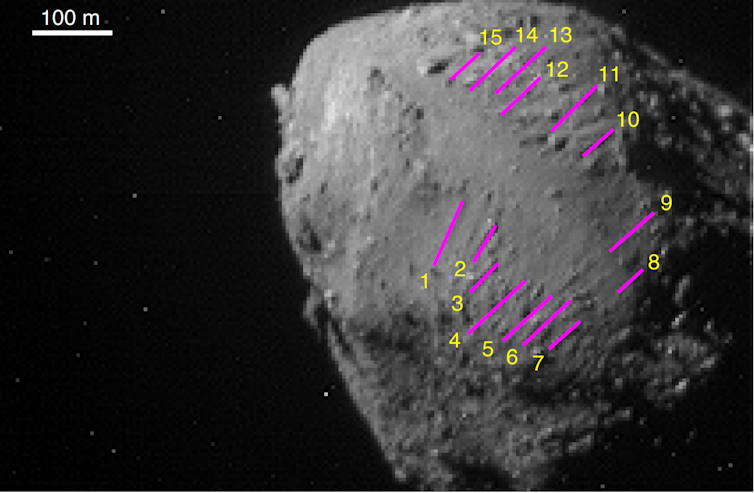
The locations of 15 suspected boulder tracks on the surface of Didymos.Bigot, Lombardo et al., (2024)/Image taken by DRACO/DART (NASA)

Lastly, another paper shows this type of asteroid appears to be more susceptible to cracking. This happens due to the heating–cooling cycles between day and night: like a freeze–thaw cycle but without the water.

This means if something (such as a spacecraft) were to impact it, there would be much more debris thrown up into space. It would even increase the amount of “shove” it could have. But there is a good chance that what lies underneath is much stronger than what we’re seeing on the surface.

This is where the European Space Agency’s Hera mission will step in. It will not only be able to provide higher-resolution images of the DART impact sites, but will also be able to probe the asteroids’ interiors using low-frequency radar.

The DART mission not only tested our ability to protect ourselves from future asteroid impacts, but also enlightened us on the formation and evolution of rubble pile and binary asteroids near Earth.The Conversation

(Author:Eleanor K. Sansom, Research Associate, Curtin University)

(Disclosure Statement:Eleanor K. Sansom receives funding from the International Centre for Radio Astronomy Research and is supported by the Australian Research Council)

This article is republished from The Conversation under a Creative Commons license. Read the original article.
 

(Except for the headline, this story has not been edited by NDTV staff and is published from a syndicated feed.)

Waiting for response to load…



Source link

World Tags:Asteroid, DART Mission, NASA DART Mission, NASA Smacked A Spacecraft Into An Asteroid, Near Eath Object

Post navigation

Previous Post: Rafael Nadal-Carlos Alcaraz Men’s Doubles Quarterfinals Live Streaming Olympics 2024 Live Telecast: When And Where To Watch
Next Post: Men's Doubles QFs Olympics Live: Nadal-Alcaraz Fight Back In 2nd Set

Related Posts

  • Rockets Fired At Iraq Air Base Housing US Forces: Report World
  • 5 killed and dozens injured in Bangladesh in violent clashes over government jobs quota World
  • Two dead, two hurt, in Dutch bridge collapse: officials World
  • European Union Agrees 5 Billion Euro Boost For Ukraine Military Aid Fund World
  • Amid massive search for mass killing suspect, Maine residents remain behind locked doors World
  • 5,000 Rockets From Gaza Hit Israel, “State Of War” Declared World

More Related Articles

Samsung union in South Korea says will strike indefinitely World
US Rapper Nicki Minaj Detained At Amsterdam Airport Over Suspicion Of Carrying Drugs World
President Macron says France will end its military presence in Niger and pull ambassador after coup World
Pakistan Ex-Prime Minister Imran Khan Could Be Slow-Poisoned To Death In Jail, Claims His Lawyer Naeem Panjutha World
Panama’s next president says he’ll try to shut down one of world’s busiest migration routes World
21 dead in fire at ArcelorMittal mine in Kazakhstan World
SiteLock

Archives

  • August 2024
  • July 2024
  • June 2024
  • May 2024
  • April 2024
  • March 2024
  • February 2024
  • January 2024
  • December 2023
  • November 2023
  • October 2023
  • September 2023
  • August 2023
  • July 2023
  • June 2023
  • May 2023
  • April 2023
  • March 2023
  • February 2023
  • January 2023
  • December 2022
  • November 2022
  • October 2022
  • September 2022
  • August 2022
  • July 2022
  • June 2022
  • May 2022

Categories

  • Business
  • Nation
  • Science
  • Sports
  • World

Recent Posts

  • Sri Lanka crush India by 110 runs to win ODI series 2-0
  • Meitei Alliance On Letter Questioning Troop Movement
  • Lok Sabha Passes Bill To Amend Long Term Tax Provision On Properties
  • Woman Says She Was Groped By Man In Dhoti-Kurta While Shopping In Delhi’s Lajpat Nagar
  • Capital gains tax on real estate: Lok Sabha passes Finance Bill, amends LTCG tax provision on immovable properties

Recent Comments

  1. TpeEoPQa on UP Teacher Who Asked Students To Slap Muslim Classmate
  2. xULDsgPuBe on UP Teacher Who Asked Students To Slap Muslim Classmate
  3. KyJtkhneiLmcq on UP Teacher Who Asked Students To Slap Muslim Classmate
  4. mOyehudovB on UP Teacher Who Asked Students To Slap Muslim Classmate
  5. GFBvgSrWPcsp on UP Teacher Who Asked Students To Slap Muslim Classmate
  • Williamson, Kohli, Smith, Babar, Warner have been my biggest challenges as a bowler: Lungi Ngidi Sports
  • RCB Had Special Season Turning It Around With Six Wins In Six: Skipper Faf Du Plessis Sports
  • Fitch raises India’s growth estimates for FY25 to 7.2% Business
  • Singapore holds first contested presidential vote in over a decade World
  • Personal Details Of Thousands Of Qantas Passengers Exposed Due To Glitch World
  • Rahul Gandhi Claims Raid Being Planned Against Him Nation
  • Kylian Mbappe Breaks Nose In France Euro 2024 Win Sports
  • Javed Akhtar Schools Social Media User Who Called Him “Son Of Traitor” Nation

Editor-in-Chief:
Mohammad Ariff,
MSW, MAJMC, BSW, DTL, CTS, CNM, CCR, CAL, RSL, ASOC.
editor@artifex.news

Associate Editors:
1. Zenellis R. Tuba,
zenelis@artifex.news
2. Haris Daniyel
daniyel@artifex.news

Photograher:
Rohan Das
rohan@artifex.news

Artifex.News offers Online Paid Internships to college students from India and Abroad. Interns will get a PRESS CARD and other online offers.
Send your CV (Subjectline: Paid Internship) to internship@artifex.news

Links:
Associate Journalism
About Us
Privacy Policy

News Links:
Breaking News
World
Nation
Sports
Business
Entertainment
Lifestyle

Registered Office:
72/A, Elliot Road, Kolkata - 700016
Tel: 033-22277777, 033-22172217
Email: office@artifex.news

Editorial Office / News Desk:
No. 13, Mezzanine Floor, Esplanade Metro Rail Station,
12 J. L. Nehru Road, Kolkata - 700069.
(Entry from Gate No. 5)
Tel: 033-46011099, 033-46046046
Email: editor@artifex.news

Copyright © 2023 Artifex.News Newsportal designed by Artifex Infotech.