
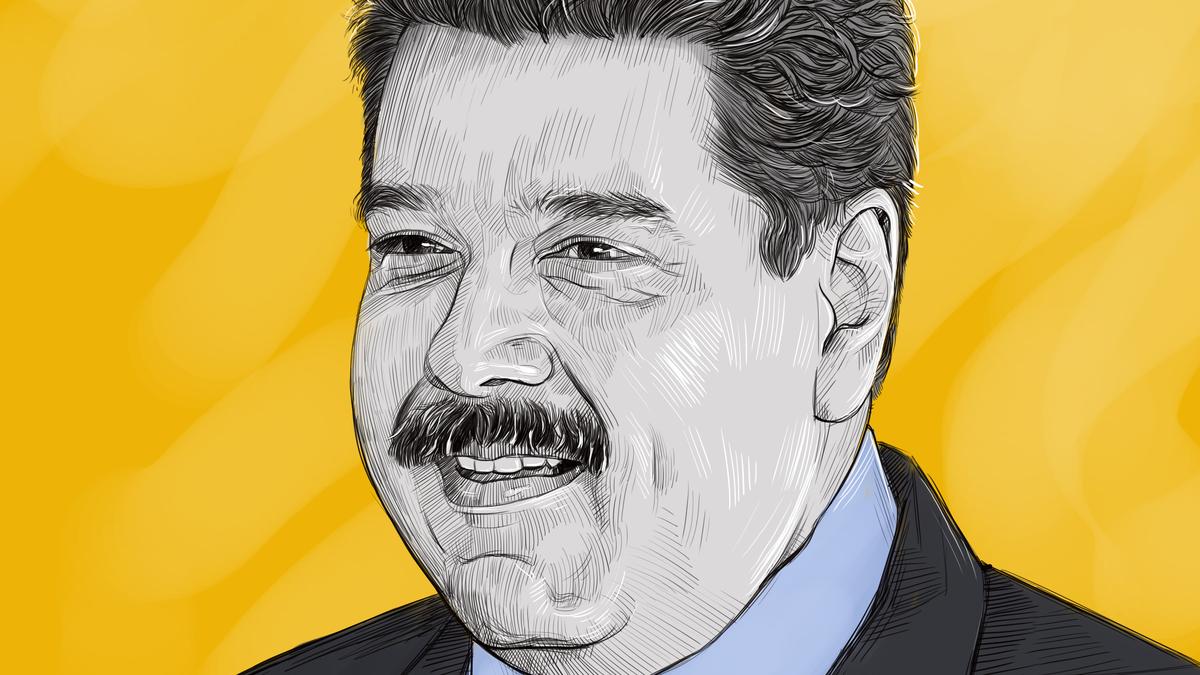
On Sunday, a battered Venezuela, still reeling from an economic crisis that has resulted in the largest forced displacement crisis in Latin America, will vote to choose a President for a new six-year term, beginning January 10, 2025. The incumbent, who has presided over this economic decline, Nicolas Maduro, is running for his third consecutive term, after first coming to power in March 2013 as the designated successor of the late Hugo Chavez, who heralded the Bolivarian turn in Venezuela’s polity in 1999.
Mr. Maduro’s presidency has led to a significant decline in Venezuela’s economic standing, with millions being pushed into poverty, persistently high inflation and severe food shortages. According to the UNHCR, more than 7.7 million Venezuelan citizens have fled the country to become refugees and 6.5 million among them (84%) are in Latin America and the Caribbean. This number is larger than that of the migrants fleeing the Russian invasion of Ukraine and the Syrian civil war. While the bulk of the migrants — 2.9 million — have fled to neighbouring Colombia and 1.5 million to Peru, more than 2,40,000 have undertaken perilous journeys such as crossing the Darien Gap between Colombia and Panama to seek entry into the U.S. via the Mexican border. The U.S. is now host to more than half a million Venezuelan migrants.
How did this go so wrong for a country that was touted as the lynchpin of “21st century socialism”and a model of how to redistribute wealth from a thriving petroleum extractive industry to fund pro-poor programmes such as schooling and housing, only a decade ago, under the charismatic “Bolivarian” rule of Hugo Chavez? Indeed, when Chavez had passed away due to cancer in 2013, Venezuela had a household poverty rate of 33.1% and extreme poverty at 11.4%, down from 61.5% and 30%, respectively, in 2003. The figures for 2021, meanwhile, have increased to 82% and 53%, respectively.
Critics of Mr. Maduro blame the catastrophic economic situation on the stark authoritarian turn since he came to power. Some suggest that the economic decline was inevitable as Venezuela was overly dependent upon the petroleum sector — crude constituted 95% of the country’s exports in 2014 and the oil price crash in the same year sent it into a spiral.
Chavez’s supporters — the Chavistas — argue that the regime enhanced grassroots participation in the polity, exemplified by the high turnouts in popular elections, and built cooperatives while using the proceeds of the extractive economy to fund pro-poor programmes. And while the regime was cognisant about diversification, the lack of it during the oil price crash resulted in the economic crisis, which was exacerbated by a series of economic sanctions imposed by the U.S. and the EU after Mr. Maduro came to power.
The Donald Trump administration in August 2017 first imposed sanctions prohibiting the Venezuelan government from accessing U.S. financial markets, a move that affected Venezuela’s state-run oil company, PDVSA. The U.S. went on, in 2019, to impose further and direct sanctions on PDVSA, preventing it from being paid for petroleum exports to the U.S, froze its U.S. assets and disallowed the supply of diluents that aided the refining of Venezuelan heavy crude, among other measures.
The U.S.-imposed economic sanctions were compounded by the EU’s own embargo on arms and material to be traded with Venezuela, imposed in 2017 and restrictions still remain.
Sanctions reprieve
The country got a respite when the U.S. eased some sanctions following an agreement signed between Mr. Maduro and representatives of opposition parties in October 2023 in Barbados with political prisoners being released. Indeed, the country’s oil output underwent an increase, resulting in more exports and a partial easing of the severity of the economic situation. However, in April 2024, the U.S. announced that sanctions would be reinstated on the oil sector as leading opposition figure Maria Corina Machado was not allowed to run in the presidential elections.
Critics argue that the seeds of the economic decline were laid during Chavez’s regime, as he tried to undo the remnants of the country’s liberal democratic order to create a personalised state with concentrated powers for the executive presidency. Following a coup attempt in 2002 against Chavez, the Chavistas sought to rewrite the rules of power in the country by moving it away from what observers termed an inflexible and ideologically one-sided, two-party system (a byproduct of the Puntofijo Pact between political parties in 1958). The Chavistas instituted a series of measures, including constitutional referendums and structural changes, most of which received popular support as Chavez won several elections. But following the economic crisis, these structures of power were utilised by his successor to entrench himself.
Mr. Maduro is a former bus driver and as a trade union activist represented bus drivers of the Caracas (Venezuelan capital) Metro System. In the early 1990s, he joined Chavez’s social movement MBR-200 (“Revolutionary Bolivarian Movement-200”) and campaigned for the release of Chavez after his arrest following a coup attempt in 1992. Mr. Maduro was also one of the founding members of the “Movement of the Fifth Republic”, which supported Chavez’s candidacy for President in 1998 and later became a parliamentarian representing the Chavistas, including as Speaker in 2005-06. After serving as Foreign Minister from 2006 to 2012, he was named Vice-President in October 2012 and was the designated successor of Chavez when he was ailing from cancer.
Since his ascent to power, Mr. Maduro’s regime has moved away from a popular regime that was dependent upon grassroots mobilisation and participatory democracy to an authoritarian system. Here, privileges were granted to figures in the military, so much so that researcher Thomas Posado claims that “more than a third of the governorates, a quarter of the ministries and at least 60 public companies, are entrusted to [the military]”. Elections were no longer seen free and fair during Mr. Maduro’s tenure, resulting in significant discontent even among the ranks of his supporters and growing abstentions. The regime was accused of using repressive measures against protestors even as the economy fell into a spiral of crisis.
Constitutional crisis
Following a constitutional crisis in 2017, when the government-backed Supreme Tribunal of Justice dissolved an opposition-led National Assembly, there was a significant drop in voter turnout in the 2018 elections, which returned Mr. Maduro to power. A leading opposition figure, Juan Guaido, was unilaterally declared as the acting President by the opposition-dominated National Assembly and was promptly recognised by the U.S., Canada and other Latin American countries. This recognition, especially by the U.S., effectively ceased in 2023 when opposition forces voted to dissolve Mr Guaido’s “interim government”.
Following the Barbados agreement, an opposition primary was held in late 2023, which was won by Ms. Machado. But she was later disqualified by the Supreme Court for her role in supporting Mr. Guaido. Ms. Machado has now backed former diplomat Edmundo Gonzalez Urrutia as the primary challenger to Mr. Maduro in the July 28 elections.
Opinion polls are notoriously unreliable in Venezuela, but many suggest that Mr. Maduro is trailing. The incumbent has also warned that a loss will result in a “bloodbath”. Mr. Maduro has sought to use state agencies to browbeat opposition supporters and leaders during the campaign, but these seem as desperate measures of an unpopular President losing support from the core sections of the poor who once endorsed and even deified the ideology of Chavism.