





Skip to content
  • Facebook
  • X
  • Linkedin
  • WhatsApp
  • Associate Journalism
  • About Us
  • Privacy Policy
  • 033-46046046
  • editor@artifex.news
Artifex.News

Artifex.News

Stay Connected. Stay Informed.

  • Breaking News
  • World
  • Nation
  • Sports
  • Business
  • Science
  • Entertainment
  • Lifestyle
  • Toggle search form
  • Pakistani Actress’ Bold ‘Date Promise’ If Bangladesh Beat India In Cricket World Cup 2023 Match Sports
  • Assam Flood Situation Improves But 6 More Die, Death Count Rises To 85 Nation
  • China continues to harp on its claim over Arunachal Pradesh World
  • Quiz | Easy like Sunday morning: Space and beyond Science
  • Pakistan’s PM-elect Shehbaz Sharif to take oath of office today World
  • “Rahul Gandhi Rallies Remind Me Of Film Ghajini”: Devendra Fadnavis Taunts Nation
  • Bombay HC to decide on Goyal’s bail plea on May 6 Business
  • Heartbroken Lionel Messi Inconsolable As Injury Forces Him Out Of Copa America Final. Video Sports

Webb telescope reveals wild weather on cosmic brown dwarfs

Posted on July 17, 2024 By admin


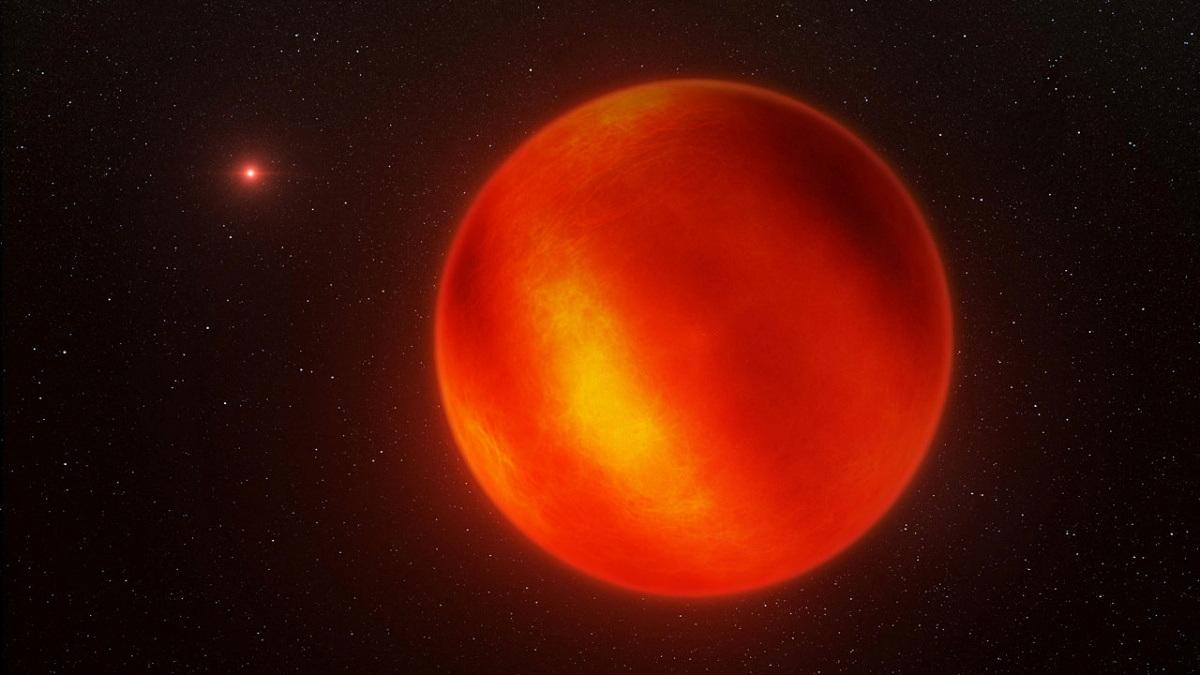
An artist’s illustration shows the nearest brown dwarf to Earth. ESO-I. Crossfield-N.
| Photo Credit: Reuters

The weather report is in for the two brown dwarfs – celestial bodies bigger than a planet but smaller than a star – closest to us. It is inclement, to put it mildly: blazingly hot, with a toxic chemical cocktail swirling in the atmosphere and clouds of silicate particles blowing around like a Saharan dust storm.

Researchers have used James Webb Space Telescope observations to conduct detailed examinations of the atmospheric conditions on brown dwarfs, specifically a pair that orbit each other around six light years from Earth, quite close by cosmic standards. A light-year is the distance light travels in a year, 5.9 trillion miles (9.5 trillion km).

The Webb data provided a three-dimensional look at how the weather changed over the course of a brown dwarf’s rotation – the larger of the two taking seven hours and the smaller five hours – with multiple layers of clouds found at different atmospheric depths.

Both have atmospheres dominated by hydrogen and helium, with trace amounts of water vapor, methane and carbon monoxide. The temperature at their cloud tops was about 1,700 degrees Fahrenheit (925 degrees Celsius), similar to a candle flame.

“In this study, we created the most detailed ‘weather maps’ for any brown dwarf to date,” said astronomer Beth Biller of the University of Edinburgh’s Institute for Astronomy, lead author of the study published on Monday in the scientific journal Monthly Notices of the Royal Astronomical Society.

Brown dwarfs are neither a star nor a planet, but something in between. They give off their own light thanks to their sheer heat – “just like you would see embers in a fire glowing red because of how hot they are,” Biller said. It was that light that the researchers observed with Webb. Unlike stars, brown dwarfs do not have nuclear fusion occurring at their core.

“Like planets, but unlike stars, brown dwarfs can also have clouds made out of precipitates in their atmospheres. However, while we have water clouds on Earth, the clouds on brown dwarfs are much hotter and likely made up of hot silicate particles -kind of like a very hot Saharan dust storm,” Biller said.

The current scientific thinking is that brown dwarfs form from large clouds of gas and dust like stars do, but fall short of mass sufficient to ignite nuclear fusion. Their composition is similar to gas giant planets like Jupiter, our solar system’s largest planet. Their mass is up to 80 times greater than Jupiter’s. By comparison, the sun’s mass is about 1,000 times greater than Jupiter’s.

The two brown dwarfs examined by Webb formed about 500 million years ago. Each has a diameter comparable to Jupiter’s. One is 35 times more massive than Jupiter, and the other 30 times.

Webb discerned how their light varied as different atmospheric features rotated in and out of view.

“The fast rotation of both objects helps to drive their weather patterns, and if you could actually directly see the cloud-top structure, you probably would be able to see bands and vortices, like the Great Red Spot, as you do on Jupiter,” Biller said.

“In the future, similar techniques could be used to study weather on potentially habitable exoplanets,” Biller added, referring to planets beyond our solar system.

Brown dwarfs are relatively common. About 1,000 are known, compared to more than 5,000 known exoplanets.

Webb examines the cosmos mainly in the infrared, while its Hubble Space Telescope predecessor does so primarily at optical and ultraviolet wavelengths.

“The atmospheres of brown dwarfs are highly complex. Webb provides a huge leap forward in our ability to understand these atmospheres by providing unprecedented wavelength range and sensitivity,” said astronomer and study co-author Johanna Vos of Trinity College Dublin in Ireland.

“These different wavelengths allow us to monitor the atmosphere from very deep to very shallow, giving a comprehensive look at the full extent of the atmosphere,” Vos added.


Source link

Science Tags:astronomy news, brown stars, dwarf star, webb telescope

Post navigation

Previous Post: Govt should rationalise customs duty in Budget to boost domestic manufacturing: Indian Chamber of Commerce
Next Post: Bangladesh’s universities urged to close after 6 die in violent protests

Related Posts

  • Daily Quiz | On scales that measure hurricanes Science
  • Sci-Five | The Hindu Science Quiz: On Domesticating Animals Science
  • ISRO carries out assessment of space situation around L1 to ensure safety of Aditya-L1 spacecraft Science
  • Is the bat’s brain wired for collective behaviour? Science
  • ‘Not considering women pilots for first Gaganyaan flight huge missed opportunity’ Science
  • Sci-Five | The Hindu Science: On Bees Science

More Related Articles

Study shows elephants might call each other by name Science
Pragyan rover comes throughout 4-meter diameter crater on lunar floor: ISRO Science
ISRO hand-holding start-ups to foster space ecosystem Science
Fourth Earth-bound manoeuvre of the Aditya-L1 mission performed successfully Science
Humble fern from New Caledonia boasts world’s largest genome Science
Smoking leaves a lasting adverse impact on immune responses Science
SiteLock

Archives

  • July 2024
  • June 2024
  • May 2024
  • April 2024
  • March 2024
  • February 2024
  • January 2024
  • December 2023
  • November 2023
  • October 2023
  • September 2023
  • August 2023
  • July 2023
  • June 2023
  • May 2023
  • April 2023
  • March 2023
  • February 2023
  • January 2023
  • December 2022
  • November 2022
  • October 2022
  • September 2022
  • August 2022
  • July 2022
  • June 2022
  • May 2022

Categories

  • Business
  • Nation
  • Science
  • Sports
  • World

Recent Posts

  • Hardik Pandya And Wife Natasa Stankovic “Mutually Part Ways”, To Co-Parent Son Agastya
  • 5 More Suspected Cases Of Chandipura Virus Reported From Gujarat
  • Vance weaves the personal into ‘America First’ politics 
  • 2 Of World’s 5 Largest Coal Mines Now In India: Report
  • German Man, 60, Seventh Person To Be Likely Cured Of HIV: Doctors

Recent Comments

  1. ywdVpqHiNZCtUDcl on UP Teacher Who Asked Students To Slap Muslim Classmate
  2. bRstIalYyjkCUJqm on UP Teacher Who Asked Students To Slap Muslim Classmate
  3. GkJwRWEAbS on UP Teacher Who Asked Students To Slap Muslim Classmate
  4. xreDavBVnbGqQA on UP Teacher Who Asked Students To Slap Muslim Classmate
  5. aANVRzfUdmyb on UP Teacher Who Asked Students To Slap Muslim Classmate
  • PV Sindhu To Spearhead India’s Challenge At BWF Singapore Open 2024 Sports
  • R Ashwin Wants ‘Red Card’ For Gulbadin Naib Accused Of ‘Cheating’ In T20 WC. Afghanistan Star Replies Sports
  • Rs 20 Crore Cash, 31.9 Kg Gold Seized After Telangana Starts Model Code Of Conduct Nation
  • Naveen Patnaik Snuffs Out BJP “Discussion” About His Hands Nation
  • Philippines suspends in-person classes due to heat, jeepney strike World
  • US Woman Leaves Children In Unlocked Car To Go Into Bar, Arrested World
  • GT vs PBKS | Efficient Titans run into inconsistent Kings Sports
  • 145 Maharashtra Prisoners’ Sentences Reduced After Securing Degrees Nation

Editor-in-Chief:
Mohammad Ariff,
MSW, MAJMC, BSW, DTL, CTS, CNM, CCR, CAL, RSL, ASOC.
editor@artifex.news

Associate Editors:
1. Zenellis R. Tuba,
zenelis@artifex.news
2. Haris Daniyel
daniyel@artifex.news

Photograher:
Rohan Das
rohan@artifex.news

Artifex.News offers Online Paid Internships to college students from India and Abroad. Interns will get a PRESS CARD and other online offers.
Send your CV (Subjectline: Paid Internship) to internship@artifex.news

Links:
Associate Journalism
About Us
Privacy Policy

News Links:
Breaking News
World
Nation
Sports
Business
Entertainment
Lifestyle

Registered Office:
72/A, Elliot Road, Kolkata - 700016
Tel: 033-22277777, 033-22172217
Email: office@artifex.news

Editorial Office / News Desk:
No. 13, Mezzanine Floor, Esplanade Metro Rail Station,
12 J. L. Nehru Road, Kolkata - 700069.
(Entry from Gate No. 5)
Tel: 033-46011099, 033-46046046
Email: editor@artifex.news

Copyright © 2023 Artifex.News Newsportal designed by Artifex Infotech.