

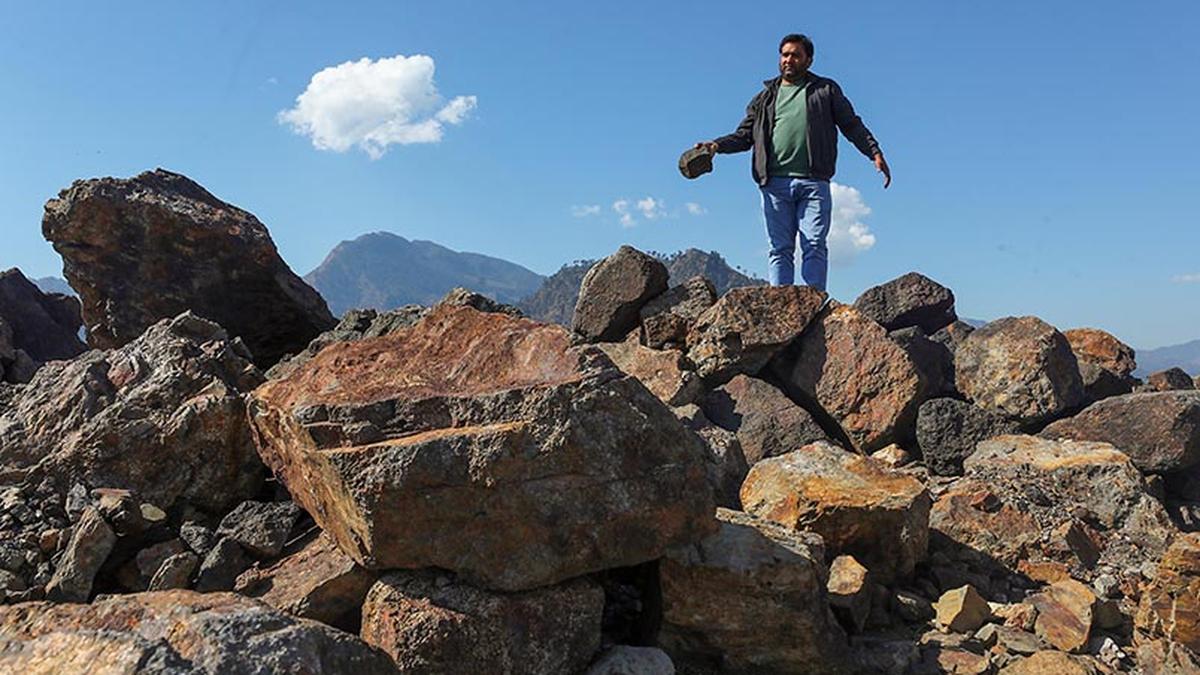
A villager poses with lithium stones in Jammu and Kashmir’s Reasi district.
| Photo Credit: PTI
The story so far: In late June, the Centre declared the winning bidders for mining rights in six blocks of critical minerals, including graphite, phosphorite and lithium, for which India largely relies on imports. These are the first private players awarded such rights under the revamped Mines and Minerals law.
Why are critical minerals important?
Minerals such as copper, lithium, nickel, cobalt are known as critical minerals, as they along with some rare earth elements, are essential for the world’s ongoing efforts to switch to greener and cleaner energy. As per the International Energy Agency (IEA), lithium demand rose by 30% in 2023, followed by nickel, cobalt, graphite and rare earth elements which saw an 8% to 15% growth, with the aggregate value of such minerals pegged at $325 billion. In its Global Critical Minerals Outlook 2024 report, the agency has flagged that the world’s goal to limit global warming to 1.5 degrees Celsius in the net zero emissions scenario, would translate into very rapid growth in demand for these minerals. By 2040, the demand for copper is expected to rise 50%, double for nickel, cobalt and rare earth elements, quadruple for graphite and eightfold for lithium, which is crucial for batteries. The development of sustainable supply chains for such minerals is, therefore, an unavoidable task. In India, the lack of ready reserves of critical minerals has resulted in 100% import dependence for minerals like lithium, cobalt, and nickel. Late last month, Union Mines Minister G. Kishan Reddy highlighted that 95% of India’s copper requirements are met through imports. China is a key supplier or processor of many of these items.
What is being done to spur production?
While India has natural reserves of some of these minerals, they haven’t been explored or tapped fully. For instance, India holds 11% of the world’s deposits of ilmenite, the main source of titanium dioxide used in many applications, but still imports a billion dollars of titanium dioxide a year, former Mines Secretary Vivek Bharadwaj once pointed out. Then there is the “lucky” discovery of lithium reserves in the Union Territory of Jammu and Kashmir (J&K) while the Geological Survey of India (GSI) was exploring the State’s terrain for limestone, which triggered hope of some self-sufficiency in the mineral. Announced as the first discovery of lithium in the country last February, these reserves were pegged at 5.9 million tonnes, enthusing the government to expedite its tapping.
Acknowledging that reliance on a few nations for the ores and processing of these minerals could pose significant vulnerabilities for Indian supply chains, the central government amended the Mines and Minerals (Development and Regulation) Act, 1957 in August 2023 to enable it to grant mining concessions for 24 critical and strategic minerals. By November, the first auctions of 20 critical mineral blocks, with the lithium block identified in J&K’s Reasi district on the list, were launched, followed by two more tranches with 18 more blocks offered this February and March. However, investor interest has been tepid — the auction of most of the first 20 blocks was scrapped for lack of adequate bidders. After a delayed process, the Mines Ministry on June 24, announced six winners from the maiden auction tranche for three blocks in Odisha, and one each in Tamil Nadu, U.P. and Chhattisgarh. The outcomes of the second and third round of auctions are still awaited, while the Ministry has initiated a fourth tranche, which includes 10 blocks that are being offered for the second time.
Why are some blocks not finding takers?
Among the first attempt blocks offered in the latest auction, two phosphorite blocks along with a glauconite block are in Chhattisgarh, while two blocks each are up for grabs in U.P. (phosphorite and rare earth elements), Karnataka (phosphate and nickel), and Rajasthan (potash and halite). A graphite block is being auctioned in Jharkhand and Arunachal Pradesh, with five additional blocks of graphite, tungsten and vanadium offered in the northeastern State for the second time. The ‘second attempt’ blocks also include a tungsten reserve in Tamil Nadu’s Madurai district, a cobalt and manganese block in Karnataka’s Shimoga, and a chromium and nickel block in Sindhudurg, Maharashtra.
As per industry experts, the reasons for low interest among miners for some of these blocks include the lack of adequate data on the potential reserves buried within them. Technology challenges also affect outcomes. For instance, the lithium block in J&K has clay deposits, and the technology for the mineral’s extraction from clay remains untested globally, pointed out Girishkumar Kadam, senior vice-president and group head for corporate sector ratings at ICRA.
When is domestic production likely to begin?
Given the preliminary stage of exploration for most of the domestic blocks being auctioned, their commercialisation and associated benefits are unlikely to fully accrue in the current decade ending 2030, ICRA said. “India’s manufacturing is thus likely to remain exposed to potential future supply shocks of these minerals till then,” it concluded. Apart from spurring exploration and attracting more miners, the Centre is looking to acquire overseas assets from key resource-rich regions as a parallel measure to bolster mineral security. The first such mine, for lithium brine, was acquired in Argentina this year by Khanij Bidesh India Limited, a joint venture of NALCO, Hindustan Copper, and Mineral Exploration Company. While it scouts for more assets, India has also joined the U.S.-led Mineral Security Partnership, a block consisting of large buyers and sellers of critical minerals.