





Skip to content
  • Facebook
  • X
  • Linkedin
  • WhatsApp
  • Associate Journalism
  • About Us
  • Privacy Policy
  • 033-46046046
  • editor@artifex.news
Artifex.News

Artifex.News

Stay Connected. Stay Informed.

  • Breaking News
  • World
  • Nation
  • Sports
  • Business
  • Science
  • Entertainment
  • Lifestyle
  • Toggle search form
  • Ukrainian strikes rock Russia as vote cements Putin’s grip on power World
  • US Woman Arrested For Forcing Child’s Head Into Toilet, Asking To Drink Its Water World
  • Alliance Francaise To Open New Branches In These Cities Nation
  • Israel-Palestine conflict live updates | Israel to stop supplying electricity, fuel and goods to Gaza World
  • The Hindu Morning Digest, June 24, 2024 World
  • China’s July exports tumble by double digits, adding to pressure to shore up flagging economy Business
  • Virat Kohli Will Score 100, India Will Win T20 World Cup 2024: Ex-England Star’s Massive Prediction Sports
  • U.S. colleges invite discussion on investments as they strike deals to end campus protests over Palestine World

Scientists search for a female partner for world’s ‘loneliest’ plant

Posted on June 21, 2024 By admin


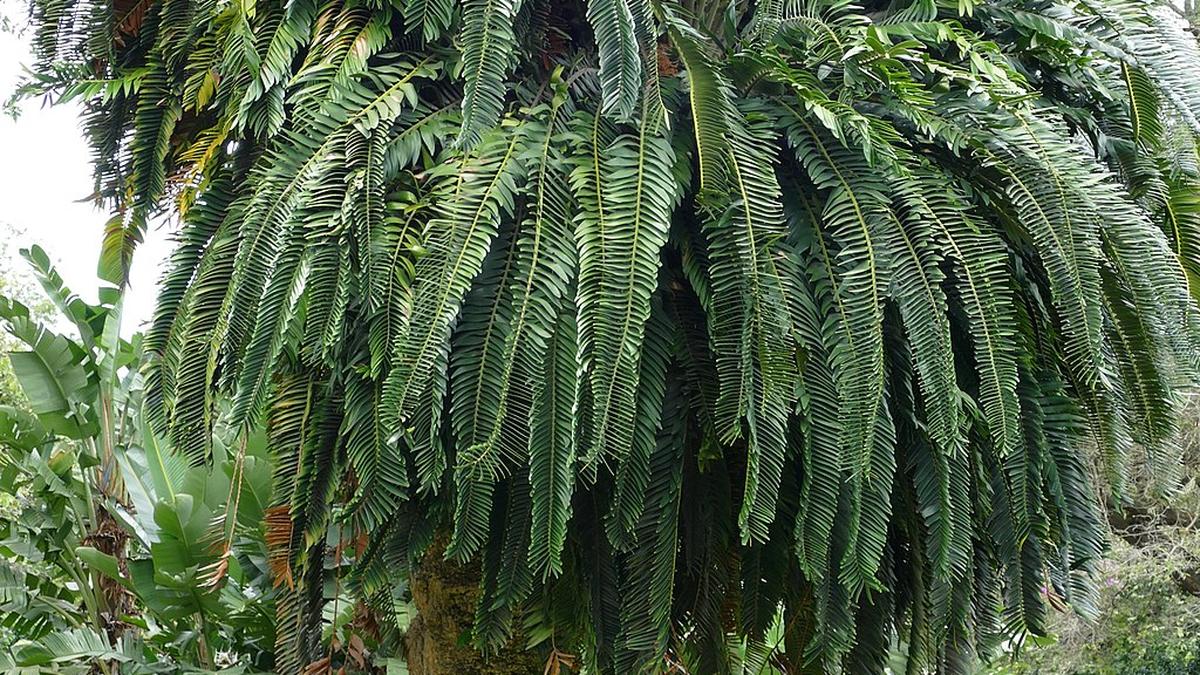
E. woodii is a member of the cycad family, heavy plants with thick trunks and large stiff leaves that form a majestic crown. 
| Photo Credit: Wikimedia Commons

“Surely this is the most solitary organism in the world,” wrote palaeontologist Richard Fortey in his book about the evolution of life.

He was talking about Encephalartos woodii (E. woodii), a plant from South Africa. E. woodii is a member of the cycad family, heavy plants with thick trunks and large stiff leaves that form a majestic crown. These resilient survivors have outlasted dinosaurs and multiple mass extinctions. Once widespread, they are today one of the most threatened species on the planet.

The only known wild E. Woodii was discovered in 1895 by the botanist John Medley Wood while he was on a botanical expedition in the Ngoye Forest in South Africa. He searched the vicinity for others, but none could be found. Over the next couple of decades, botanists removed stems and offshoots and cultivated them in gardens.

Fearing that the final stem would be destroyed, the Forestry Department removed it from the wild in 1916 for safekeeping in a protective enclosure in Pretoria, South Africa, making it extinct in the wild. The plant has since been propagated worldwide. However, the E. woodii faces an existential crisis. All the plants are clones from the Ngoye specimen. They are all males, and without a female, natural reproduction is impossible. E. woodii’s story is one of both survival and solitude.

My team’s research was inspired by the dilemma of the lonely plant and the possibility that a female may still be out there. Our research involves using remote sensing technologies and artificial intelligence to assist in our search for a female in the Ngoye Forest.

The evolutionary journey of cycads

Cycads are the oldest surviving plant groups alive today and are often referred to as “living fossils” or “dinosaur plants” due to their evolutionary history dating back to the Carboniferous period, approximately 300 million years ago. During the Mesozoic era (250-66 million years ago), also known as the Age of Cycads, these plants were ubiquitous, thriving in the warm, humid climates that characterised the period.

Although they resemble ferns or palms, cycads are not related to either. Cycads are gymnosperms, a group that includes conifers and ginkgos. Unlike flowering plants (angiosperms), cycads reproduce using cones. It is impossible to tell male and female apart until they mature and produce their magnificent cones.

Female cones are typically wide and round, and male cones appear elongated and narrower. The male cones produce pollen, which is carried by insects (weevils) to the female cones. This ancient method of reproduction has remained largely unchanged for millions of years.

Despite their longevity, today cycads are ranked as the most endangered living organisms on Earth with the majority of the species considered threatened with extinction. This is because of their slow growth and reproductive cycles, typically taking ten to 20 years to mature, and habitat loss due to deforestation, grazing and over-collection. Cycads have become symbols of botanical rarity.

Their striking appearance and ancient lineage make them popular in exotic ornamental horticulture and that has led to illegal trade. Rare cycads can command exorbitant prices from US$620 (£495) per cm with some specimens selling for millions of pounds each. The poaching of cycads is a threat to their survival.

Among the most valuable species is the E. woodii. It is protected in botanical gardens with security measures such as alarmed cages designed to deter poachers.

AI in the sky

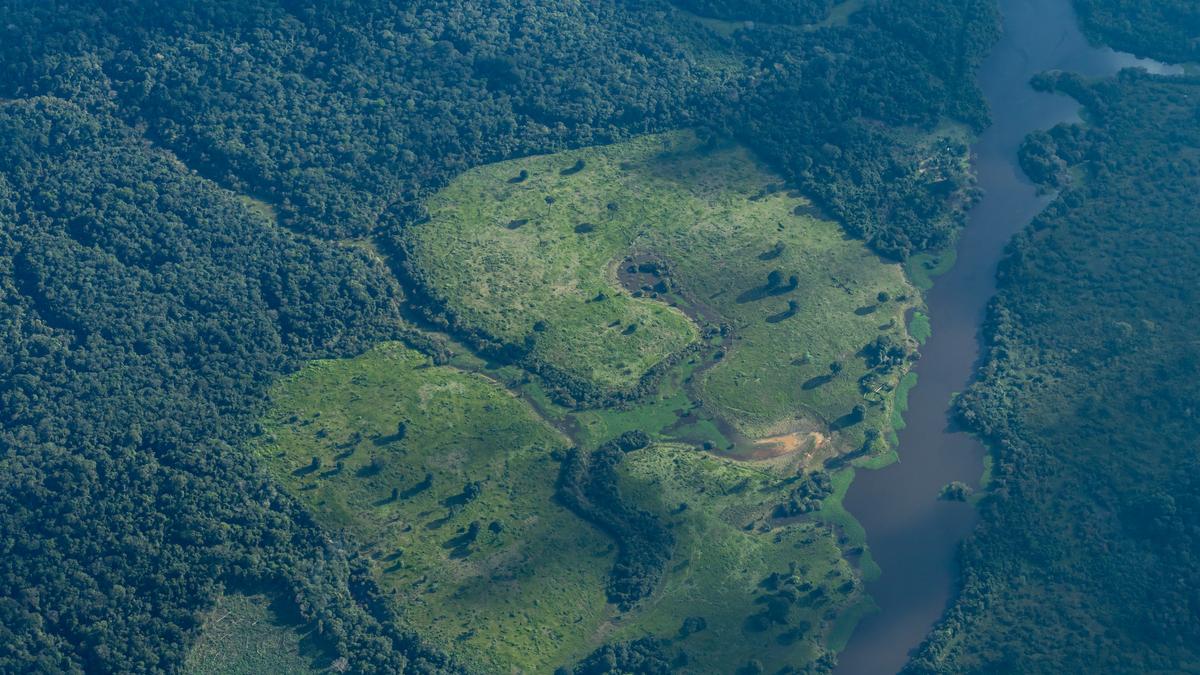
In our search to find a female E.woodii we have used innovative technologies to explore areas of the forest from a vertical vantage point. In 2022 and 2024, our drone surveys covered an area of 195 acres or 148 football fields, creating detailed maps from thousands of photos taken by the drones. It’s still a small portion of the Ngoye Forest, which covers 10,000 acres.

Our AI system enhanced the efficiency and accuracy of these searches. As E. woodii is considered extinct in the wild, synthetic images were used in the AI model’s training to improve its ability, via an image recognition algorithm, to recognise cycads by shape in different ecological contexts.

Plant species globally are disappearing at an alarming rate. Since all existing E. woodii specimens are clones, their potential for genetic diversity in the face of environmental change and disease is limited.

Notable examples include the Great Famine in 1840s Ireland, where the uniformity of cloned potatoes worsened the crisis, and the vulnerability of clonal Cavendish bananas to Panama disease, which threatens their production as it did with the Gros Michel banana in the 1950s.

Finding a female would mean E. woodii is no longer at the brink of extinction and could revive the species. A female would allow for sexual reproduction, bring in genetic diversity, and signify a breakthrough in conservation efforts.

E. woodii is a sobering reminder of the fragility of life on Earth. But our quest to discover a female E. woodii shows there is hope even for the most endangered species if we act fast enough.

This article is republished from The Conversation under a Creative Commons license. Read the original article.


Source link

Science Tags:Encephalartos woodii, loneliest plant, science news, Wood’s cycad

Post navigation

Previous Post: MEA Slams Documentary On PM, Government
Next Post: Sacked India Coach Igor Stimac Lashes Out At AIFF, Calls Indian Football ‘Imprisoned’

Related Posts

  • India aims to achieve debris free space missions by 2030 Science
  • More than 800 coal plants worldwide could be profitably decommissioned, research group says Science
  • Kerala researchers batting for better understanding of the flying mammal Science
  • Asteroid named after Bengaluru Professor Science
  • Risk of type 2 diabetes linked to air pollution in Chennai, Delhi Science
  • Russia’s war is weakening scientists’ ability to track the climate Science

More Related Articles

Anticyclones, hanging even now over India, link warming to heat | Explained Science
What is a GPU? An expert explains the chips powering the AI boom, and why they’re worth trillions Science
Three astronauts return to Earth after a year in space. NASA’s Frank Rubio sets US space record Science
Venture capitalists back ‘steroid Olympics’ where drug-testing is legal Science
Rock collected by Apollo 17 astronaut in 1972 reveals moon’s age Science
Chandrayaan-3 | ‘Smile, please!’ Pragyan’s cameras capture Vikram Science
SiteLock

Archives

  • July 2024
  • June 2024
  • May 2024
  • April 2024
  • March 2024
  • February 2024
  • January 2024
  • December 2023
  • November 2023
  • October 2023
  • September 2023
  • August 2023
  • July 2023
  • June 2023
  • May 2023
  • April 2023
  • March 2023
  • February 2023
  • January 2023
  • December 2022
  • November 2022
  • October 2022
  • September 2022
  • August 2022
  • July 2022
  • June 2022
  • May 2022

Categories

  • Business
  • Nation
  • Science
  • Sports
  • World

Recent Posts

  • Ex-India Selector Names Hardik Pandya’s Biggest Competitor For T20I Captaincy
  • Widow Of Soldier Who Died In Siachen Fire Accepts Kirti Chakra
  • Cheetah ‘Gamini’, Her 5 Cubs Enjoy Rain At Kuno National Park
  • Amid NEET Row, Close Watch On Another Medical Exam Being Held Today
  • “Would’ve Dropped Suryakumar Yadav…”: Rohit Sharma’s Hilarious Take On World Cup Final Catch

Recent Comments

  1. GkJwRWEAbS on UP Teacher Who Asked Students To Slap Muslim Classmate
  2. xreDavBVnbGqQA on UP Teacher Who Asked Students To Slap Muslim Classmate
  3. aANVRzfUdmyb on UP Teacher Who Asked Students To Slap Muslim Classmate
  4. YQCyszVBmIP on UP Teacher Who Asked Students To Slap Muslim Classmate
  5. aiXothgwe on UP Teacher Who Asked Students To Slap Muslim Classmate
  • Diesel sales fall 3% in Sept., petrol up 5.4% Business
  • India vs Bangladesh live score over Match 17 ODI 1 5 updates Sports
  • Hardik Pandya Meets Rohit Sharma For The 1st Time After MI Captaincy Change Saga. This Happens Next. Watch Sports
  • Photos Of Emergency Alert On iPhones Go Viral. Here’s What It Is Nation
  • After Women’s Quota, 76 Women To Enter Madhya Pradesh Assembly Nation
  • UN Revises India’s 2024 Economic Growth Projection Upwards From 6.2 To 6.9% Nation
  • New York Attorney General Moves To Seize Trump’s Assets As Fraud Fine Deadline Nears World
  • 6 Killed In Bar Shooting During Independence Day Celebrations In Mexico World

Editor-in-Chief:
Mohammad Ariff,
MSW, MAJMC, BSW, DTL, CTS, CNM, CCR, CAL, RSL, ASOC.
editor@artifex.news

Associate Editors:
1. Zenellis R. Tuba,
zenelis@artifex.news
2. Haris Daniyel
daniyel@artifex.news

Photograher:
Rohan Das
rohan@artifex.news

Artifex.News offers Online Paid Internships to college students from India and Abroad. Interns will get a PRESS CARD and other online offers.
Send your CV (Subjectline: Paid Internship) to internship@artifex.news

Links:
Associate Journalism
About Us
Privacy Policy

News Links:
Breaking News
World
Nation
Sports
Business
Entertainment
Lifestyle

Registered Office:
72/A, Elliot Road, Kolkata - 700016
Tel: 033-22277777, 033-22172217
Email: office@artifex.news

Editorial Office / News Desk:
No. 13, Mezzanine Floor, Esplanade Metro Rail Station,
12 J. L. Nehru Road, Kolkata - 700069.
(Entry from Gate No. 5)
Tel: 033-46011099, 033-46046046
Email: editor@artifex.news

Copyright © 2023 Artifex.News Newsportal designed by Artifex Infotech.