


Skip to content
  • Facebook
  • X
  • Linkedin
  • WhatsApp
  • YouTube
  • Associate Journalism
  • About Us
  • Privacy Policy
  • 033-46046046
  • editor@artifex.news
Artifex.News

Artifex.News

Stay Connected. Stay Informed.

  • Breaking News
  • World
  • Nation
  • Sports
  • Business
  • Science
  • Entertainment
  • Lifestyle
  • Toggle search form
  • Taiwan reports Chinese military activity after Blinken leaves Beijing
    Taiwan reports Chinese military activity after Blinken leaves Beijing World
  • Mark Zuckerberg Becomes Richer Than Elon Musk For 1st Time In 4 Years
    Mark Zuckerberg Becomes Richer Than Elon Musk For 1st Time In 4 Years World
  • Access Denied World
  • Russia says Kyiv’s statements on peace talks contradictory
    Russia says Kyiv’s statements on peace talks contradictory World
  • On Dropping Shubman Gill From 4th Test XI, India Coach Abhishek Nayar’s ‘Rohit Sharma’ Response
    On Dropping Shubman Gill From 4th Test XI, India Coach Abhishek Nayar’s ‘Rohit Sharma’ Response Sports
  • Iran to hold nuclear talks with three European powers
    Iran to hold nuclear talks with three European powers World
  • Man Arrested For Killing Father, Staging Accident To Claim Insurance Money
    Man Arrested For Killing Father, Staging Accident To Claim Insurance Money Nation
  • Access Denied Sports
Caterpillars may sense threats using electric fields

Caterpillars may sense threats using electric fields

Posted on May 27, 2024 By admin


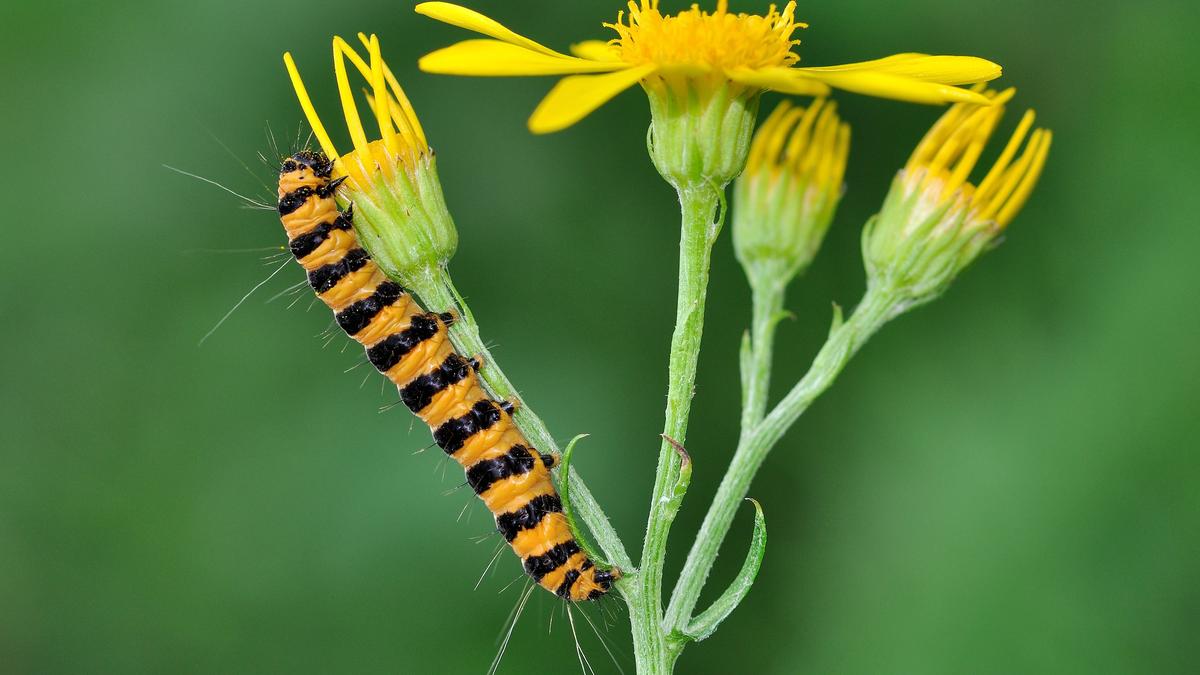
A cinnabar moth (Tyria jacobaeae) caterpillar, July 8, 2011.
| Photo Credit: Quartl (CC BY-SA 3.0)

Caterpillars have a sixth sense that most land-based animals do not. They can sense electric fields around them with small bristles called setae on its body — a feat called electroreception. British researchers have discovered this in laboratory experiments and their findings were published recently in the Proceedings of the National Academy of Sciences.

They studied four species of caterpillars: cinnabar moth, scarce vapourer moth, European peacock butterfly, and common wasp.

Researchers have long known that aquatic and amphibious use electroreception to detect both predators and prey. Since 2013, scientists have also found electroreception in arthropods like bumblebees, hoverflies, and spiders. However, none of these land-based creatures use the ability to defend against predators.

Caterpillars, which are also arthropods, may break this mould, using electroreception to sense predatory insects nearby.

“It works exactly the same way as [brushing a] rubber balloon on your hair,” said first author Sam England. He is a postdoctoral researcher at the Museum für Naturkunde in Berlin and was at the University of Bristol before.

Static charges accumulate on both the balloon and the hair, leading to a mutual electrostatic attraction. The balloon can then move the hair without needing contact.

As an insect’s wings flap through the air, static charges build up on them. When it nears the caterpillar, the setae senses these charges by building up charges of its own. This mutual interaction gives rise to an oscillating electric field.

In the study, researchers stimulated caterpillars with a live electrode carrying a voltage oscillating at 180 Hz, to mimic an approaching wasp. In response, the caterpillars flailed and coiled, a sign that they were stressed. Caterpillars around an electrode without the voltage didn’t behave this way.

The caterpillars’ setae responded to frequencies of 50-350 Hz, possibly to help distinguish between threats and non-threats, Dr. England said. The setae vibrated the most when the field frequency was 220.3 Hz — close to the rate at which many predator insects flap their wings.

He suspected the caterpillars could have evolved to tune to their predator’s wingbeats. “These animals have had a lot of evolutionary pressure upon them to evolve defences because so many animals like to eat them.”

That said, scientists also “already know” that caterpillars don’t rely on electroreception alone to sense predators, Dr. England added. It supplements the other five senses.

He also said that “sensory pollution” could damp the caterpillars’ electroreception. The setae are sensitive to voltage frequencies also present in overhead power cables, around 50-60 Hz. This ‘exposure’ could desensitise the setae and diminish the caterpillars’ ability to spot predators with them.

Dr. England said he is keen on studying this issue next.

Karthik Vinod is an intern with The Hindu.



Source link

Science Tags:caterpillar setae, caterpillars electroreception, sensory hallucination

Post navigation

Previous Post: Stage Collapses At Rahul Gandhi’s Bihar Poll Rally With Misa Bharti
Next Post: From setbacks to success: Shreyas Iyer’s journey to IPL victory

Related Posts

  • Ground control: On ISRO, policy and and its focus
    Ground control: On ISRO, policy and and its focus Science
  • How are we protecting astronauts from deadly space debris?
    How are we protecting astronauts from deadly space debris? Science
  • What is a blue moon?
    What is a blue moon? Science
  • Students should be encouraged to develop scientific temperament, says Deputy Director of U. R. Rao Satellite Centre
    Students should be encouraged to develop scientific temperament, says Deputy Director of U. R. Rao Satellite Centre Science
  • What causes nausea? – The Hindu
    What causes nausea? – The Hindu Science
  • What is helium and why is it used in rockets?
    What is helium and why is it used in rockets? Science

More Related Articles

No signals from Chandrayaan-3’s Vikram, Pragyan: ISRO No signals from Chandrayaan-3’s Vikram, Pragyan: ISRO Science
Scientists move closer to confirming existence of dark matter Scientists move closer to confirming existence of dark matter Science
Union Minister Suresh Gopi meets ISRO officials in Bengaluru  Union Minister Suresh Gopi meets ISRO officials in Bengaluru  Science
Google’s new AI for drug discovery is a win for scientific discovery Google’s new AI for drug discovery is a win for scientific discovery Science
Scientists compile largest meta-dataset of tree inventory studies from India Scientists compile largest meta-dataset of tree inventory studies from India Science
Cyborg botany: how scientists are turning plants into circuit boards Cyborg botany: how scientists are turning plants into circuit boards Science
SiteLock

Archives

  • October 2026
  • September 2026
  • August 2026
  • July 2026
  • June 2026
  • May 2026
  • April 2026
  • March 2026
  • February 2026
  • January 2026
  • December 2025
  • November 2025
  • October 2025
  • September 2025
  • August 2025
  • July 2025
  • June 2025
  • May 2025
  • April 2025
  • March 2025
  • February 2025
  • January 2025
  • December 2024
  • November 2024
  • October 2024
  • September 2024
  • August 2024
  • July 2024
  • June 2024
  • May 2024
  • April 2024
  • March 2024
  • February 2024
  • January 2024
  • December 2023
  • November 2023
  • October 2023
  • September 2023
  • August 2023
  • July 2023
  • June 2023
  • May 2023
  • April 2023
  • March 2023
  • February 2023
  • January 2023
  • December 2022
  • November 2022
  • October 2022
  • September 2022
  • August 2022
  • July 2022
  • June 2022
  • May 2022

Categories

  • Business
  • Nation
  • Science
  • Sports
  • World

Recent Posts

  • Saudi Supreme Court sets aside Sri Lankan migrant worker’s death penalty
  • Nedumbassery accident: CPI(M) stages protest march to police station over ‘indifference’ in handling of case
  • Why CJI Surya Kant said ‘no’ to Rahul Gandhi’s request to meet | Explained
  • September WPI Inflation rises to 11.39% as food, fuel and manufactured goods prices increase
  • Frankfurt-Delhi Air India flight diverted to Jaipur following bomb threat

Recent Comments

  1. RobertTes on UP Teacher Who Asked Students To Slap Muslim Classmate
  2. Manuelret on UP Teacher Who Asked Students To Slap Muslim Classmate
  3. RobertTes on UP Teacher Who Asked Students To Slap Muslim Classmate
  4. RobertTes on UP Teacher Who Asked Students To Slap Muslim Classmate
  5. BrentWes on UP Teacher Who Asked Students To Slap Muslim Classmate
  • Access Denied
    Access Denied Nation
  • Zero-dose children comparison flawed, India’s population not considered: Sources on WHO-UNICEF data
    Zero-dose children comparison flawed, India’s population not considered: Sources on WHO-UNICEF data World
  • Access Denied World
  • Access Denied
    Access Denied Nation
  • Access Denied Sports
  • BBC’s former lead news presenter Huw Edwards pleads guilty to 3 counts of making indecent images of children
    BBC’s former lead news presenter Huw Edwards pleads guilty to 3 counts of making indecent images of children World
  • Sri Lanka Beat England By Eight Wickets, Register First Test Win On English Soil Since…
    Sri Lanka Beat England By Eight Wickets, Register First Test Win On English Soil Since… Sports
  • Access Denied
    Access Denied Nation

Editor-in-Chief:
Mohammad Ariff,
MSW, MAJMC, BSW, DTL, CTS, CNM, CCR, CAL, RSL, ASOC.
editor@artifex.news

Associate Editors:
1. Zenellis R. Tuba,
zenelis@artifex.news
2. Haris Daniyel
daniyel@artifex.news

Photograher:
Rohan Das
rohan@artifex.news

Associate Journalists
1. Subrata Paul - AN/2020/01
2. Quamruz Zaman - AN/2021/22
3. Ahmed Sha - AN/2021/035
4. Ajay Kumar Shaw - AN/2021/39
5. Tahqiqul Hoda - AN/2021/21

Artifex.News offers Online Paid Internships to college students from India and Abroad. Interns will get a PRESS CARD and other online offers.
Send your CV (Subjectline: Paid Internship) to internship@artifex.news

Links:
Associate Journalism
About Us
Privacy Policy

News Links:
Breaking News
World
Nation
Sports
Business
Entertainment
Lifestyle

Registered Office:
72/A, Elliot Road, Kolkata - 700016
Tel: 033-22277777, 033-22172217
Email: office@artifex.news

Editorial Office / News Desk:
No. 13, Mezzanine Floor, Esplanade Metro Rail Station,
12 J. L. Nehru Road, Kolkata - 700069.
(Entry from Gate No. 5)
Tel: 033-46011099, 033-46046046
Email: editor@artifex.news

Copyright © 2023 Artifex.News Newsportal designed by Artifex Infotech.