



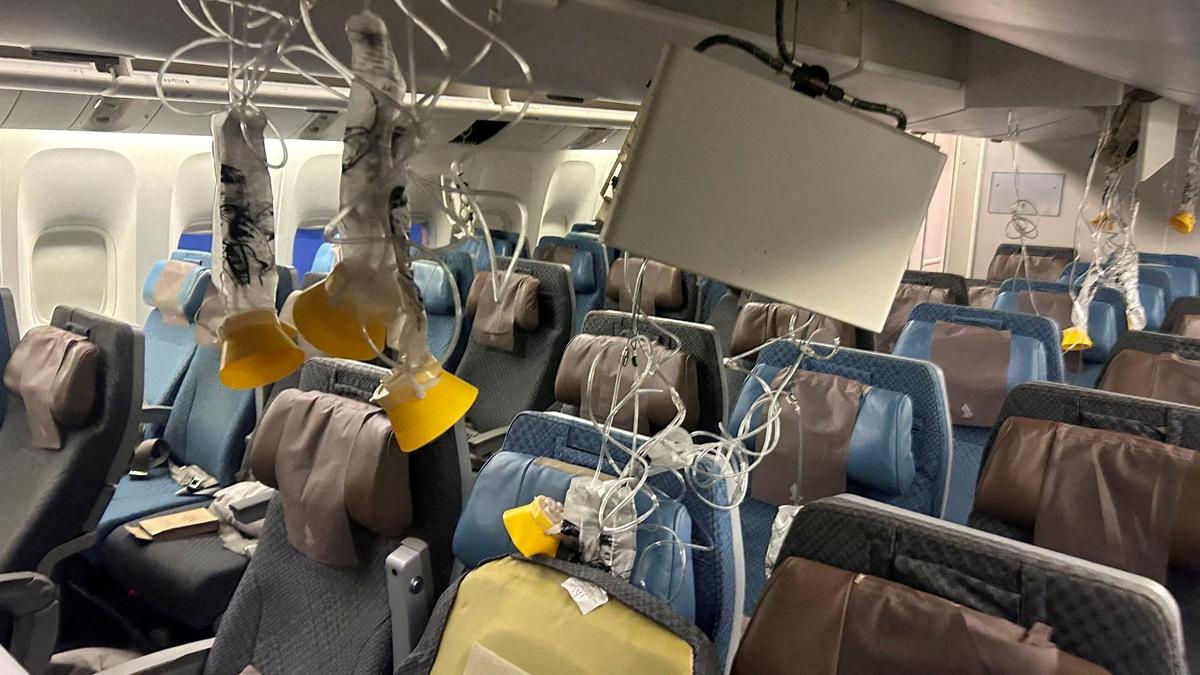
The interior of Singapore Airlines flight SQ321 is pictured after an emergency landing at Bangkok’s Suvarnabhumi International Airport, Thailand on May 21, 2024.
| Photo Credit: Reuters
The story so far: On May 20-21, a Singapore Airlines flight, SQ321, with 211 passengers and 18 crew, from London’s Heathrow Airport to Singapore encountered severe turbulence while over the Andaman Sea/Bay of Bengal near the Irrawaddy Basin, Myanmar. A passenger passed away and several others suffered injuries of varying degrees. The crew decided to divert the Boeing 777-312ER to Bangkok, Thailand. The United States National Transportation Safety Board (NTSB) is to assist Singapore’s investigation — also because the aircraft is a Boeing jet.
What do we know about the incident?
Granular flight data shows the aircraft dropping rapidly before the crew began (“controlled”) descent from 37,000 feet to 31,000 feet. It also shows the aircraft had had an altitude deviation prior to this.
There has been much focus on ‘turbulence’. What have experts told The Hindu?
Turbulence occurs “by the relative movement of disturbed air through which an aircraft is flying”. It could be thermal or mechanical and can happen “either within or when it is clear of cloud”. Its severity depends on the “rate at which the speed or the direction of airflow/or both changes”.

According to Professor Guy Gratton, Associate Professor of Aviation and the Environment at Cranfield University, U.K., turbulence is basically what happens when there is friction between airflow or wind flowing in different directions. When it involves aviation, there are two main forms, which are Clear Air Turbulence (CAT), which happens around jet streams, and the other being inside or around cumulonimbus clouds. These clouds have very strong upwards air currents in the middle and downwards air current around the outside, he explains, which can result in quite serious turbulence. The faster an aircraft is, the more severe the response to the turbulence.
Prof. Richard Dale, Senior Lecturer in Aviation and Tourism at the University of West London, says turbulence consists of changes in the movement of air which the aircraft is moving through over a short distance. For example, there might be updrafts that are quickly followed by downdrafts, but also changes in the horizontal movement of the air. The movement of the air, to some degree, is random and unpredictable, although the location where turbulence will be encountered is more certain. These changes cause the lift produced by the aircraft wing to change for a short time, forcing the aircraft up or down, suddenly and unexpectedly. According to A.D. Ravishankar, former Director, Aviation Meteorology, India Meteorological Department, CAT is turbulence suffered by an aircraft above 18,000 feet.

Dr. Paul Williams, Professor of Atmospheric Science, University of Reading, U.K., says that turbulence fatalities on commercial flights are, fortunately, very rare. Turbulence on flights can be caused by storms, mountains, and strong air currents called jet streams. In this last case, it is called clear air turbulence, and can be difficult to avoid because it does not show up on the weather radar in the flight deck. He adds that a detailed analysis of the meteorological circumstances and the type of turbulence that affected the Singapore Airlines flight will take some time. He also says that there is strong evidence that turbulence is increasing because of climate change. “We recently discovered that severe clear air turbulence in the North Atlantic has increased by 55% since 1979. Our latest future projections indicate a doubling or trebling of severe turbulence in the jet streams in the coming decades, if the climate continues to change as we expect.”
Will passenger injuries lead to litigation?
As visuals from the Singapore incident show, there has been serious injury to some passengers. Injuries occur from passengers not wearing their seat belts resulting in them being violently thrown from their seats, the overhead bins opening causing items to fall, the cabin ceiling and panels coming off and hot beverages causing burn injuries. A Singapore Airlines spokesperson has told The Hindu that it has adopted a more cautious approach to managing turbulence in-flight.

Turbulence injuries have resulted in the realisation that winning a turbulence claim needs skill and knowledge of the factors that caused the incident. Aviation attorneys work with aviation and weather experts to plot the aircraft’s route, obtain satellite images of the weather at the time and location of the encounter, and to quickly secure airline data to help prove the claim. They even look at whether the crew knew there was bad weather ahead but decided not to deviate to save time, fuel, and airline money. In the U.S., for instance, aviation attorneys review government data and reports, Federal Aviation Administration and NTSB findings, and the airline’s procedures to obtain full and fair compensation. Magan vs Lufthansa German Airlines is one case where a passenger was injured and won a “substantial verdict pursuant to the Montreal Convention”.
What about technology in flight planning?
Bill Duncan, aviation forecast operations leader at The Weather Company (a weather forecasting and information technology company) has told The Hindu that there is a process behind a dispatcher or pilot planning a route, which includes meteorologists looking at flight planning guidance charts. There is also an accounting for year-round turbulence impacted by climate change. Extreme weather events have risen in severity since 2000. According to Mr. Duncan, there is no doubt that there is warming going on, which can impact and divide the jet stream. “As the jet stream buckles a bit because it is not as strong as it was in the past, you have all this energy associated with the jet stream up 30,000 feet or so, which is allowing colder air to spill south”. So the world is seeing major weather events happening more often.

Aviation meteorologists use model data, weather pattern recognition, and experience to help identify these areas of potential turbulence. Pilots get reports out ahead of their route on reported turbulence, and dispatchers are in contact with local meteorologists who actively watch routes and issue Flight Planning Guidance Charts (FPGs) and Significant Meteorological Information (SIGMETs). These SIGMETs are the information that the dispatcher can relay to the pilot about hazardous weather. With improvements in technology and science, there are better numerical weather prediction models. The Weather Company, for instance, has a Global high-Resolution Atmospheric Forecasting model which simulates the physics of the atmosphere to predict the weather and also uses artificial intelligence (AI) methods that build on weather forecasts to predict turbulence and other aviation hazards. Mr. Duncan adds that machine learning algorithms and AI are being used to find the links between historical weather and observations of turbulence. Separately, over 20 airlines now participate in the International Air Transport Association’s ‘Turbulence Aware Platform’.