


Skip to content
  • Facebook
  • X
  • Linkedin
  • WhatsApp
  • YouTube
  • Associate Journalism
  • About Us
  • Privacy Policy
  • 033-46046046
  • editor@artifex.news
Artifex.News

Artifex.News

Stay Connected. Stay Informed.

  • Breaking News
  • World
  • Nation
  • Sports
  • Business
  • Science
  • Entertainment
  • Lifestyle
  • Toggle search form
  • Access Denied
    Access Denied Nation
  • No entry, says Simon – The Hindu
    No entry, says Simon – The Hindu Sports
  • Big Changes In Bowling Line-Up As England Name Playing XI For Ranchi Test
    Big Changes In Bowling Line-Up As England Name Playing XI For Ranchi Test Sports
  • Access Denied
    Access Denied Nation
  • Supreme Court rejects Gujarat’s petition to remove comments made against state over release of Bilkis Bano case convicts
    Supreme Court rejects Gujarat’s petition to remove comments made against state over release of Bilkis Bano case convicts Nation
  • Bengaluru-based natural history platform, Nature in Focus, introduces new category to its annual photography contest
    Bengaluru-based natural history platform, Nature in Focus, introduces new category to its annual photography contest Nation
  • Access Denied Sports
  • Pakistan human rights lawyer re-arrested in terrorism case hours after getting bail in sedition case
    Pakistan human rights lawyer re-arrested in terrorism case hours after getting bail in sedition case World
India-China consumption comparison – The Hindu

India-China consumption comparison – The Hindu

Posted on May 20, 2024 By admin


In 2023, India surpassed China to become the world’s most populous country. The development came against the backdrop of a declining birth rate (6.4 births per 1,000 people) and total fertility rate (~1%) in China. China also recorded a negative population growth rate for the first time in six decades. This means a rising dependency ratio, which is projected to increase over time. In contrast, India’s population, despite reaching replacement levels (total fertility rate of 2.1), is expected to grow and peak around 2060.

These developments have significant consequences on domestic consumption in the two countries. Consequently, it becomes imperative to compare their consumption figures and strengths/weaknesses. A cross-comparison also assumes significance owing to the contrasting experiences of the two countries in their respective geopolitical landscapes.

How do the numbers compare?

Both India and China have a large consumer base. A consumer is anyone who spends more than $12 a day, as per the Purchasing Power Parity [PPP], 2017.
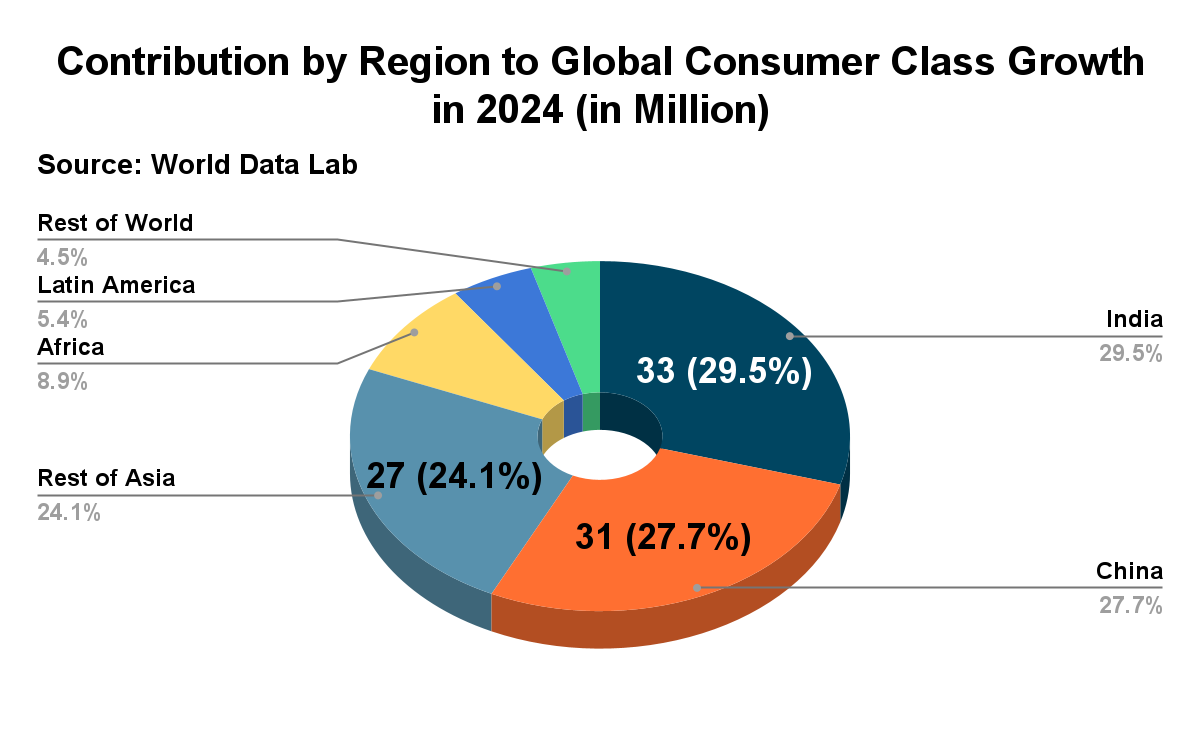
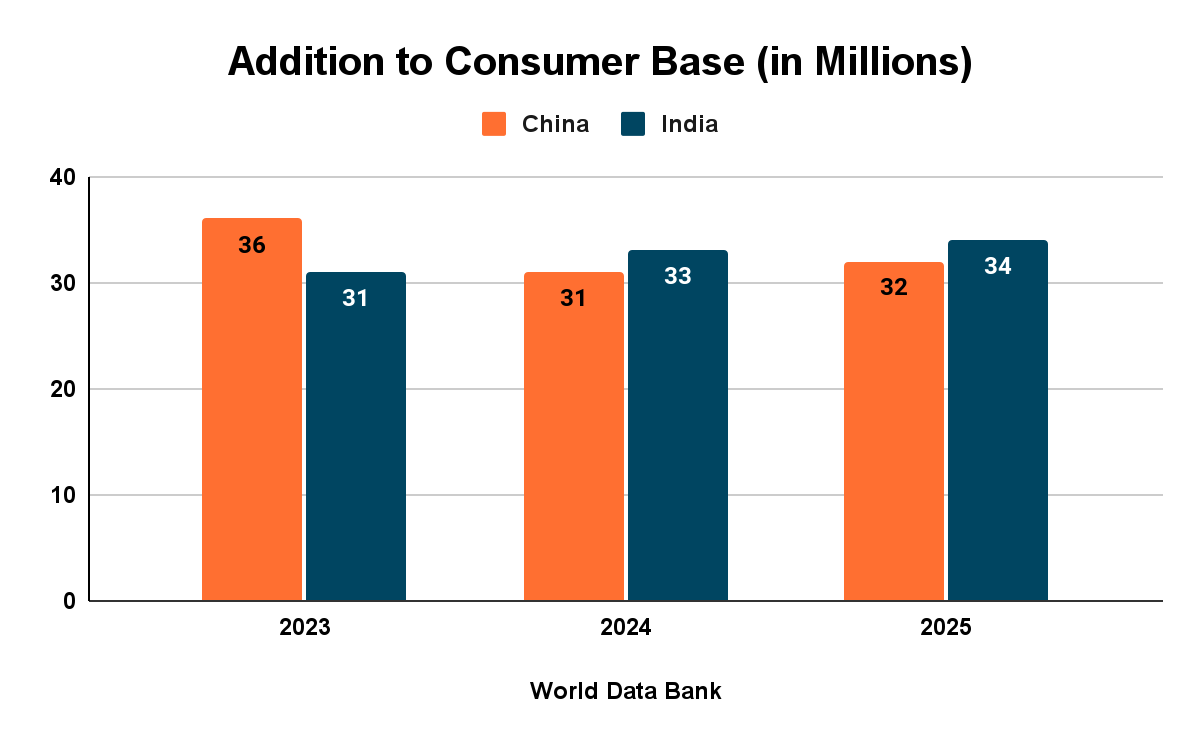
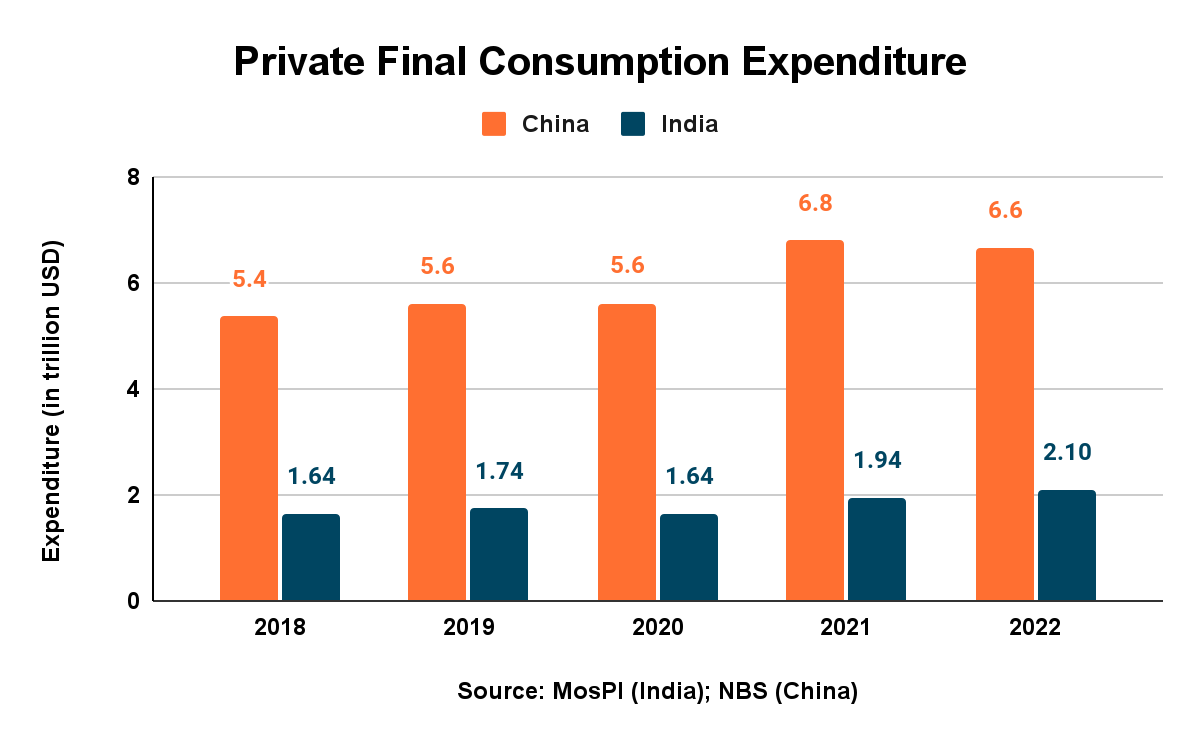
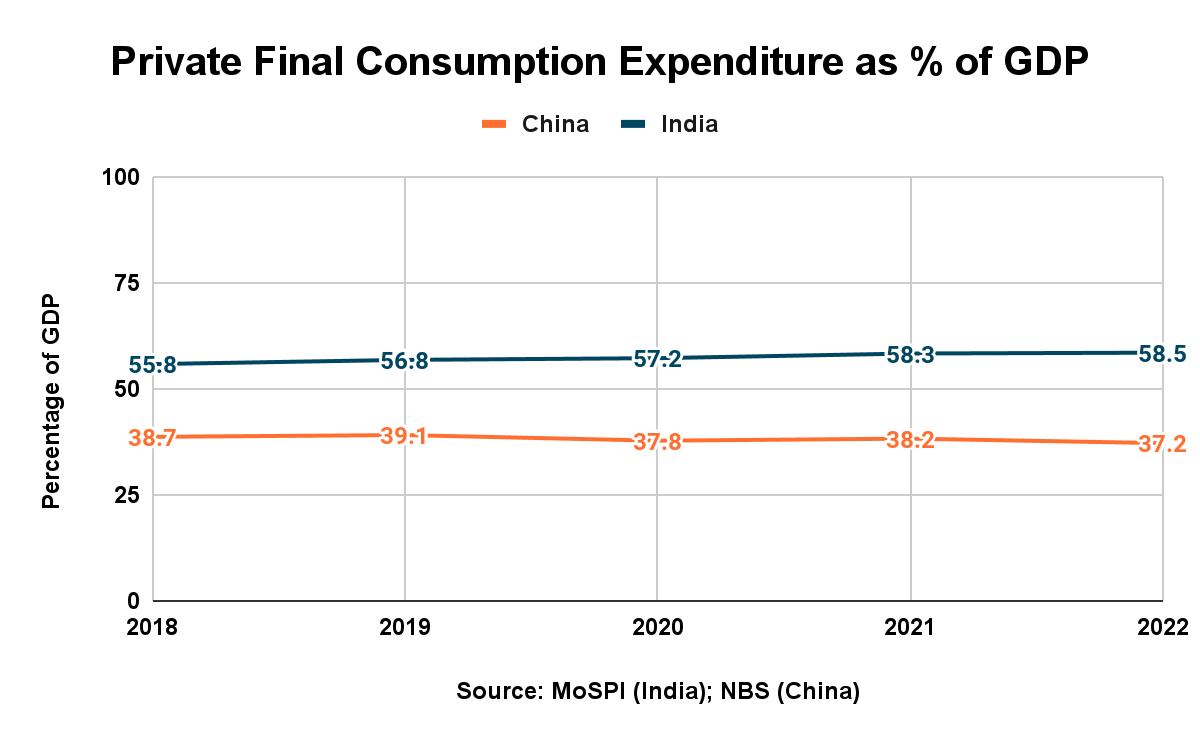
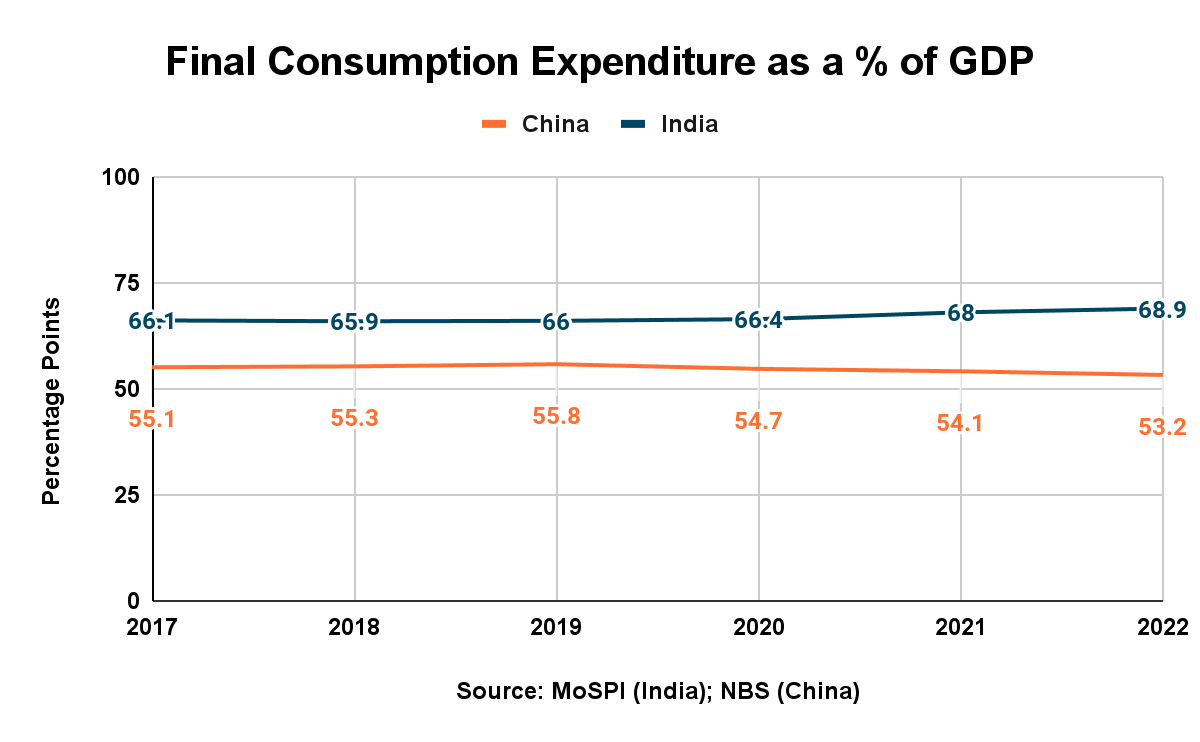
Private Final Consumption Expenditure (PFCE), which measures total consumption expenditure by households and non-profit institutions serving households on goods and services, serves as a useful proxy for consumer spending especially as income and consumption are concentrated within the consumer classes. The data reveals that as a percentage of GDP, India spends significantly more on consumption than China. While PFCE contributes more than 58% to India’s GDP currently, it contributes only 38% to China’s economy. Additionally, the final consumption, which also includes government consumption expenditure, constitutes 68% of the GDP for India and 53% for China. This implies that the government is a much bigger consumer in China than in India. Furthermore, while the percentage for India is steadily increasing, the same for China has been on a decline.
The aggregate data on PFCE reveals that despite China’s economy being approximately five times bigger than that of India’s, its PFCE amounts to relatively a lot less, only about 3.5 times that of India’s. This not only means that consumption is a much larger contributor to India’s GDP, but that India will equal China’s consumption level at a relatively much lower GDP (~$10 trillion) as against China, which achieved the scale at approximately $17 trillion.

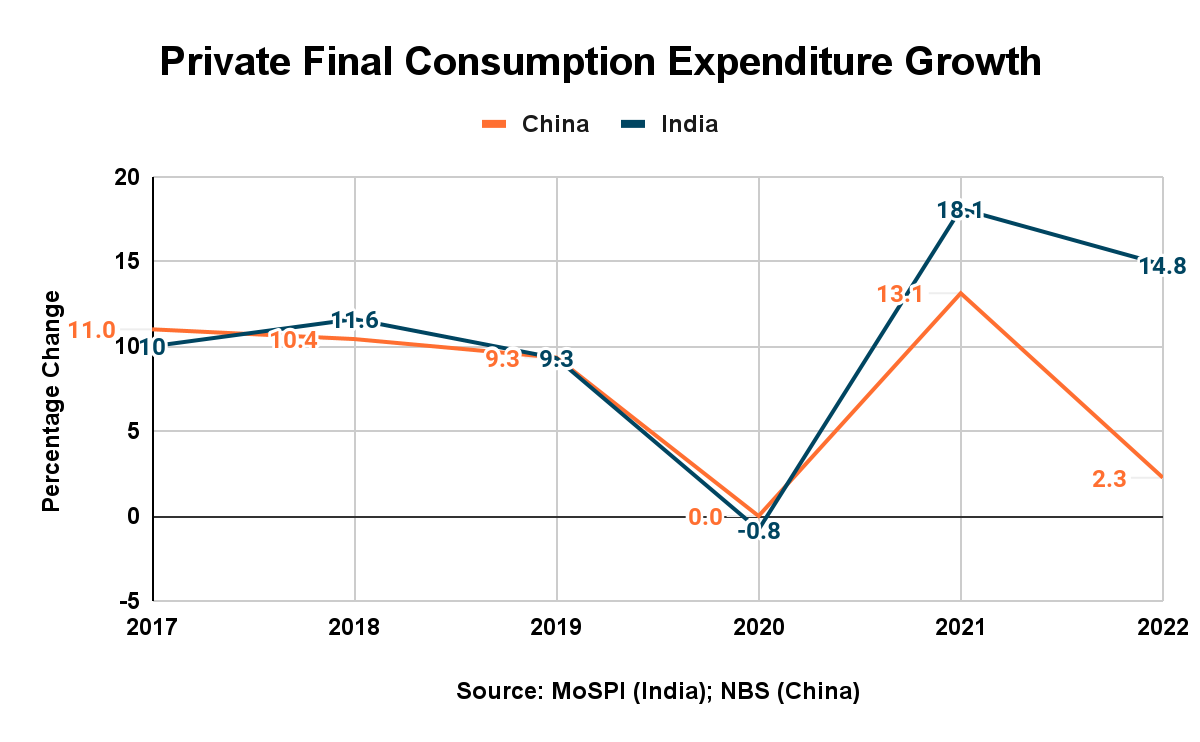
Secondly, despite the gloomy narrative around China’s consumption, its PFCE has registered a significant increase in the past four years. Its PFCE remained rather constant in 2020 (pandemic year) before registering a huge uptick in 2021. On the other hand, India’s figures have steadily increased from $1.64 trillion in 2018 to $2.10 trillion in 2022. Thirdly, in 2022, while China recorded a decline in its numbers — both aggregate ($6.6 trillion compared to $6.8 trillion) and per-capita ($4,730 compared to $4,809) — India witnessed marginal growth in both categories. Nevertheless, the difference in the expenditure between the two countries has widened from $3.8 trillion in 2018 to more than $4.5 trillion in 2022.

Finally, in terms of ratio, India’s PFCE has closed the gap with China from ~3.3 to ~3.1. The significance of India closing the gap in terms of ratio here needs to be underlined. Usually, with a country like China that is operating on a huge base, even a marginal growth rate could inflate the aggregate numbers manifold. This would be true even if India, on the other hand, were adding expenditure at a relatively higher growth rate than China. But to beat China in terms of ratio would have required India to grow at a significantly higher rate than China, which it did.
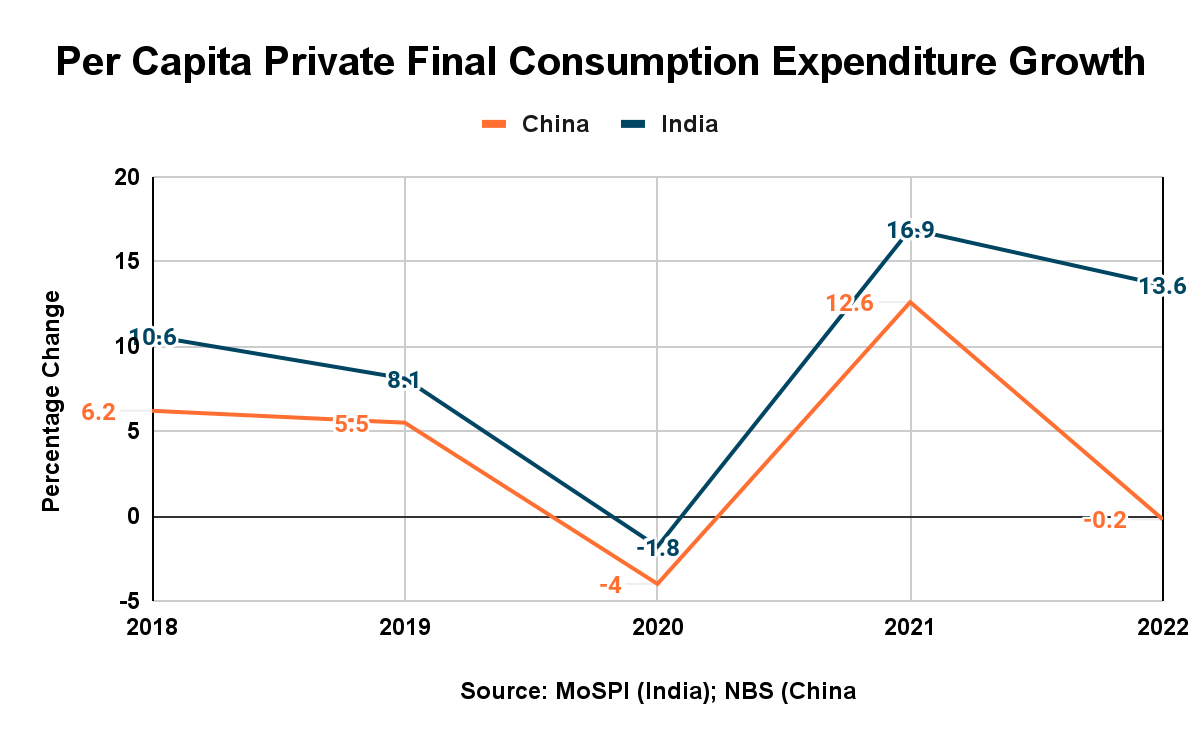
In terms of per capita PFCE, while the values mirror aggregate numbers, there is one exception. Even as India closed the gap in aggregate terms, China widened the per capita PFCE marginally from ~3.0 times of India in 2018 to ~3.1 in 2022. This could be explained by China’s negative population growth in 2022.

Comparing the nominal PFCE numbers alone could sometimes lead to a distortion. This is because the nominal figures do not take into account the discrepancies between the cost of living that might exist. Consumption is not just about consumed value but also consumed volume. And nominal figures only give an idea of total consumption value — might not give an idea of the volume of goods and services consumed. Thus, to account for consumption by value, a comparison of PPP figures becomes imperative.

On comparing the PPP numbers, the gap between the consumption expenditure further closes down. In PPP terms, China’s PFCE is approximately 1.5 times that of India. To put this in context, China’s GDP (PPP) is approximately 2.5 times of India’s. The relative gap between China and India widened from ~1.58 in 2018 to ~1.66 in 2020 and 2021, but 2022 witnessed India closing the gap to ~1.55.
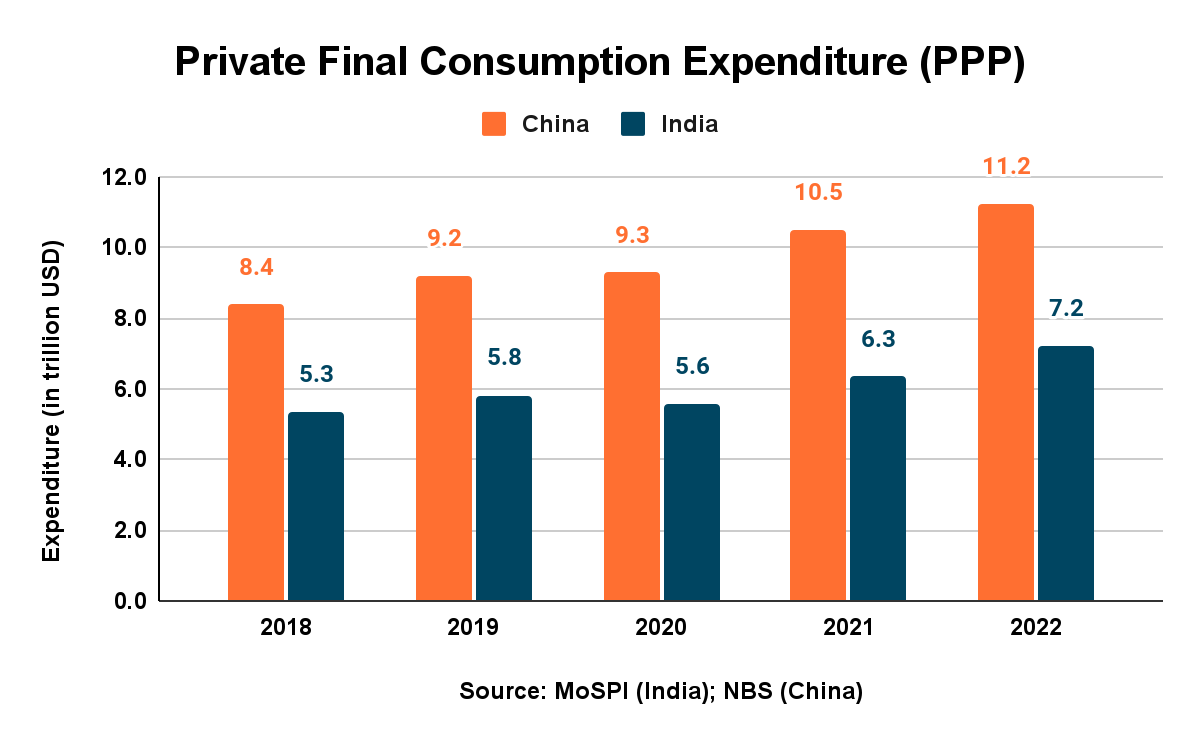
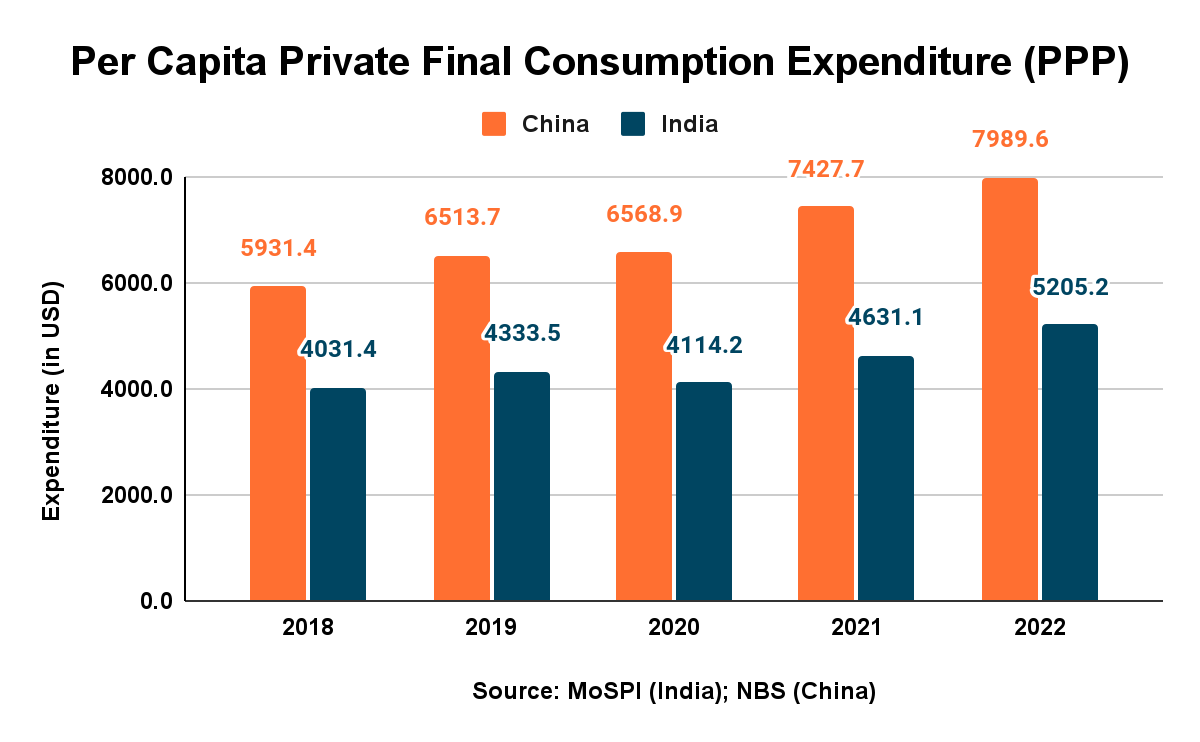
However, in PPP terms, China witnessed a marginal increase of ~$0.7 trillion owing to improved yuan-dollar PPP exchange rates. On the other hand, India added a trillion dollars to its consumption expenditure (PPP) in 2022 despite a worsening exchange rate.

Expenditure by categories

India’s consumption expenditure is characterised by higher spending on food, clothing, footwear, and transport and low spending on education, culture, recreation, and healthcare — typical of an underdeveloped or developing market. China’s consumption basket, on the other hand, represents a relatively developed market. Even as food and beverages constitute the biggest chunk of China’s consumption, it is declining as a percentage of its total consumption expenditure — a sign of a maturing market. Additionally, it spends a substantially higher percentage of its expenditure on housing, white goods, recreation, education, and healthcare than India. To put things in context, in advanced economies like the U.S., Japan, EU, Germany and the U.K., expenditure on food isn’t the highest bracket.
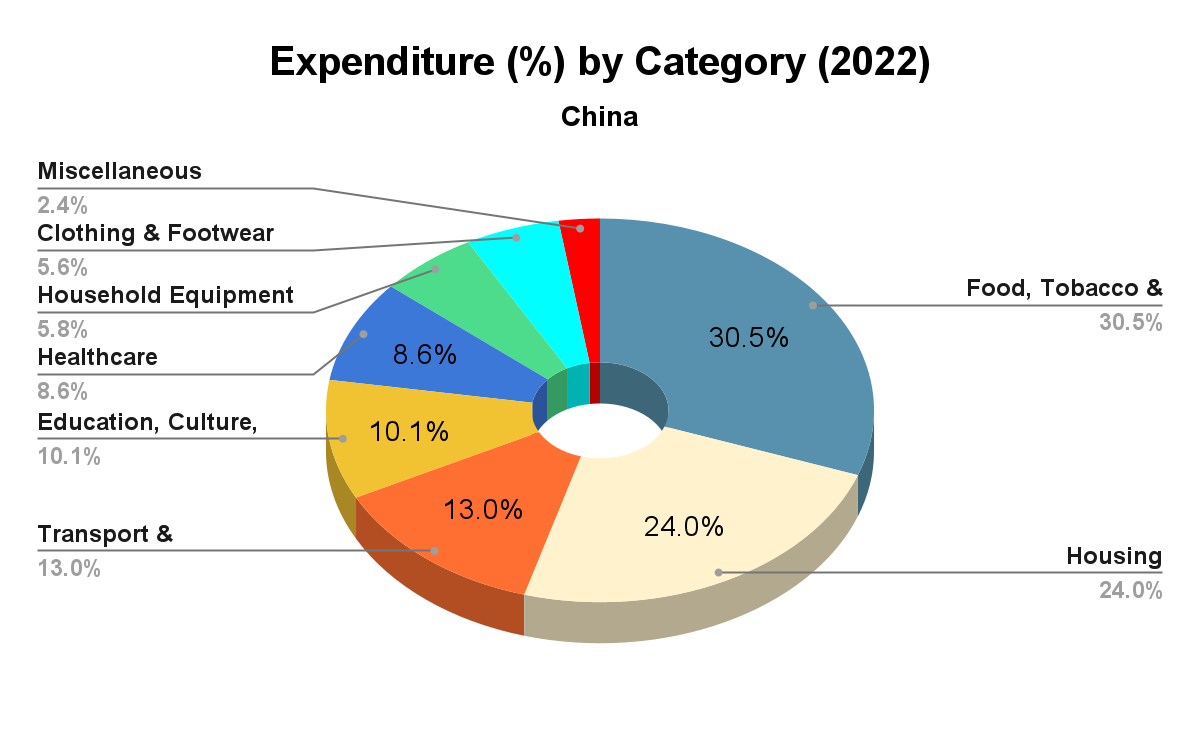
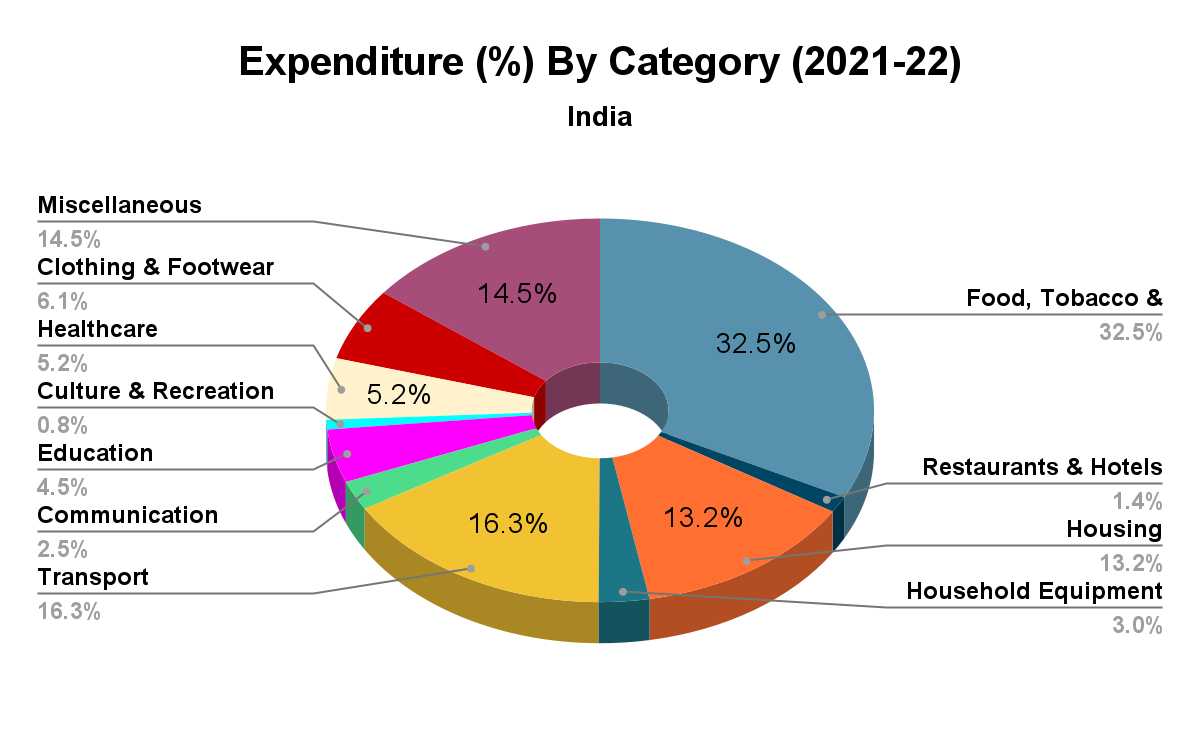
In aggregate terms, India spends around half of what China spends on food, transport and communication, and clothing and footwear. For India, which is a fifth of the Chinese economy and spends almost the same percentage (of the total expenditure) as China on these three sectors, the fact that its total expenditure in the above three categories is around half of China is quite significant. In fact, India spends a little over 50% of what China spends on transport and communication. (Note: India’s data for 2022 were not available.)

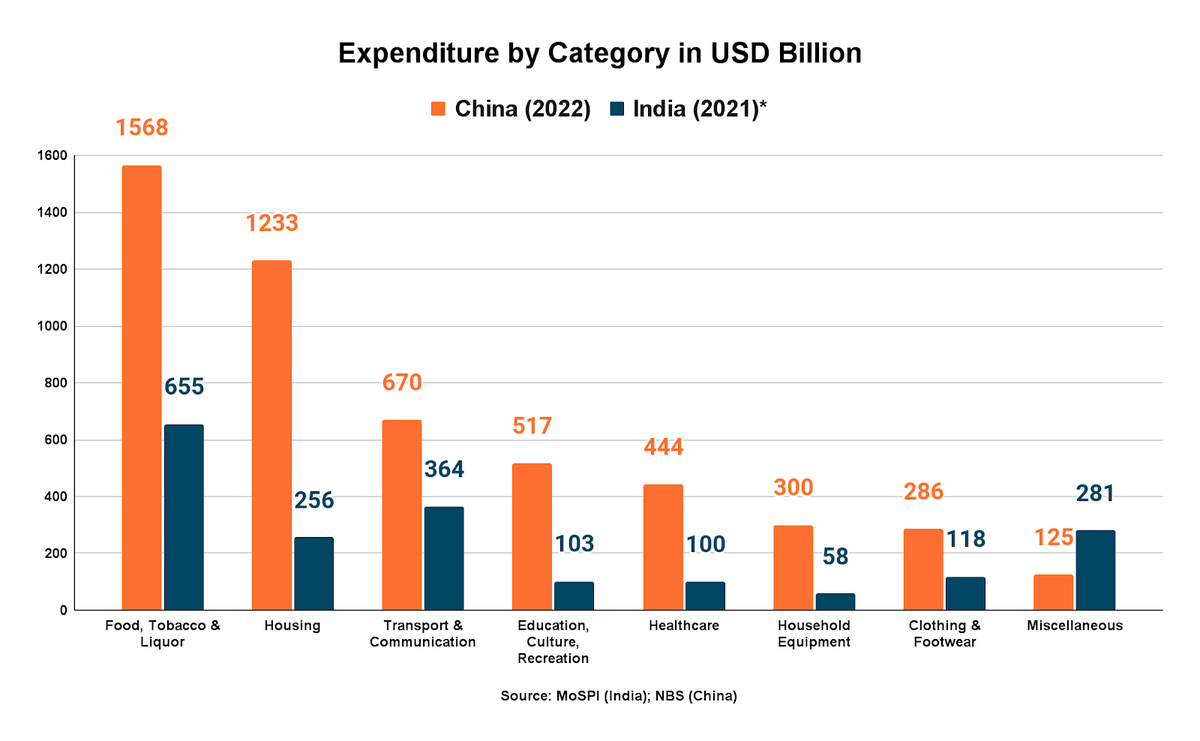
Adding to the optimism is the fact that the real growth rate registered by each of these individual categories in India often outperformed even the nominal growth rates observed in China.

Whether India’s consumer class with increased spending enhances its appeal to foreign businesses as a preferred destination over its competitors amidst the China+1 narrative remains to be seen.

Amit Kumar is a Research Analyst at Takshashila Institution. He tweets at am_i_t_kumar.



Source link

World

Post navigation

Previous Post: Climate Change Key Factor Of Record-Low Antarctic Sea Ice: Study
Next Post: Did MS Dhoni’s 110m Six End Up Costing CSK A Spot In IPL Playoffs – Explained

Related Posts

  • Israel Army Reviews Gaza Aid Convoy Deaths
    Israel Army Reviews Gaza Aid Convoy Deaths World
  • Israeli military actions had ‘influence’ on Hamas’ killing of six hostages, report finds
    Israeli military actions had ‘influence’ on Hamas’ killing of six hostages, report finds World
  • Pro-Khalistan Slogans Raised In Presence Of Canada PM Justin Trudeau On Khalsa Day Event
    Pro-Khalistan Slogans Raised In Presence Of Canada PM Justin Trudeau On Khalsa Day Event World
  • Israeli far-right Minister Ben Gvir slams U.S.-Iran deal, urges stronger campaign in Lebanon
    Israeli far-right Minister Ben Gvir slams U.S.-Iran deal, urges stronger campaign in Lebanon World
  • US Teacher, 26, Arrested For Sexually Abusing Teenager She Met In Church
    US Teacher, 26, Arrested For Sexually Abusing Teenager She Met In Church World
  • The Hindu Morning Digest, April 1, 2024
    The Hindu Morning Digest, April 1, 2024 World

More Related Articles

Nepal’s ruling parties’ bid to change electoral laws could deal a blow to inclusivity   Nepal’s ruling parties’ bid to change electoral laws could deal a blow to inclusivity   World
Access Denied World
Access Denied World
Sikh extremists on Canada’s no-fly list lose appeal, court sees ‘reasonable grounds’ for terror concern Sikh extremists on Canada’s no-fly list lose appeal, court sees ‘reasonable grounds’ for terror concern World
Freedom of speech ‘not an absolute right’, Hong Kong trial of Tiananmen activists hears Freedom of speech ‘not an absolute right’, Hong Kong trial of Tiananmen activists hears World
Access Denied World
SiteLock

Archives

  • October 2026
  • September 2026
  • August 2026
  • July 2026
  • June 2026
  • May 2026
  • April 2026
  • March 2026
  • February 2026
  • January 2026
  • December 2025
  • November 2025
  • October 2025
  • September 2025
  • August 2025
  • July 2025
  • June 2025
  • May 2025
  • April 2025
  • March 2025
  • February 2025
  • January 2025
  • December 2024
  • November 2024
  • October 2024
  • September 2024
  • August 2024
  • July 2024
  • June 2024
  • May 2024
  • April 2024
  • March 2024
  • February 2024
  • January 2024
  • December 2023
  • November 2023
  • October 2023
  • September 2023
  • August 2023
  • July 2023
  • June 2023
  • May 2023
  • April 2023
  • March 2023
  • February 2023
  • January 2023
  • December 2022
  • November 2022
  • October 2022
  • September 2022
  • August 2022
  • July 2022
  • June 2022
  • May 2022

Categories

  • Business
  • Nation
  • Science
  • Sports
  • World

Recent Posts

  • Saudi Supreme Court sets aside Sri Lankan migrant worker’s death penalty
  • Nedumbassery accident: CPI(M) stages protest march to police station over ‘indifference’ in handling of case
  • Why CJI Surya Kant said ‘no’ to Rahul Gandhi’s request to meet | Explained
  • September WPI Inflation rises to 11.39% as food, fuel and manufactured goods prices increase
  • Frankfurt-Delhi Air India flight diverted to Jaipur following bomb threat

Recent Comments

  1. RobertTes on UP Teacher Who Asked Students To Slap Muslim Classmate
  2. Manuelret on UP Teacher Who Asked Students To Slap Muslim Classmate
  3. RobertTes on UP Teacher Who Asked Students To Slap Muslim Classmate
  4. RobertTes on UP Teacher Who Asked Students To Slap Muslim Classmate
  5. BrentWes on UP Teacher Who Asked Students To Slap Muslim Classmate
  • PV Sindhu stranded in Dubai as flights remain suspended after tensions across West Asia
    PV Sindhu stranded in Dubai as flights remain suspended after tensions across West Asia World
  • Centre’s Fiscal Deficit Touches 39% Of Full-Year Target In FY24’s 1st Half
    Centre’s Fiscal Deficit Touches 39% Of Full-Year Target In FY24’s 1st Half Business
  • Company that sent AI calls mimicking Joe Biden to voters agrees to pay  million fine
    Company that sent AI calls mimicking Joe Biden to voters agrees to pay $1 million fine World
  • Access Denied
    Access Denied Nation
  • Sri Lanka reaches debt-restructuring agreement
    Sri Lanka reaches debt-restructuring agreement World
  • Narottam Mishra On BJP’s Madhya Pradesh List
    Narottam Mishra On BJP’s Madhya Pradesh List Nation
  • Access Denied Business
  • Cricket World Cup 2023 Warm-Ups: England, New Zealand Win Rain-Affected Games
    Cricket World Cup 2023 Warm-Ups: England, New Zealand Win Rain-Affected Games Sports

Editor-in-Chief:
Mohammad Ariff,
MSW, MAJMC, BSW, DTL, CTS, CNM, CCR, CAL, RSL, ASOC.
editor@artifex.news

Associate Editors:
1. Zenellis R. Tuba,
zenelis@artifex.news
2. Haris Daniyel
daniyel@artifex.news

Photograher:
Rohan Das
rohan@artifex.news

Associate Journalists
1. Subrata Paul - AN/2020/01
2. Quamruz Zaman - AN/2021/22
3. Ahmed Sha - AN/2021/035
4. Ajay Kumar Shaw - AN/2021/39
5. Tahqiqul Hoda - AN/2021/21

Artifex.News offers Online Paid Internships to college students from India and Abroad. Interns will get a PRESS CARD and other online offers.
Send your CV (Subjectline: Paid Internship) to internship@artifex.news

Links:
Associate Journalism
About Us
Privacy Policy

News Links:
Breaking News
World
Nation
Sports
Business
Entertainment
Lifestyle

Registered Office:
72/A, Elliot Road, Kolkata - 700016
Tel: 033-22277777, 033-22172217
Email: office@artifex.news

Editorial Office / News Desk:
No. 13, Mezzanine Floor, Esplanade Metro Rail Station,
12 J. L. Nehru Road, Kolkata - 700069.
(Entry from Gate No. 5)
Tel: 033-46011099, 033-46046046
Email: editor@artifex.news

Copyright © 2023 Artifex.News Newsportal designed by Artifex Infotech.