



Job seekers gather to attend a walk-in-interview during a State-level job fair organised by Karnataka in Bengaluru on February 26.
| Photo Credit: AFP
A recent report released by the International Labour Organization (ILO) and the Institute for Human Development (IHD) revealed that two out of every three unemployed individuals was a young graduate, highlighting the need for urgent policy intervention. Little is understood about the causes of unemployment in India, a knowledge gap that requires urgent redressal.
This analysis looks at unemployment in the major States of India — excluding the Union Territories —among individuals aged 15 and above as measured by the Usual Principal and Subsidiary Status (UPSS), utilising data from the Periodic Labour Force Survey (PLFS) of 2022-23. (Manipur is not included here since field work was not completed owing to the conflict). Since the coverage of smaller States in the overall sample is less compared to larger States, these estimates should not be taken as definitive measurements but as indicators of the important factors driving unemployment.
An analysis of unemployment
Figure 1 outlines the unemployment rates across Indian States in 2022-23 from the highest to the lowest. At almost 10%, Goa’s unemployment rate —more than three times the national average (3.17%) — is the highest. Interestingly, 4 of the top 5 States — Goa, Kerala, Haryana and Punjab — are comparatively richer states. The rich States of western India — Maharashtra and Gujarat — experience unemployment rates far less than the national average. All northern States — Jammu and Kashmir, Punjab, Haryana, Uttarakhand and Himachal Pradesh — have unemployment rates higher than the national average, as do all southern States with the exception of Karnataka.
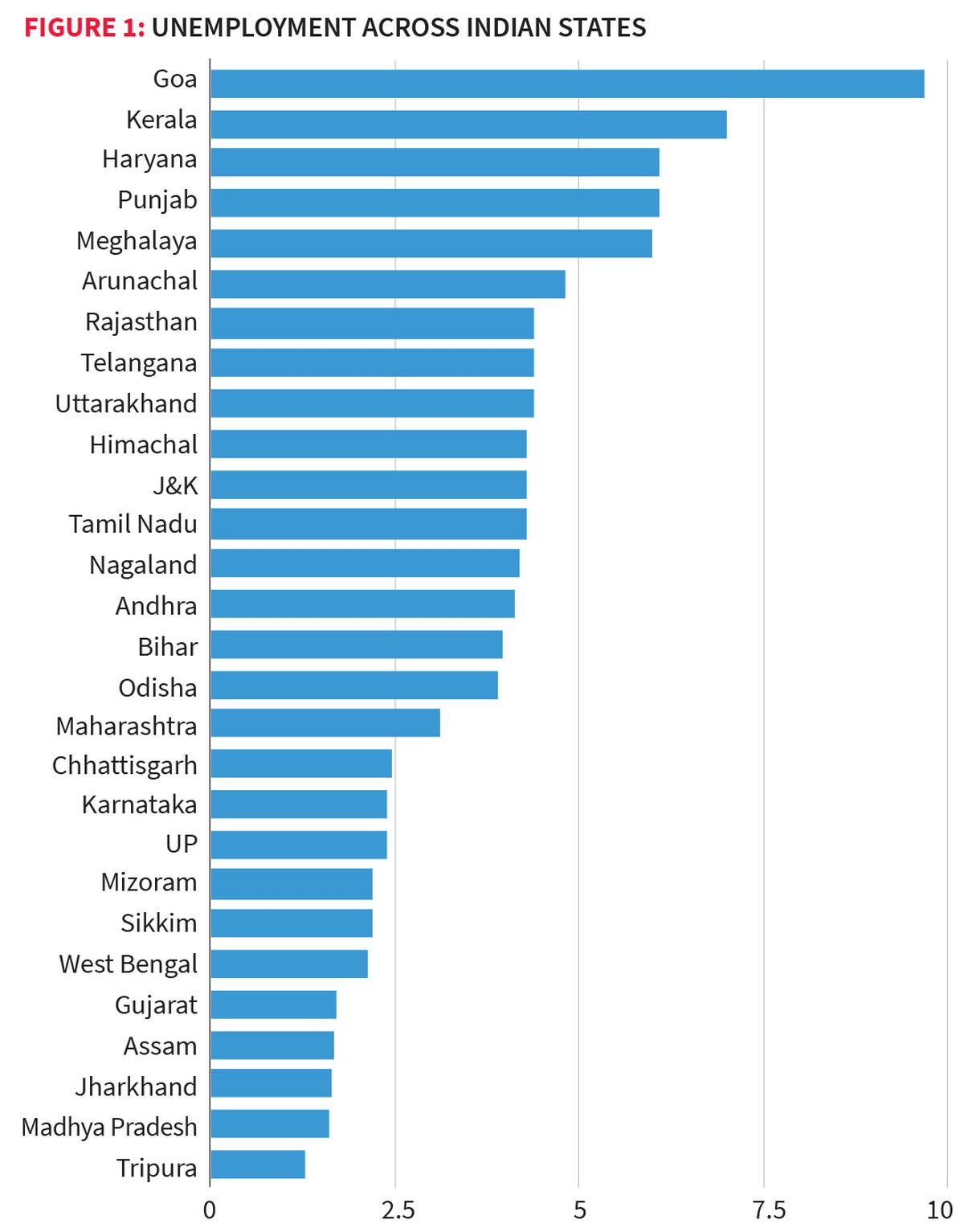
Out of the 27 States considered, 12 States have unemployment rates less than the national average. Low rates in larger States — 3% in Maharashtra, 2.4% in Uttar Pradesh and 1.6% in Madhya Pradesh — bring down the national average. But this presents a conundrum: barring Maharashtra and Gujarat, much of the States with unemployment rates lower than the national average also have per capita incomes lesser than the national average.
The determinants of unemployment
Figure 2 depicts the relationship between unemployment rates and the share of the labour force in self-employment.
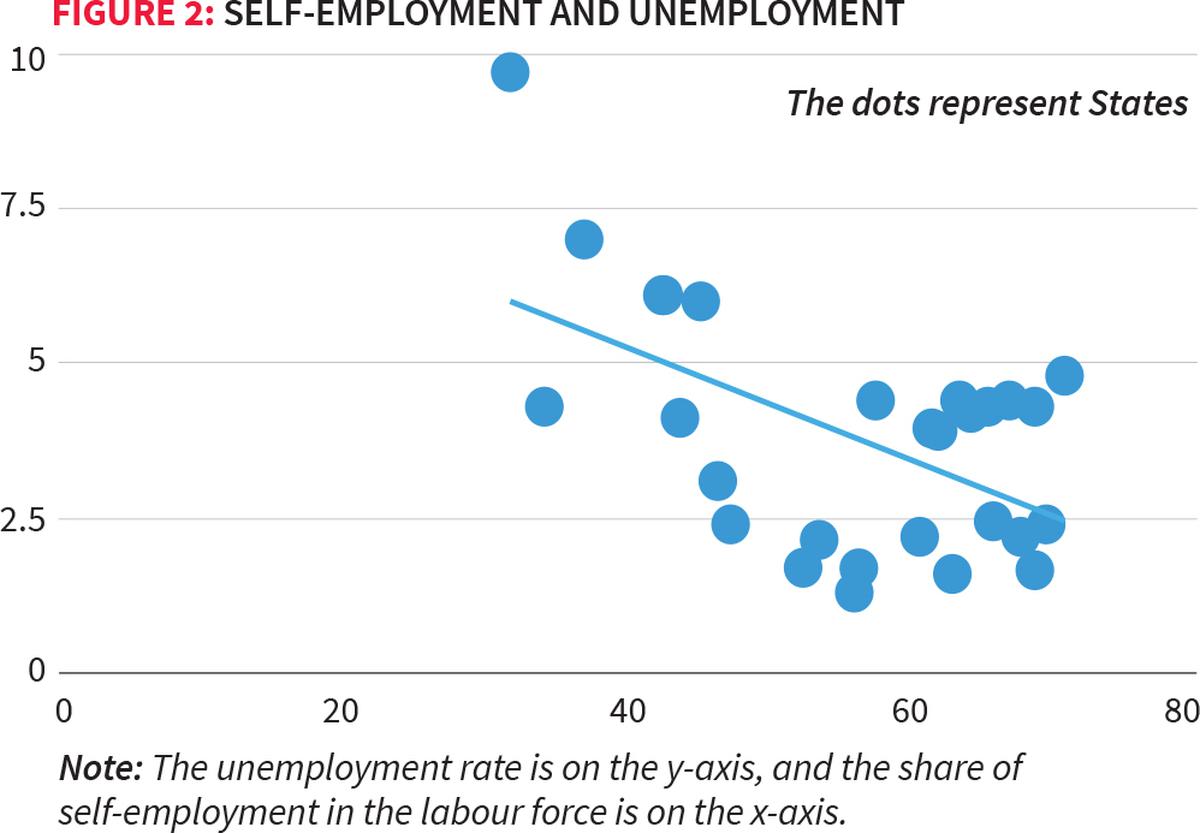
The trend line drawn through the data is downward-sloping, indicating that there exists a negative relationship between the two; in States where a large proportion of the labour force is engaged in self-employment, the unemployment rate is low. Since a bulk of the self-employment in India is of the informal variety, States with a large proportion of informal work would find it easy to absorb a large number of job-seekers. Yet it is unclear whether this relationship is cause or effect. Does a lack of self-employment opportunities result in high unemployment? Or is it that in States with high unemployment, individuals do not wish to engage in self-employment?
A large proportion of informal self-employment is accounted for by agriculture and the rural economy. A useful proxy, therefore, is to examine the size of the labour force engaged in the urban sector. Figure 3 outlines the relationship between the urban share of the labour force and the unemployment rate.
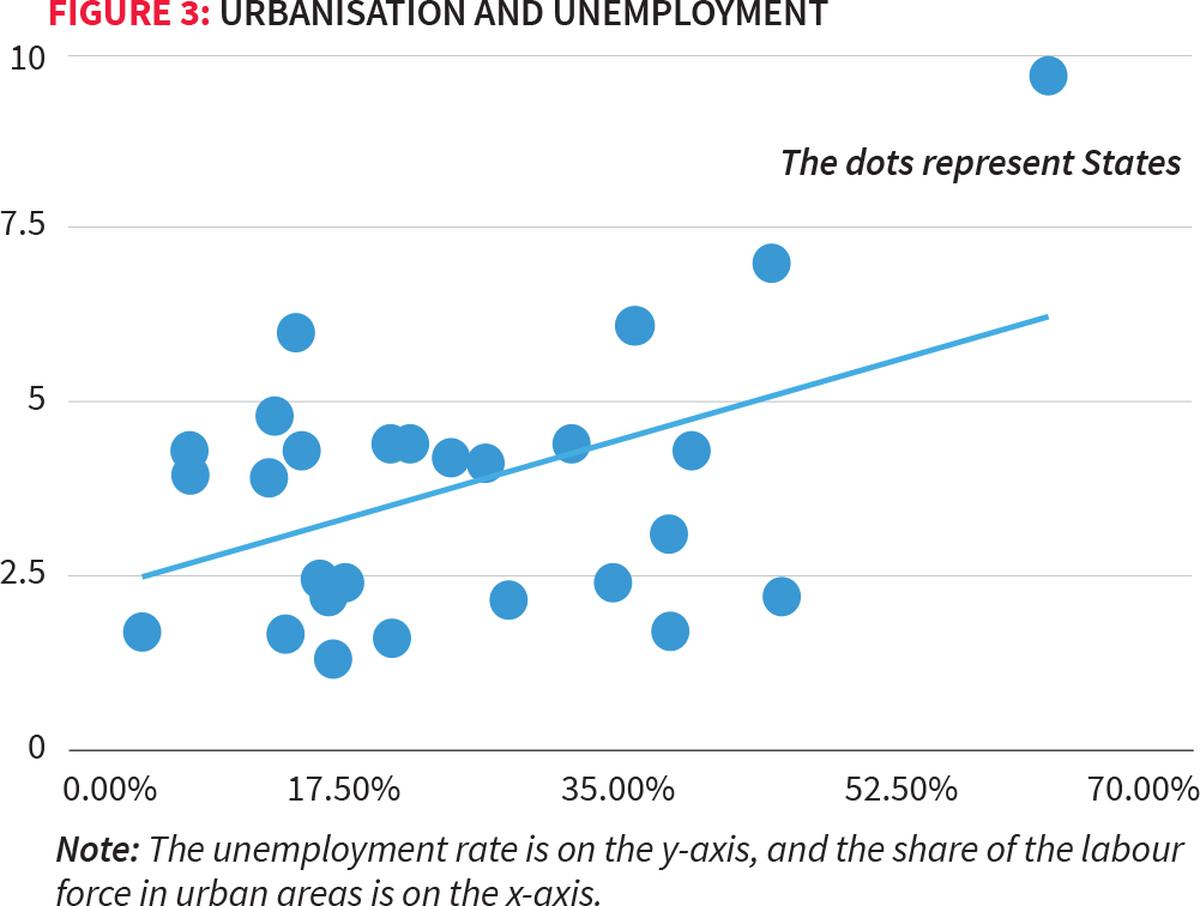
There is a clear positive relation, indicating an increase in unemployment rates in highly urbanised States. This explains the high degree of unemployment in States like Goa and Kerala — both highly urbanised — and low unemployment in States like U.P., Jharkhand and Madhya Pradesh. Urbanised States have smaller agrarian and agrarian-dependent sectors and hence have a relatively smaller source of informal jobs available. While informal sectors do exist — and thrive — in urban settings, the scope for the absorption of job-seekers is limited as compared to rural agriculture, which often acts as a ‘reserve’ absorbing surplus labour.
On education and employment
Exceptions, however, do exist. Gujarat and Maharashtra are highly urbanised — the share of the urban labour force is 37% in both States, much higher than States like U.P. (17%) and Madhya Pradesh (20%) — and yet have lower unemployment. Much of the discussion in the wake of the release of the ILO-IHD report has centred on the link between education and unemployment. A previous column in this newspaper on December 26, 2023, ‘Are graduates facing unemployment’, also discussed the high prevalence of unemployment amongst graduates. Figure 4 outlines this link across Indian States.
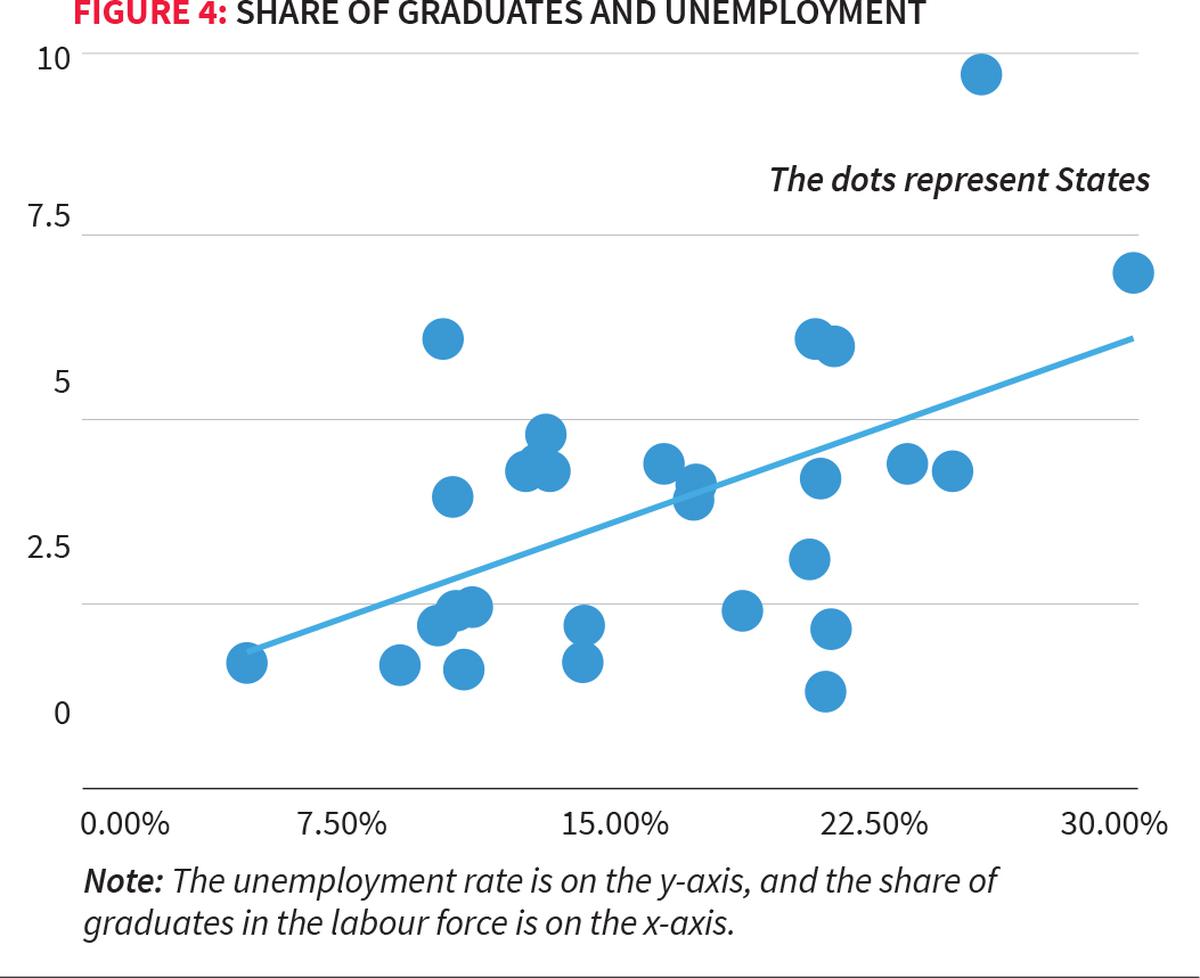
There is a clear positive relationship. Kerala, for instance, has a highly educated labour force — 30% of the labour force are graduates — and faces high unemployment. Gujarat and Maharashtra have a relatively lower share of graduates in their labour force — roughly 14% and 20% respectively — and hence have lower unemployment in spite of being richer and urbanised.
There might be several reasons for this outcome. Perhaps graduates do not possess the requisite skills required for the growing modern sector. This necessitates a focus on teaching infrastructure and standards. But this does not explain why graduates have always faced unemployment, even when the modern sector was in its infancy.
Another possible explanation is linked to aspirations. Graduates seek high-wage jobs in line with their skills, and not informal jobs. If the modern sector does not expand sufficiently to absorb new graduates, it would result in unemployment. These are not the only factors driving unemployment. State policy also plays a key role. But this analysis highlights the links between structural transformation and unemployment.
Growing developing economies experience a reduction in the role of agriculture, and an increase in urbanisation and educational attainment. As India develops, these factors would add an upward pressure to the unemployment rate. It is imperative that policy concentrates on the question of employment generation to counter these tendencies.
Rahul Menon is Associate Professor in the Jindal School of Government and Public Policy at O.P. Jindal Global University.