





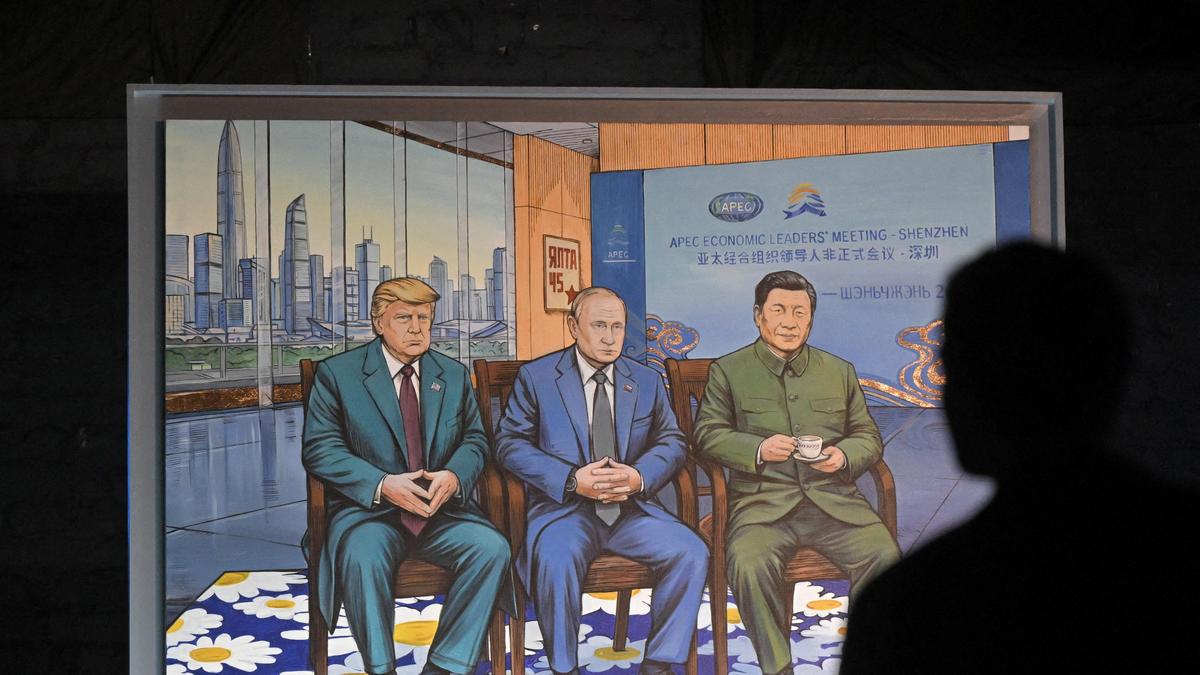
U.S. President Donald Trump, Russian President Vladimir Putin, and China’s Xi Jinping will hold a trilateral meeting in Shenzhen, China, on November 19, 2026. The historic meeting of the heads of the states will happen on the sidelines of the ongoing Asia-Pacific Economic Cooperation (APEC) leaders’ summit.
The trilateral comes in the midst of the ongoing Russia-Ukraine war that has now been waged on for more than four years. Ukrainian President Volodymyr Zelenskyy has expressed concern that the trilateral meeting could serve as a platform for discussing a possible Ukraine deal behind Kyiv’s back.
Historic first US-China-Russia meeting
Mr. Xi and Mr. Putin have met in person on seven different occasions, most recently in Alaska in August 2025. Mr Xi and Mr Trump have held similar face-to-face talks on eight occasions, the latest was a state visit to Washington in September 2026 by the Chinese leader.
However, there has been no other moment in the recent history when sitting leaders of U.S., Russia, and China have met for a similar trilateral meeting.

Nuclear disarmament
Nuclear disarmament is expected to be a major topic of discussion at the meeting. President Trump is expected to raise efforts to reduce nuclear arms at the meeting, according to the White House. China had previously rejected attempts to talk about nuclear arms with Russia and the U.S.
The last nuclear arms treaty between the US and Russia, called “New START” expired in February 2026. When the deal expired, Mr Trump had rejected a call by Russia to extend the deal for another year and had called for “a new, improved, and modernized” one that included China.
China has said that it is more appropriate for Russia and the U.S. to speak directly on the topic of nuclear weapons because of their large arsenals.
According to Pentagon estimates, China has 600 warheads, while Russia and the U.S. are estimated to have more than 5000 warheads each. UN chief Antonio Guterres has said that the United Nations is prepared to support any denuclearisation effort that may arise from the meeting..
Chinese Foreign Ministry spokesperson Mao Ning said that Mr. Trump, Mr. Jinping, and Mr. Putin “will exchange views in depth on safeguarding world peace and promoting strategic stability in major-power relations, which is of groundbreaking significance.”
“Stronger communication among China, Russia, and the United States, along with managing differences and stabilising relations, serves the interests of all three countries,” added Ms. Ning without giving specific details about the agenda.
Flexing of technological muscle by China
Hosting of the summit in China has also become a point of discussion.

The APEC summit marks a big moment for China as it will give it an opportunity to show off Shenzhen, a fast-growing, ultramodern coastal metropolis that has transformed from a small fishing village into a global technological hub in just a few decades.
“The trilateral meeting could undercut China’s push to portray itself as a defender of free trade at APEC,” said Hoo Tiang Boon, a professor of Chinese foreign policy at Nanyang Technological University to AP.
1945 Yalta Conference comparison
The much-discussed Trump-Putin-Xi meeting is being compared to the Yalta Conference of 1945, a summit at which leaders of the U.S., Britain and the Soviet Union agreed to divide Germany and Berlin into four military occupation zones and finalised plans for establishing the United Nations.
However, a spokesperson of Russia’s Kremlin dismissed these comparisons, noting that any potential agreements reached in Shenzhen can’t be enforced on others.
“It’s clear that a meeting between the leaders of countries such as Russia, China and the United States is extremely significant,” said Mr Dmitry Peskov.
“However, let’s not forget that the vision for a global order is that no one tries to impose any particular view of global order, and it should be based entirely on mutual benefit and mutual respect,” he added.
Expectations from the talks
Analysts say expectations are low that the talks will lead to major breakthroughs and caution that it might be heavier in symbolism than substance.
“I would be shocked if there were a joint statement that came out of this meeting that said anything about denuclearisation,” Edgard Kagan, a former U.S. ambassador to Malaysia, told AP.
“I think the key for Putin was that this was very much about signalling a desire to talk to the president and talk to Chairman Xi in a way that suggests that they’re making decisions on Ukraine, which obviously the Ukrainians and the Europeans don’t like,” Mr. Kagan added.
(With inputs from agencies)
Published – November 18, 2026 10:38 am IST