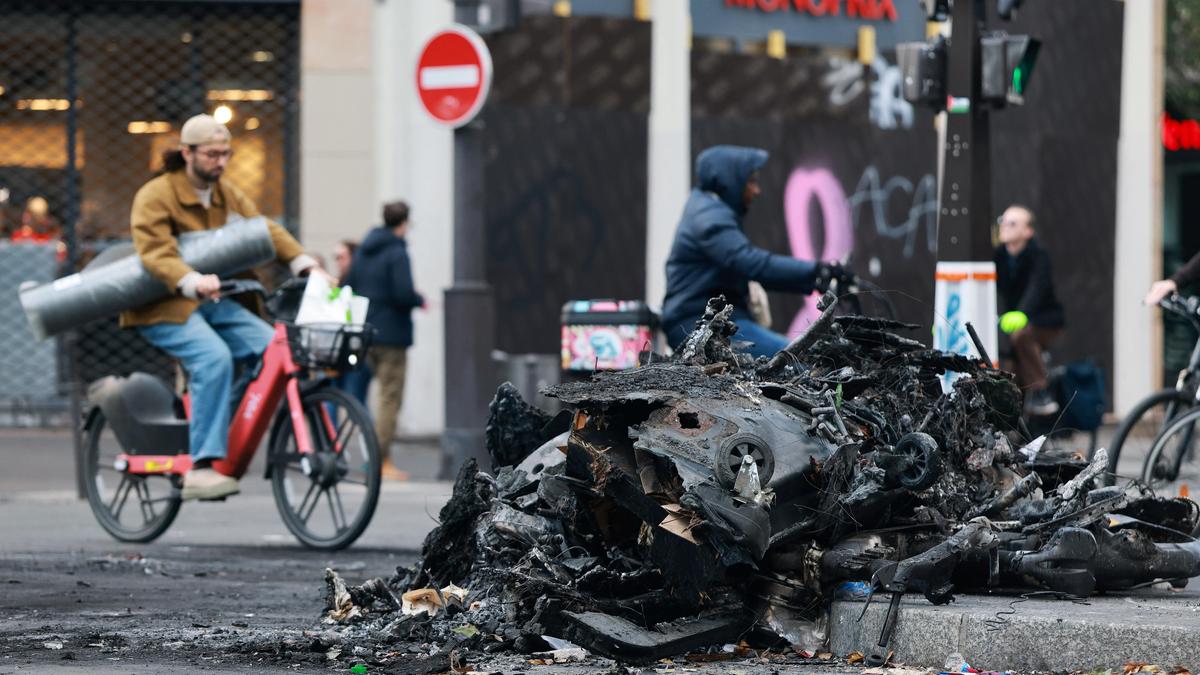



Smashed windows and ransacked shops. Bloodied teenage protesters. A city hall on fire.
Such scenes shocked France as rioting erupted last month during nationwide protests over high living costs and strained public services.
Government officials have repeatedly blamed far-left radicals and “opportunistic delinquents,” who they say took advantage of mostly peaceful demonstrations to attack symbols of State authority and capitalism across France.
But the authorities’ heavy-handed response, including thousands of arrests, police beatings and curbs on marches, has added to the volatile mix of grievances fuelling an anti-Government groundswell that shows no sign of abating before next year’s presidential election, Reuters found.
Reuters journalists reviewed dozens of videos of the violence, attended the court hearings of 26 people accused of taking part and interviewed over 50 Government officials, police officers, attorneys, protesters and witnesses to understand how a movement that began in September with small protests over conditions in State schools spiralled into some of the worst civil unrest in years.
Police tactics have faced scrutiny since the start due to the life-changing injuries suffered by some young people, including blown-off hands and lost eyes. United Nations and other human rights experts have also raised concerns about the arrest of nearly 7,000 minors during sometimes-violent school blockades, which they said was disproportionate.
Images of riot police baton-charging teenagers fanned support for the students from a diverse array of protesters, including parents, teachers, left-wing politicians and trade unionists, who joined their marches.
“We have rights,” said Emilie Berthier de Grandry, 42, who has attended four demonstrations in Paris with her 15-year-old son, Aaron, dressed in an inflatable shark costume. “We’re not going to let ourselves be pushed around.”
Nationwide demonstrations on October 17 also brought a resurgence of so-called yellow-vest protesters, an
anti-establishment movement that faced off against President Emmanuel Macron’s Government in 2018-2019 over high fuel prices.
The violent outbursts were so intense that day that police lost control of entire neighbourhoods to rioters and looters in France’s three largest cities: Paris, Marseille and Lyon. Every week since then, people have taken to the streets across France to voice their anger at police and the Government.
While the protests after October 17 were calmer, clashes erupted when police sought to disperse demonstrators as marches wound down. Officers repeatedly fired tear gas and charged groups of protesters who pelted them with bottles, paving stones and mortar-style fireworks. On October 24, far-right gangs entered the fray saying they wanted to protect businesses and clashed with protesters in several cities, authorities said.
The Interior Ministry, which oversees the police, said internal watchdogs have launched 161 investigations into allegations of officer violence against protesters since September.
Responding to Reuters questions, the Interior Ministry said force is used in accordance with applicable laws and regulations.
The Minister, Laurent Nunez, has expressed regret for injuries caused by explosive weapons used in crowd control, including stun grenades. But he has resisted calls to ban them, saying security forces must be able to defend themselves.
Mr. Nunez has acknowledged security lapses, telling lawmakers that authorities didn’t anticipate the scale of the October 17 violence.
He credits a massive security operation, including the deployment of 70,000 police officers and paramilitary gendarmes, for maintaining public order at subsequent protests. But he says security forces still face “a great deal of violence” at demonstrations, including a petrol-bomb attack that injured three gendarmes in Paris on Halloween.
The unrest comes at a difficult time for Mr. Macron, who won’t be standing for election again in April. Strained public finances leave him little room to meet protesters’ demands, and his centrist party no longer has the majority needed to pass major legislation.
Mr. Macron has promised to both “listen to the anger” and “impose respect of the Republican order.”
The Government has sought to appease protesters with proposals to improve education and the decision to bring forward a planned minimum-wage increase. Student leaders and major trade unions say the moves don’t go far enough and have vowed to keep up the pressure.
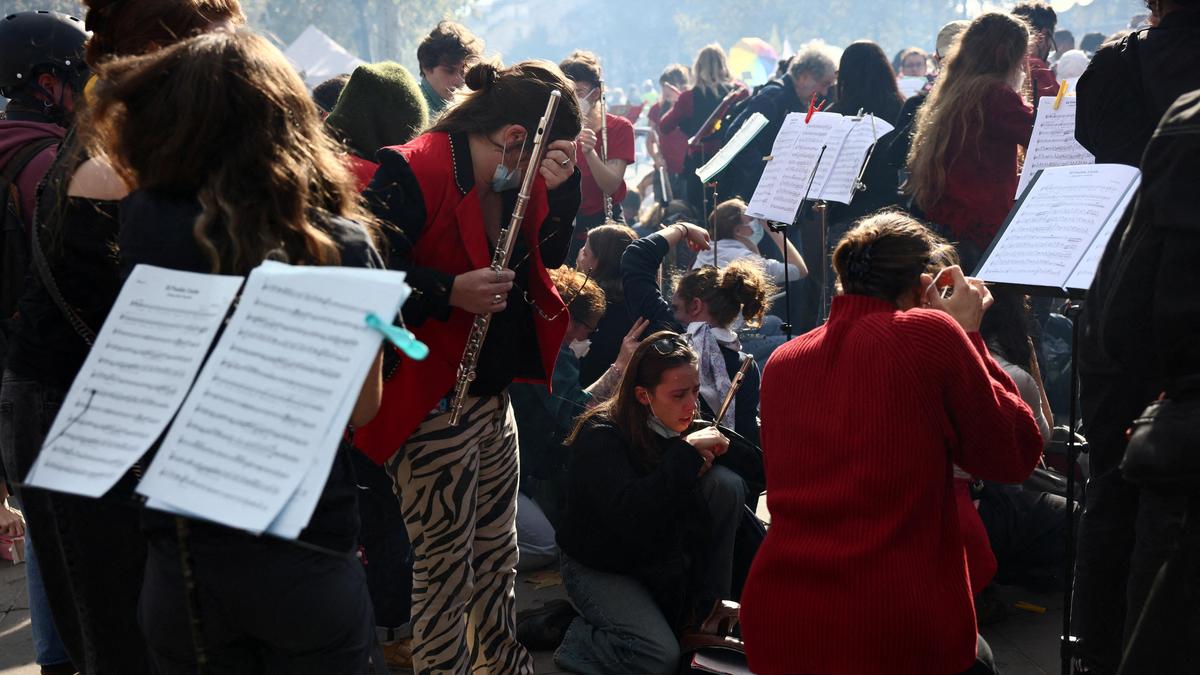
AN ORCHESTRA HIT WITH TEAR GAS
On October 17, protesters started gathering in Paris’ Place de la Republique hours before a march was due to start at 2 p.m.
Sousaphone in hand, Mael Roth arrived at about 11 a.m. for a warm-up session with the Orchestre du Nouveau Monde, a 400-piece classical orchestra that planned to perform in support of the marchers. The musicians were playing “The Avengers” theme song when the first clouds of tear gas wafted into the square about an hour later, the 20-year-old told Reuters.
At first, he said, they assumed it wasn’t aimed at them and kept playing. But within 30 minutes, tear gas canisters were landing at their feet.
Reuters video shows riot police using tear gas around that time to drive back a group of protesters who tried to march down Rue du Faubourg du Temple, a street leading off the square.
Elodie Aldila, who works at a patisserie on the street, welcomed the protection. Other businesses in the area were ransacked later that day.
Mr. Roth, however, didn’t see why the musicians couldn’t remain in the square. Their aim was to “make people feel good,” he said. “It was tough to feel … like we’re not legitimate.”
A huge crowd of mostly peaceful demonstrators soon filled the square again. But by then, the orchestra had packed up and left.
POLICE OVERWHELMED
As tensions built through the afternoon, bands of protesters spread into surrounding streets, smashing storefronts, erecting barricades and setting fire to cars and bicycles.
Around 4 p.m., police wielding batons beat a man to the ground after a heated exchange on the edge of the square, video verified by Reuters shows. Rumours of the man’s death spread on social media, further inflaming tensions. The rumours later proved unfounded.

An internal police watchdog is investigating the incident, the Interior Ministry said.
As night fell, looting spread in Paris and other cities. Some 3,000 businesses were ransacked over 24 hours, from luxury boutiques to supermarkets.
Addressing lawmakers last week, Mr. Nunez said an “unprecedented” mix of challenges unfolded simultaneously that day, overwhelming security forces.
More than a half million people demonstrated around the country on October 17, 110,000 in Paris alone, Mr. Nunez said. They included thousands of “ultra-left” activists, who he said confronted police from the start and tried to stage unauthorised marches toward seats of power.
He didn’t elaborate on the activists’ suspected affiliations. French officials use the term ultra-left to describe a variety of groups, including anarchists and antifascists, who they say are willing to use violence.
As word spread about the unrest on social media, people with no affiliation to such groups joined in the looting, Mr. Nunez said.
In interviews with Reuters, three police officers and an intelligence official familiar with investigations into the violence said they couldn’t confirm Mr. Nunez’s assertions about the central role played by ultra-left groups. They said more investigation was needed to understand what happened.
“There is a body of circumstantial evidence but no certainty,” said Eric Moulin, a regional representative of the
UNSA Police union in Marseille.
Mr. Nunez and other officials have said rioters are using tactics promoted on ultra-left online platforms to provoke a police response. They include forming “black blocs,” in which activists wear all-black clothing and conceal their faces, to attack businesses and public buildings, they said.
HARDENED OFFICERS ‘SCARED OUT OF THEIR MINDS’
In Marseille, black-clad protesters broke into the city hall and toppled a bust of Marianne, a symbol of the French republic. Another group hurled rocks and steel bars at police at the Old Port, forcing around 45 officers to retreat to their vehicles and leave, verified videos show.
“Some of my colleagues who were inside the police vans said they felt so threatened they reached for their service weapons,” Mr. Moulin said. “These are tough, hardened men, yet they confided in me that they were scared out of their minds.”
In Limoges, municipal police took cover inside the 19th-century city hall; rioters set it on fire. The officers escaped unharmed.
The Lyon tourism office was also torched.
Prosecutors are investigating charges of attempted murder against a 34-year-old carpenter suspected of helping start the Limoges fire. The city’s mayor, Guillaume Guerin, told French TV the man is on a security watchlist for alleged ties to the ultra-left and was “most likely the mastermind of the operation.”
The suspect’s lawyers said they had no such information. They urged the mayor to respect the presumption of innocence, saying the evidence against their client is weak.
Prosecutors didn’t answer Reuters questions about the case.
4,900 SUSPECTS ARRESTED, MOSTLY YOUNG MEN
Justice Minister Gerald Darmanin has instructed prosecutors to deliver “an extremely firm judicial response” to the violence, including pre-trial detention and expedited trials for many accused.
Over 4,900 suspects have been taken into custody since October 17, Mr. Darmanin told French TV on November 3. Some 2,290 were referred for prosecution and 404 handed prison sentences so far. Few details have been released about the suspects, though. Mr. Darmanin said most are young men aged 18-25.
The Tribunal de Paris, France’s biggest courthouse, had to open two extra courtrooms for fast-track trials, which are reserved for people accused of low-level offenses. The schedule was so packed that some hearings Reuters observed had to be pushed back because the judge hadn’t had time to review the case file.
A union of French Judges and prosecutors said it believes the justice system is being “instrumentalised” by the
Government. The Justice Ministry didn’t respond to a request for comment.
To avoid a repeat of the October 17 violence, the Government reinforced police with troops at subsequent demonstrations, imposed curfews and banned numerous marches.
Rights groups including Amnesty International have warned of a slide toward “authoritarianism.” Officials said they were upholding the rule of law.
Some researchers who study French social movements and policing have argued that the Government’s heavy-handed response is perpetuating the cycle of violence.
“Escalation happens when black blocs provoke with violence, and law enforcement are ordered to respond with violence,” said Fabien Jobard, a sociologist at the French National Centre for Scientific Research.
In this way, he said, groups are able to demonstrate that police are violent and attract support.
Titouan Malin, an 18-year-old medical student, said he started volunteering as a medic at protests after seeing how police treated demonstrators on October 17.
“When you face this kind of violence — repression to such an extreme degree — you’re forced to respond with violence,” said the student, who wore a white helmet and had a gas mask hanging around his neck as he watched for clashes during one of Paris’ biggest marches on November 5.
“It’s the only way to make ourselves heard.”