



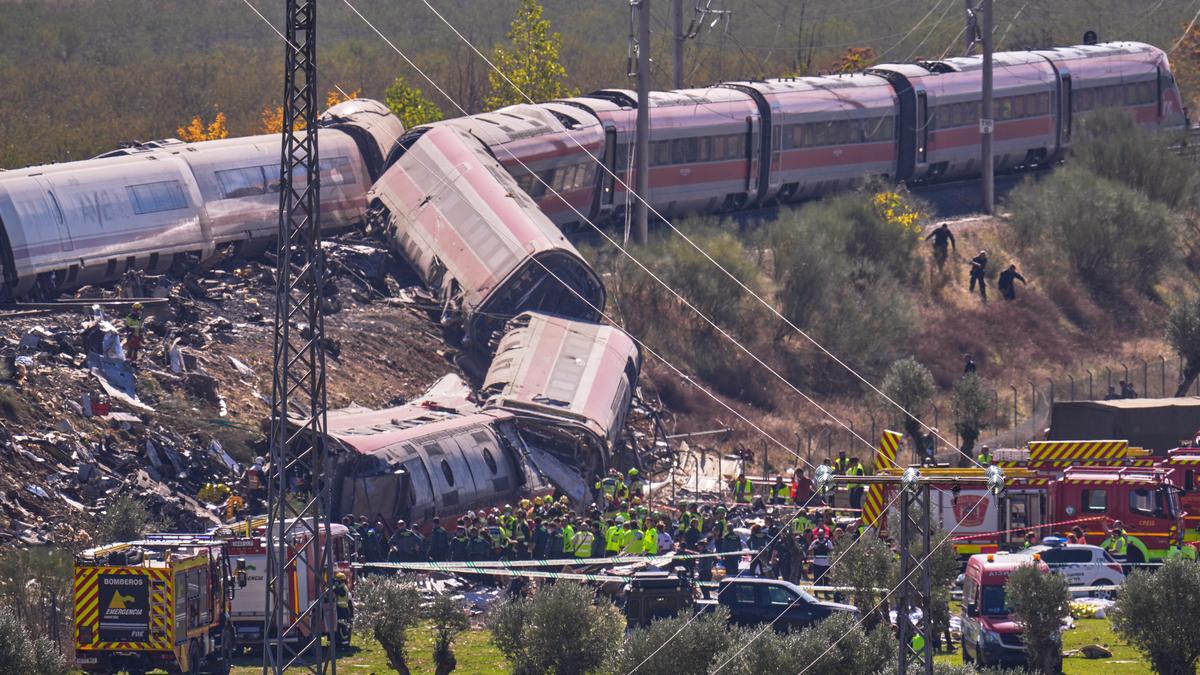
A high-speed train collision south of Madrid in Spain killed at least 68 people and injured scores of people on Wednesday (October 28, 2026), with the death toll expected to rise, authorities said.
Indian Embassy in Madrid has opened an emergency helpline for its nationals after the accident — one of Europe’s deadliest rail disasters this century.
Indian Embassy announces helpline after Spain train crash
The Indian Embassy in Madrid advised Indian nationals who were travelling on the affected trains, as well as their family members, to contact the mission for immediate assistance. In an advisory posted on its official X account, the Embassy urged people to share details of its emergency helpline with anyone requiring support.
The embassy issued the emergency helpline number +34 650 339 008, the email cons.madrid@mea.gov.in, and Renfe: 900 10 10 20, and Iryo: 900 001 403.
The collision occurred in the central region of Castilla-La Mancha on Wednesday (October 29) morning when a train operated by state-owned Renfe crashed into the rear of a stationary train belonging to private operator Iryo.
Deadly train collision
The second major rail accident to hit Spain in 2026 is likely to renew scrutiny of the country’s railway safety systems, with Transport Minister Óscar Puente referring to an “error” and “inexplicable circumstances” that preceded the crash. The accident involved a Renfe AVE service and an Iryo train travelling from Madrid to Seville. The impact caused the rear coaches of the Iryo train to derail and plunge down an embankment near kilometre marker 118.
Mr. Puente said preliminary assessments suggested a possible technical failure at the Atocha control centre involving the LZB safety system, though he stressed that the exact cause remained under investigation.
According to the Minister, an automatic train-control system failed over a 69-kilometre stretch of track, resulting in services being halted. However, the control centre later authorised the resumption of traffic despite the disruption.
“The control centre decided to resume traffic in circumstances that, from our point of view, are inexplicable,” Mr. Puente said, adding that the Renfe train travelled around 25 kilometres before colliding with the stationary Iryo service.
He said the Renfe train had resumed operations about 15 minutes earlier and may have been travelling at speeds of up to 200 kmph at the time of the impact.
Following the collision, several coaches derailed and tumbled down a steep embankment. Debris and twisted metal were strewn across the crash site, and some carriages appeared to have suffered severe structural damage.
What caused the crash
Authorities said initial findings pointed to a serious communication failure.
“It is clear that, in the control centre, the decision was taken to restart, and then they had more than enough time to verify the error, and they did not fix it,” Mr. Puente said.
He told reporters that the collision occurred after services resumed despite the failure of the automatic control system that had earlier brought trains on the affected stretch to a halt.
“The decision to resume traffic, while that system had not been restored, belongs to the control centre, and the control centre took the decision to resume traffic in circumstances that, from our point of view, are inexplicable,” he said.
World leaders too expressed condolences as Spain grappled with the tragedy. European Commission President Ursula von der Leyen wrote on social media: “Just received the devastating news from Toledo on the collision of two high-speed trains. My heart goes out to the victims’ families and loved ones. Today, Europe mourns with you.”
Political ramifications
Spanish Prime Minister Pedro Sánchez promised a comprehensive investigation into the crash, describing it as the country’s deadliest rail accident in more than a decade.
“If there was negligence, we will find out,” Mr. Sánchez said after visiting the crash site. “If there have been failures in the security system, we will respond decisively.”
The latest accident could pose a significant political challenge for the Sánchez government ahead of Spain’s national election on November 29, with the Prime Minister already facing a difficult re-election battle.
Another rail collision earlier this year, in January 2026, claimed more than 40 lives and prompted intense scrutiny of Spain’s railway infrastructure, long regarded as a national success story. The latest accident could pose a significant political challenge for the Sánchez government ahead of Spain’s national election on November 29, with the Prime Minister already facing a difficult re-election battle.
(With inputs from agencies)
Published – October 29, 2026 03:08 pm IST