Behind every satellite launch and every drone strike lies a less-discussed layer: the classrooms, laboratories, and degree programmes that produce the engineers who design, build, and operate India’s military space and drone assets.
Even during Operation Sindoor in May 2025, when the limelight was on the modern technologies used in warfare by the armed forces – drones, missiles, surface-to-air missiles, attack aircraft, etc. But another crucial aspect was overlooked. Satellites, which are used for spying, surveillance, communication, and navigation, also played a significant role. ISRO Chairman V. Narayanan revealed that at least 10 satellites were kept on standby around the clock to meet the strategic needs of India’s armed forces.
Later, the numbers released by the Department of Space indicate strain in that layer. In a written reply to the Lok Sabha on February 11, 2026, the Minister of State for Personnel, Public Grievances & Pensions and the Prime Minister’s Office, Dr Jitendra Singh, confirmed that against a combined sanctioned strength of 18,142 posts (14,108 Scientific & Technical, 4,034 Administrative) across the Department of Space, only 15,529 were filled: a vacancy of 2,613 posts, or a staffing level of 85.6%. Of the vacant posts, recruitment action was in progress for 1,449, with the department targeting completion by October 2026; action on the remaining 933 was yet to be initiated, the statement said.
Subjects that matter
Military aerospace and unmanned aerial vehicle development rely on drone work fed by a specific cluster of engineering and science streams. The Indian Institute of Space Science and Technology (IIST), the country’s only dedicated space university, offers a curriculum that covers this domain.
IIST has undergraduate degree programs such as B.Tech majors in Aerospace Engineering and Electronics and Communication Engineering, alongside a dual-degree route combining a B.Tech in Engineering Physics with postgraduate specialisations in Astronomy and Astrophysics, Earth System Science, Solid State Physics, and Optical Engineering. Additionally, IIST provides standalone postgraduate programmes in satellite systems, space communications, and spacecraft systems.

India’s Gross Expenditure on Research and Development (GERD) has stagnated at 0.6-0.7% of GDP for over a decade: 0.66%, 0.66%, and 0.64% respectively for 2018-19, 2019-20 and 2020-21, according to government data in Parliament: “below global average and lower than countries like China, South Korea and the U.S.” A more recent parliamentary response confirms India’s GERD at the same range, as the country’s Global Innovation Index ranking rose from 81st in 2015 to 38th in 2025.
The role of schools
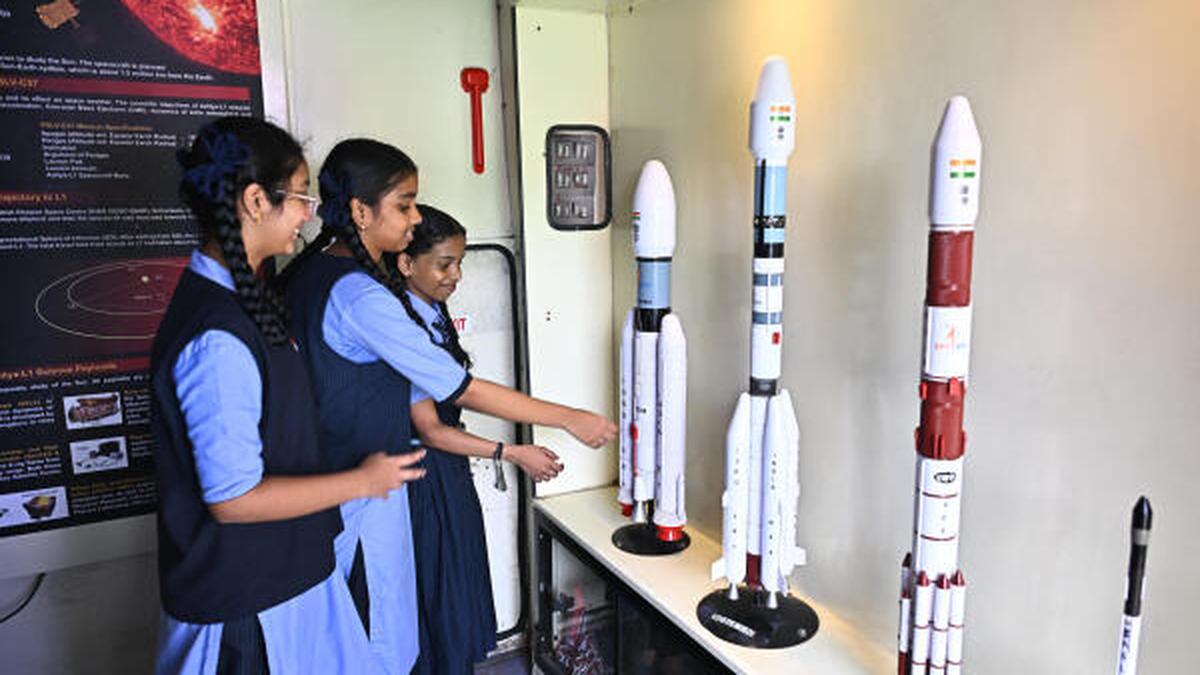
Captain Abhijeet Bhutey (Retd.), a former Indian Navy fighter pilot, says, “India’s most systematic school-level intervention is ISRO’s YUVIKA (Yuva Vigyani Karyakram / Young Scientist Programme), launched in 2019, a two-week residential programme wholly sponsored by ISRO, held at various ISRO centres across the country: Indian Institute of Remote Sensing (Dehradun), Vikram Sarabhai Space Centre (Thiruvananthapuram), Satish Dhawan Space Centre (Sriharikota), U.R. Rao Satellite Centre (Bengaluru), Space Applications Centre (Ahmedabad), National Remote Sensing Centre (Hyderabad) and the North-Eastern Space Applications Centre (Shillong).”
Captain Bhutey says, “The programme’s selection process highlights a talent discovery mechanism that targets a minuscule fraction of school-going children (0.00035% in the case of 350 students selected from 100 million school-going children in India). Only students of class 9 are eligible and selected through a competitive examination process. However, YUVIKA selects a few hundred students a year out of a school-age population running into tens of millions: a talent-scouting exercise rather than a mass STEM pipeline. In 2024, 350 students from all 28 States and eight Union Territories qualified to participate at the seven ISRO centres.”
India’s only space university
IIST, at Valiamala near Thiruvananthapuram, is a Deemed-to-be-University set up in 2007 under the Department of Space, with a stated mission to “nurture exceptional human resources for the Indian Space Research Organisation.” As of 2025, IIST had 101 faculty members and 1,356 students in total (634 undergraduates, 286 postgraduates, 436 doctoral students), with a budget of ₹147.50 crore for the year 2026-2027. Graduates historically move directly into ISRO in various capacities.

Discussions between ISRO’s Space Applications Centre (a DoS enterprise) and Space Technology Cells (STCs) at IITs and IISc (created by Joint Policy Committees headed by the Director/ Vice-Chancellor with ISRO scientists as members): a formal channel for passing ISRO research challenges to top engineering schools. Even though this gateway exists, this structure covers only a small fraction of the country’s 23 IITs and hundreds of engineering colleges, thereby proving that most engineering graduates in India get their degree without even touching a space-relevant research project.
DRDO’s institution: DIAT
The DRDO has its own little institution for space called the Defence Institute of Advanced Technology (DIAT), Pune, a DRDO deemed university, which, per DRDO’s own recruitment and institutional materials, educates and trains specialists in disciplines in space domain including guided missiles, aerospace, and electronics, largely for candidates sponsored by the armed forces and DRDO itself rather than the open civilian applicant pool.
DRDO does not have a single unified recruitment pipeline; however, its hiring process is split into 2 channels, independent boards, depending on the tech and non-tech roles. The tech channel offers a gateway to the role for Scientists, while, to support the infrastructure, Technical and Admin staff roles are also available.
There are three channels for recruitment. The RAC (Recruitment & Assessment Centre) is a pathway to the tech roles that provides a direct route for Scientist ‘B’ and above. Candidates are required to hold a valid GATE score in the relevant discipline, spanning Engineering Sciences, Life Sciences, and Humanities & Social Sciences, followed by a personal interview. The lateral recruitment for senior Scientist grades ‘C’, ‘D’ and ‘E’ is through occasional specialised advertisements.
The second is the CEPTAM (Centre for Personnel Talent Management), which offers pathways for technical support roles (Senior Technical Assistant and Technician grades), only for graduates with a diploma and ITI. According to DRDO’s website, CEPTAM is responsible for “all recruitment-related functions including advertisement of vacancies, receipt and evaluation of applications, preparation of question papers, conduct of written examination (CBT), trade tests and formation of selection committees for these categories”.
The DRDO website offers a continuous stream of lab-level walk-in interviews and Junior Research Fellowship (JRF) postings advertised independently by individual labs, providing DRDO with all the information of postgraduate and doctoral researchers directly into applied projects at the lab level, separate from the centralised RAC/CEPTAM exams.

The DRDO careers page publishes fellowships and apprenticeships for Junior Research Fellows, Senior Research Fellows, and Research Associates. Selection usually happens via a walk-in or structured online interview evaluating your master’s or doctoral project work
Overall, a fresh B.Tech graduate, who is aiming for DRDO’s core R&D work needs to have a strong GATE score for the RAC route. For Tier-1 colleges (IITs/NITs), candidates with an aggregate of 80% or above can sometimes bypass the initial GATE cutoff shortlisting. A diploma holder can also enter through CEPTAM; while a postgraduate or PhD researcher is more likely to enter through a specific lab’s JRF advertisement than through either centralised channel.
The government’s startup bridge
Since 2021, the government has tried to bridge the gap between capital and talent of the country into defence and space technology through the private sector via iDEX (Innovations for Defence Excellence), run by the Defence Innovation Organisation under the Department of Defence Production.
The iDEX’s scheme documentation aims to provide a budget of ₹498.78 crore over five years (2021 to 2022 through 2025 to 2026), to support approximately 300 startups, MSMEs and 20 partner incubators. Moreover, individual grants may go up to ₹1.5 crore under standard Defence India Startup Challenges (DISC) and up to ₹10 crore under iDEX Prime.
The iDEX official portal lists all the active challenge tracks, including Mission DefSpace: the space-technology-specific vertical under iDEX, through which challenges are floated for satellite, launch, and space-surveillance-related problem statements sourced from the Defence Forces, Coast Guard, and Defence Space Agency.
Throwing the light on space startups specifically, a Lok Sabha written reply (Unstarred Question No. 4049, answered 12 August 2026) said that around 440 space technology startups are registered on the DPIIT Start-up India Portal. IN-SPACe has granted 113 authorisations to 52 Non-Government Entities (NGEs), of which 18 are startups.
The NewSpace India Limited (NSIL), in coordination with IN-SPACe, has signed 118 Technology Transfer Agreements for 83 technologies developed at ISRO/Department of Space, transferred to Indian industry, including Small Satellite Launch Vehicle (SSLV) technology, the Indian Mini Satellite-1 (IMS-1) Bus, and the ISRO Laser Gyro (ILG) and deployed across the country.
Government-run financial support mechanisms named in the same reply include the IN-SPACe Seed Fund Scheme, the Technology Adoption Fund (TAF) (₹500 crore), and a dedicated ₹1,000 crore Venture Capital Fund for space startups.
How a military satellite or drone is built
Official government replies describe India’s satellite-building ecosystem as running through three tracks rather than one:
1. Pure ISRO builds: Cartosat, RISAT, and GSAT-class satellites, built inside ISRO’s own centres (U.R. Rao Satellite Centre, Space Applications Centre) by government scientists.
2. Technology-transfer-enabled private builds: The 118 Technology Transfer Agreements referenced above show ISRO/DoS-developed technologies, including SSLV and satellite-bus technology, being formally licensed to private industry rather than developed from scratch by each company.
3. Direct private authorisation: IN-SPACe’s 113 authorisations to 52 Non-Government Entities represent companies cleared to independently build and operate space assets under India’s regulatory framework, rather than through ISRO technology transfer alone.
India’s indigenous military drone effort traces back three decades. DRDO’s own archive documents DRDO’s Aeronautical Development Establishment (ADE), Bengaluru, conducting the 5th successful flight of the indigenously designed and developed Rustom-1 Medium Altitude Long Endurance UAV in the early 2010s, flying at 2,300 ft AGL and 100 knots during a 25-minute test near Hosur, with ADE named as the nodal DRDO laboratory for the programme. The Rustom family subsequently evolved into the TAPAS-BH-201 (also called Rustom-II), an indigenous Medium Altitude Long Endurance UAV built for intelligence, surveillance, and reconnaissance missions. (Wikipedia, DRDO Rustom)
A parallel public-private track produced Netra, jointly developed by ideaForge and DRDO’s Research & Development Establishment, now used not just by the military but by central and state police forces for law-enforcement and disaster-response operations.
Satellites and launch vehicles remain tightly bottlenecked through aerospace-specific degrees and a small number of specialised institutes like IIST and DIAT. While drone development at DRDO’s ADE has historically drawn on a broader mix of aeronautical and electronics engineering talent, and has produced a wider public-private ecosystem (DRDO lab plus commercial partner), the production of satellite and launch-vehicle segments are yet to achieve.
What’s lacking
A scale problem lies in grass root level mainly in school outreach. YUVIKA educates a few hundred students annually nationally with a talent-scouting exercise, unlike a mass STEM pipeline touching India’s school-age population.
Even in higher education, IIST plays a solo part in space education. Despite its proper structure, India’s only dedicated space university has just 1,356 students across all levels, a small base to feed a rapidly scaling space and defence-space programme. Space Technology Cells extend ISRO’s research reach into only a handful of IITs and IISc, out of hundreds of engineering colleges nationally.
A workforce gap at the apex space department itself. Even on the government’s own confirmed figures, 2,613 of 18,142 Department of Space posts stood vacant as of the 11 February 2026 Lok Sabha reply: a 14.4% vacancy rate at the very department responsible for Gaganyaan, the Next Generation Launch Vehicle, further Chandrayaan missions, and India’s proposed space station.
An early-stage but still small private funding base where the cumulative investment in India’s roughly 440 registered space-tech startups stood at approximately $618.5 million as of 31 March 2026 (Lok Sabha Unstarred Question No. 4049), a foundation the government’s own Seed Fund Scheme, TAF, and ₹1,000 crore VC Fund are designed to grow, but still an early-stage base relative to the scale of India’s stated space ambitions.
The vacancies, the small IIST student body, and the still-nascent startup base described above are not abstract administrative statistics.
Air Vice Marshal Dhananjay Khot (Retd.), former Director General of the Defence Space Agency and an expert advisor to IN-SPACe, shares, “In any modern operation, several categories of space systems work simultaneously. For instance, satellite-derived intelligence is fused with data from aircraft, drones and UAVs to build the full operational picture and strategy.”
By giving examples he explains, “Indian defence satellites such as Cartosat and RISAT supply high-resolution maps and thermal imagery that drone operators use to plan flight paths, read terrain, and pinpoint targets on the ground.”
Commander Arun Ravindranathan (Retd.), a former naval officer who has worked on defence aerospace projects, said, “In today’s warfare, the greatest strength is not the weapon itself but information delivered at the right time, for target selection, command and control, navigation, secure communication, and fast decision-making under fire.”
(Uttkarsha Shekhar is an independent journalist whose interests span defence, science, environment, education, entertainment and fashion.)