


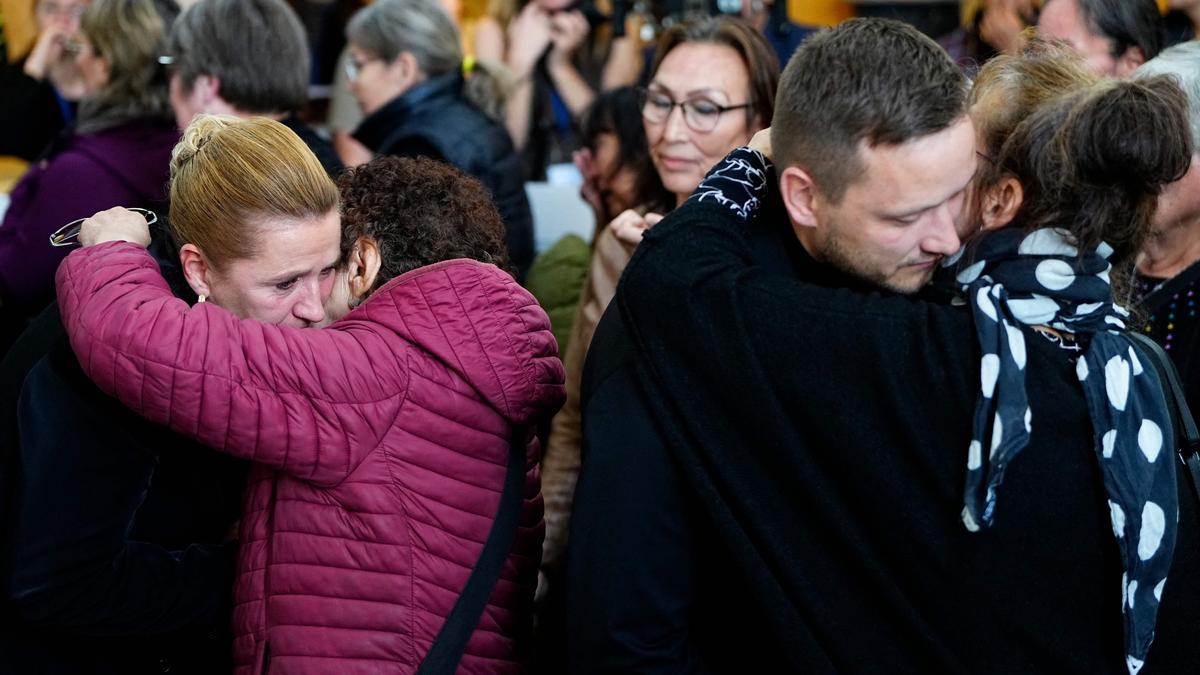
The story so far: United Nations (UN) human rights experts on October 7, 2026, urged Denmark and Greenland to ensure accountability and the rights of Inuit women at the centre of their response to a forced contraception case in Greenland. “Attempts to minimise or exonerate responsibility for wrongdoing and injustices undermine redress for victims because true and effective remedy should be based on factual records and the lived experiences of victims”, the experts said.
Also Read: Indigenous Greenland women sue Denmark over forced contraception
The statement comes as Denmark and Greenland continue to address the forced contraception case, in which Greenlandic Inuit women and girls were given intrauterine devices (IUDs) without their knowledge or consent.
What happened?
From the 1960s to the 1990s, the Danish doctors placed IUDs (a small plastic or copper device that is placed in the uterus to prevent pregnancy) in thousands of Greenlandic Inuit girls and women, often without consent and sometimes without the girls being aware of it, under the direction of Danish government officials.
Reportedly, the programme was created as a family planning policy to control Greenland’s birth rate. More than 4,000 Inuit women and girls were affected. Some were even underage school children who were called out of class by teachers to undergo the procedure, without their consent or that of their parents.
It was called “Spiral Campaign”. “Spiral” or “coil” are the everyday terms used for the IUD, originating from its historical loop shape. Many women with these intrauterine devices grew up to be infertile or developed serious complications while trying to conceive.
As per reports, the practice only became public when Inuit women, now in their sixties and seventies, began speaking to the media. The scale of the birth-control programme was first brought to light reportedly in 2022, by an investigative podcast called ‘Spiralkampagnen’ – the coil campaign. Since then, numerous women have come forward to share their story, with a hundred and forty-two of them taking their claims to the Danish domestic courts.
Various inquiry reports by the UN in the following years looked into the gravity of the events. It argued that control over Indigenous women’s reproduction has historically been used as a means of exercising power over Indigenous people.
Was there any redress?
In 2024, A group of women from Greenland sought compensation from its former colonial ruler, Denmark, in court. Greenland was a Danish colony until 1953 but is now a semi-sovereign territory of Denmark, with a population of just 57,000 people.
In 2025, the Danish government issued an official apology, acknowledging the “systematic discrimination” that occurred during the contraceptive campaign and recognising these women had “experienced both physical and psychological harm.”
“We cannot change what has happened. But we can take responsibility. Therefore, on behalf of Denmark, I would like to say: Sorry,” Prime Minister Mette Frederiksen said. Greenland’s Prime Minister Jens-Frederik Nielsen separately apologised for cases that occurred after Greenland assumed responsibility for the healthcare system.
The policy was a consequence of the “legacies of colonialism that translate today into structural and systemic racial discrimination” against the Inuit people, as stated by the United Nations Special Rapporteur Cali Tzay.
Women who sought compensation were asked to submit an application describing what they had experienced in detail, the Danish authorities said. Medical records are not required, although applicants can supply them to bolster their case.
In August 2026, Danish Parliament (Folketinget), finally took a major step toward compensating the women, passing a Bill that offers those who qualify a one-time payment of 3,00,000 Danish kroner, or about $47,000. Applications can be submitted in Danish or Greenlandic. Applications have been open since July 1, 2026 and can be submitted until September 1, 2028.
The scheme covers women who were subjected to contraception without consent or sufficient consent in Greenland or Denmark between 1960 and 1991, when Denmark was responsible for Greenland’s healthcare system.
After 1953, Greenland became a county of Denmark. In 1979, it gained autonomy, and in 2009, its powers were expanded to include all areas except international relations and defence. United States (U.S.) President Donald Trump, in a recent statement, claimed that the U.S. needs to control Greenland for security reasons and suggested the use of force or economic pressure to achieve this goal.
Was it identified as a ‘genocide’?
According to the UN Convention on the Prevention and Punishment of the Crime of Genocide, genocide means any of five specific acts committed with the intent to destroy, in whole or in part, a national, ethnical, racial, or religious group, such as – killing members; causing serious bodily or mental harm; deliberately inflicting on the group conditions of life calculated to bring about its physical destruction in whole or in part; imposing measures intended to prevent births; forcibly transferring children of the group to another group.

In 2024, the then government in Nuuk tasked three legal experts and one psychologist with establishing whether there have been violations of human rights and the rights of Indigenous peoples, and whether these violations met the definition of genocide.
The panel split during its work, with two members resigning and submitting a separate report. The two experts who remained, Alaskan lawyer Dalee Sambo Dorough and University of Copenhagen law professor Miriam Cullen, found in their report that the rights of Inuit women in Greenland had been violated. But they said that they could not conclude that genocide had taken place “on the basis of contraceptive practices alone”.
They added that genocidal intent by Denmark remained a “possible inference” that a court might establish, based on evidence that fell outside the scope of their report, such as the removal of Inuit children to be raised by Danish families.
The rival report, produced by Jonas Christoffersen, former head of the Danish Institute for Human Rights, and Jensine Nedergaard, a psychologist who had worked in Greenland, accepted that women had been wronged but could not establish the extent of their mistreatment. They found no evidence that “any authority or health professional at any time had any intention of destroying the Greenlandic population”.
Mr. Nielsen said the government would establish a reconciliation commission whose work “should not be about assigning blame, but about uncovering the truth with a view to genuine reconciliation, which will create the future we desire as a society.”
Ms. Frederiksen said she would read the reports “with great interest” and welcomed the proposal from Mr. Nielsen. “A reconciliation commission allows us to look back at the darkness in our shared history, engage with it critically, and acknowledge the pain it may have caused,” she said.
Greenland’s Justice Minister Marianne Paviasen said the two reports were so different that one “says there was no genocide at all” while the other “says there could have been”. Ms. Paviasen, recently, said that the government cannot conclude whether a genocide was committed or not against the Inuit community.