


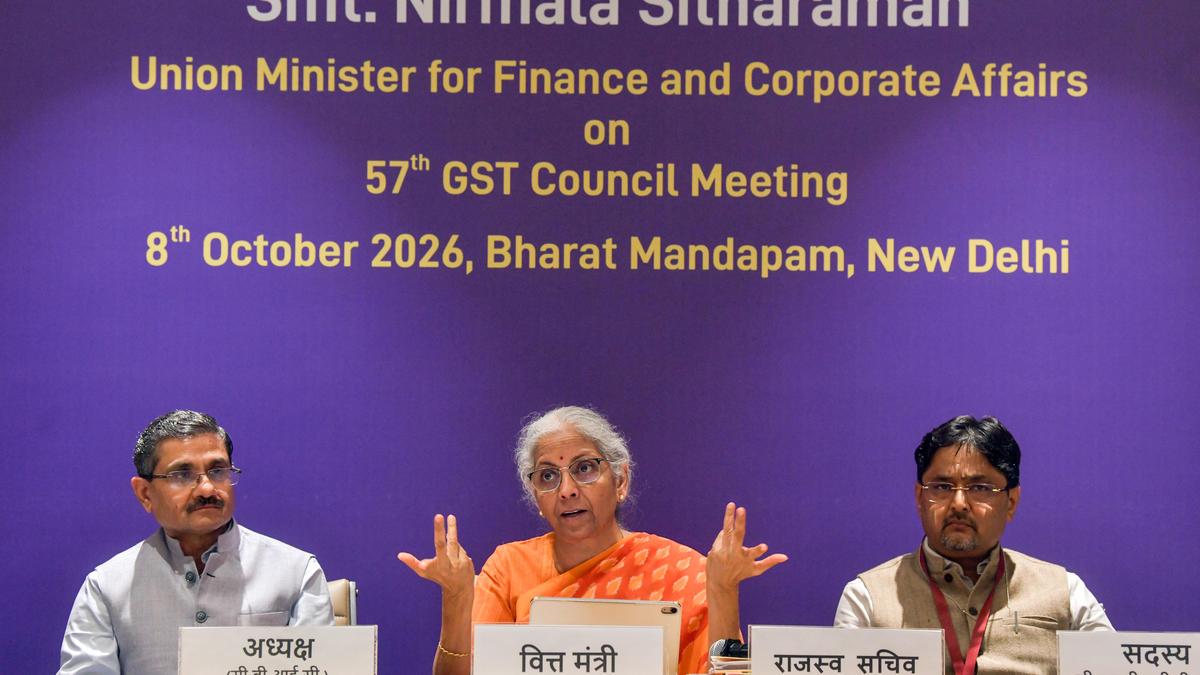
The story so far:The Goods and Services Tax (GST) Council met on Thursday (October 8, 2026) for the 57th time since GST was introduced a little more than nine years ago. In the run-up to the meeting, officials in the Finance Ministry said that GST rates would not be discussed in this meeting, something that was confirmed by Finance Minister Nirmala Sitharaman following the meeting. Nevertheless, the decisions that were taken by the Council stand to significantly alter GST in the medium and long term.
What was the plan for this meeting?
The Centre has realised that, nine years on, the GST system has largely settled down now in terms of revenues. That is, the monthly collections are stable and do not vary by a large degree; the number of return filers has also stabilised, and businesses around the country have become familiar with the GST procedures.
Having implemented wide-ranging GST rate changes in its last meeting in September 2025 that not only rationalised rates across a wide range of products and services but also reduced the number of slabs in GST, the Council could now look at substantial reforms in the administrative and procedural aspects of GST — which so far have remained a big pain point for businesses.
According to sources in the Finance Ministry, the Centre entered the meeting with a five-pronged proposal ranging from process reforms, structural reforms, and ease of living and doing business aspect, to the exports of services, and e-commerce related complications.
Several of these proposals were accepted by the Council while some have been slated for further discussion. However, as per Ms. Sitharaman, all of them will come into force from April 1, 2027 onwards.

How has the Council eased GST-related paperwork?
One of the more far-reaching steps approved by the GST Council is a system that will provide greater certainty about the documents required during registration. As per the government, 61% of taxpayers are already being granted automatic registration within three working days.
Now, the upgraded system is expected to further streamline the process for remaining low-risk taxpayers by doing away with unnecessary queries and rejections as far as possible. That is, the system is moving to a black-list, where most applications are accepted and only a few might get rejected, from the current white-list kind of system where each company has to go through the registration process before it can do business in the GST system.

The new system will also incorporate a simplified registration mechanism for small taxpayers who provide supplies through e-commerce platforms, such that they will have to register in only their home State rather than in each State that they want to sell in. The process for amendments and cancellation of registrations has also been eased.
In what could substantially ease the paperwork process for small businesses, the Centre has shared a concept note with the GST Council and has received its in-principle approval for an optional scheme where business-to-consumer (B2C) firms with a turnover of up to ₹5 crore a year that supply to consumers can file returns one a year instead of quarterly. This will be taken up again in the next GST Council meeting.
Regarding refunds, the new system aims at a faster processing time of acknowledgements of 10 days, down from the current 15 days. The system will also conduct a risk assessment using Customs and banking data and release 90% of the refund claims within three working days of acknowledgement.
At the moment, additional business expenditure or expenditure incurred in the normal course of doing business, including employee health and life insurance, is not eligible for input tax credits. The new system will now make such expenditure eligible.
How does the new system reduce litigation and harassment?
In a major departure from the earlier system, the GST Council has recommended removing the arrest powers of GST officers and has increased the prosecution threshold from ₹1 crore to ₹5 crore. The general penalty will also be reduced from ₹25,000 to ₹10,000.
In addition, it said that only GST officers in originating or destination States can inspect, detain, or seize inter-State supplies. That is, no officer in a State in between the source and destination can interfere with the supply of goods. Further, such interceptions can only be done with the authorisation of a joint commission-level officer and that too only after “specific intelligence” has been obtained about the consignment.
A major issue taxpayers have been facing over the years has been that the system rejects their claim for input tax credits because their suppliers have not filed their returns. So, even though a business receives supplies, has the invoice, and pays the tax on these supplies, it often cannot get a refund until the supplier themselves file their returns. This has been leading to a lot of businesses seeing their working capital being locked up.
The GST Council has instructed its officers’ committee to examine this issue. A decision on this will be taken so that it can be implemented by April 1, 2027.
Finally, the GST has also announced common standards for notices and proceedings, under which no notices will be sent for a tax amount below ₹10,000. All pending notices so far issued that fall below this threshold will be withdrawn, the government said.
What has been done for services?
Service exporters have, in particular, had a problem with the GST system. India’s service export industry usually functions through branches abroad. However, the system currently says that the business done by those branches can’t count as exports. That is what the GST Council has now decided to change. Basically, an Indian company selling its services to a foreign client through an overseas branch can now avail of export benefits under the GST system.
Another issue is that the GST system currently says that something can be classified as an export only if it leaves India. However, there are a number of services offered by Indian companies where the final product does not leave Indian shores. For example, when a car or a phone is sent to India for testing, it is destroyed after that testing is done and not sent back. So far, this was not classified as an export of services.
Now, the GST Council has said that testing, repair, certification, and research done in India for a client abroad will be classified as an export of services even if the goods stay within the country.
There have also been some compliance issues regarding when a payment has been deemed to have been received by an Indian exporter, with different bodies having different rules on the matter. The Council has now decided that the date on which an export payment is deemed to have been received will follow the Reserve Bank of India’s rules.
Overall, these changes will not only eliminate uncertainty but will allow exporters of services to recover the tax paid on the export of their services and also recover this amount faster.
What more remains to be done?
During her press conference, Ms. Sitharaman said that 99% of GST reforms relating to rates as well as processes will have been completed when this latest tranche of changes comes into effect. She said that the Council is open to more reforms, and that those will be taken up as and when needed. However, the overwhelming bulk has been sorted out.
In an indication of the incremental work that remains to be done, the Union Finance Minister announced that the Centre was going to be rolling out a faceless assessment system for Central GST-registered companies along the line of the system that is currently in place for income tax. It will be up to each State to come up with a similar system in their own jurisdictions.
There are also some inverted duty structure issues that remain. Ms. Sitharaman said that rates were not discussed during this GST Council meeting. She added that rates will now be discussed once a year, and that any changes would be applicable from April 1 of the subsequent financial year.