



Skip to content
  • Facebook
  • X
  • Linkedin
  • WhatsApp
  • YouTube
  • Associate Journalism
  • About Us
  • Privacy Policy
  • 033-46046046
  • editor@artifex.news
Artifex.News

Artifex.News

Stay Connected. Stay Informed.

  • Breaking News
  • World
  • Nation
  • Sports
  • Business
  • Science
  • Entertainment
  • Lifestyle
  • Toggle search form
  • Access Denied Sports
  • Access Denied World
  • Access Denied
    Access Denied Nation
  • OPEC forecasts India’s oil demand to accelerate by 0.06 mb/d in 2026
    OPEC forecasts India’s oil demand to accelerate by 0.06 mb/d in 2026 Business
  • Access Denied Sports
  • House returns for vote to end government shutdown after nearly 2 months away
    House returns for vote to end government shutdown after nearly 2 months away World
  • Saudi envoy says leader of Yemen separatist group STC blocked delegation’s landing in Aden
    Saudi envoy says leader of Yemen separatist group STC blocked delegation’s landing in Aden World
  • India pips Sri Lanka, seals women’s u-19 T20 series
    India pips Sri Lanka, seals women’s u-19 T20 series Sports
The Nobel for IceCube and the search for neutrinos from outer space | Explained

The Nobel for IceCube and the search for neutrinos from outer space | Explained

Posted on October 7, 2026 By admin


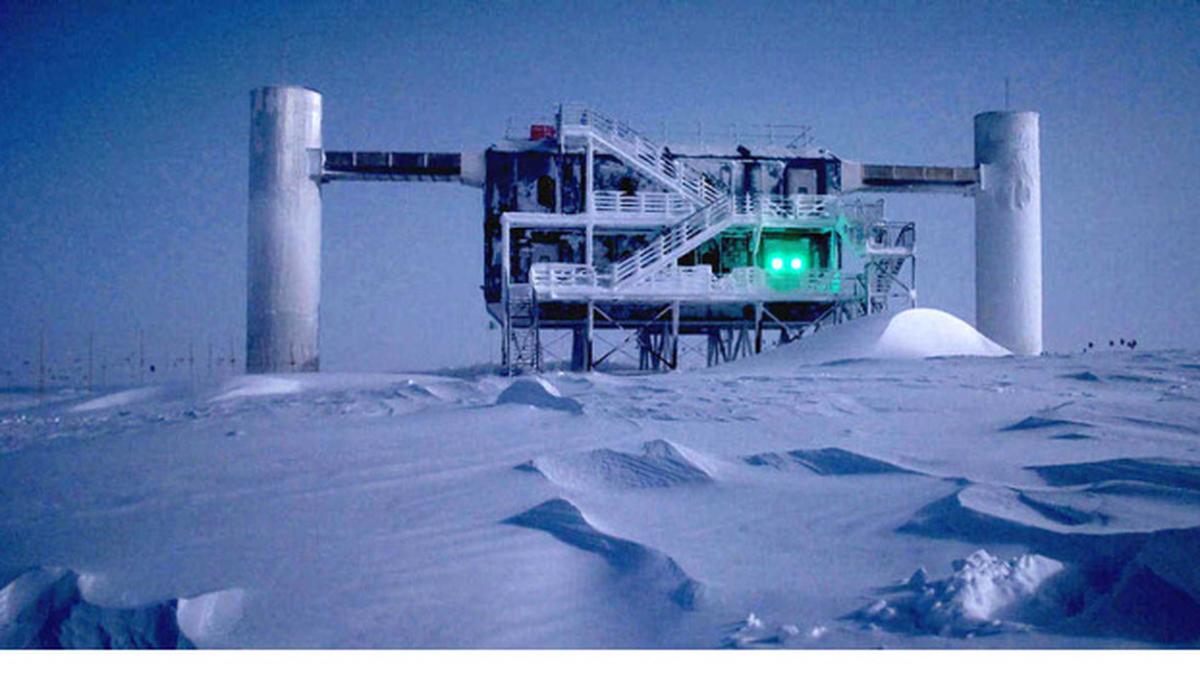
The story so far: Belgian-born U.S. physicist Francis Halzen has won the physics Nobel Prize for 2026 for helping build the IceCube observatory in Antarctica — a telescope that has no mirrors or lenses and doesn’t even point at the stars. Using 5,000 sensors buried deep in the ice, IceCube has explored what natural processes in the cosmos can accelerate subatomic particles to energies far beyond any human technologies have managed so far.

What are neutrinos?

Since the early 20th century, scientists have known that energetic particles called cosmic rays constantly bombard the earth from outer space. Most cosmic rays are protons or the nuclei of elements like helium and iron. Some of these particles have been found to have more energy than the world’s largest particle accelerator — the Large Hadron Collider (LHC) in Europe — can manage.

Scientists thought powerful events like exploding stars or jets of energy emitted by distant galaxies could have given these particles a Herculean push, but they couldn’t know for sure. Just looking in the direction a cosmic ray came from didn’t help. Since cosmic rays are charged particles, they could have been deflected by magnetic fields in space before reaching the earth.

So scientists turned to neutrinos. These subatomic particles have no electric charge, a very small mass, and interact very rarely with matter. Nuclear reactions, like fusion in the sun’s belly, produce neutrinos in copious numbers, and trillions of them pass through your body — and through the earth — every second without leaving any trace. And they travel in a straight line through space.

How do you catch a neutrino?

Halzen and others came up with the idea of IceCube to ‘catch’ and study neutrinos with very high energy. When a cosmic-ray proton strikes other atoms, it can produce particles called pions, which rapidly decay through reactions that could produce neutrinos. And these high-energy neutrinos are an indication that some high-energy event produced them.

But neutrinos’ reluctance to interact with matter also makes them extremely hard to catch. This is why the IceCube observatory is in Antarctica: the enormous volume of frozen water ice is the catcher, and the 5,000 sensors embedded in the ice look for the occasional evidence of a neutrino striking the ice.

This idea actually predated Halzen’s insight, going back to the 1960s. Scientists, including John Learned, once tried to build a detector in the Pacific Ocean but maintaining the facility’s instruments underwater proved too difficult. In 1987, after being alerted to a Soviet Union plan to study neutrinos in Antarctic ice, Halzen, Thomas Stanev, and Enrique Zas concluded the approach would be unsuitable for the energies they were interested in.

Instead, Halzen wondered if it’d be possible to track neutrinos colliding with ice by looking for small flashes of light their collisions might produce. After discussing the idea with Learned, the two physicists proposed using South Pole ice as a neutrino catcher, with Halzen going on to organise the effort, funded primarily by the U.S. National Science Foundation, that eventually became IceCube.

One of the sensors the IceCube detector array uses to spot signs of neutrinos in the ice.

One of the sensors the IceCube detector array uses to spot signs of neutrinos in the ice.
| Photo Credit:
Amble (CC BY-SA)

According to the Nobel committee, Halzen has been feted for proposing the idea as well as keeping hundreds of scientists and engineers working on it for decades. In this sense, the physics prize this year is reminiscent of the same prize for Barry Barish in 2017, who coordinated the complex effort to set up the LIGO gravitational-wave detectors.

How does IceCube work?

After unsurprising delays and setbacks attending to an enterprise of this magnitude, IceCube took its full shape in 2011 following seven years of construction. In particular, crews of experts dug holes in the ice to place the sensors not using shovels but by shooting jets of hot water, then lowering sensors suspended on cables fast enough before the ice froze again.

Today, IceCube includes 5,160 optical sensors on 86 cables, lying 1.4 km to 2.4 km under the ice, altogether encompassing roughly a cubic kilometre of ice. Each sensor has a device that converts the faint light from a collision into an electric signal and records it. The collective data flows to computers on the surface and thereon to researchers around the world.

A schematic illustration showing the arrangement of the laboratory and the sensors. The Eiffel Tower is depicted in the bottom right corner for a size comparison.

A schematic illustration showing the arrangement of the laboratory and the sensors. The Eiffel Tower is depicted in the bottom right corner for a size comparison.
| Photo Credit:
Karen Andeen and Matthias Plum/IceCube Collaboration

When an energetic neutrino strikes an atom’s nucleus inside the ice, the event creates charged particles that streak through the surrounding ice. Some of them even move faster than light can in that material. Just as doing this with sound creates shockwaves, outrunning light causes the particles to emit Cherenkov radiation, visible as a dull blue glow. The sensors look for and record this emission.

Different kinds of neutrino interactions produce different kinds of particles that outrun light. Taking this together with which sensors recorded the glow and in what order, IceCube researchers can piece together the neutrino’s energy and direction. Of the lakh or so neutrinos IceCube registers every year above an energy cutoff, only around a hundred come from astrophysical sources in outer space.

What has IceCube found?

In 2013, scientists identified two neutrinos with around 140-times the energy of a proton accelerated by the LHC. With more data and analysis, the collaboration established that a population of high-energy neutrinos was coming to our planet from elsewhere in the universe — and that IceCube could spot them. It was a landmark event in a new field called neutrino astronomy.

In 2017, IceCube found an energetic neutrino coming from a distant galaxy, whose central black hole was also powering a jet of radiation pointed roughly at the earth. In 2022, the instrument found more neutrinos than expected coming from NGC 1068, a galaxy 46 million lightyears away, also with an active central black hole.

The observatory has also been a centerpiece of multi-messenger astronomy, in which astronomers study the universe using a combination of messengers — e.g. light particles (e.g. visible light, gamma rays, etc.), neutrinos, and gravitational waves — to acquire a picture more complete than only one of these modes could reveal.

IceCube’s own work remains unfinished as scientists are still working on the sources of the universe’s most energetic neutrinos and how neutrino-catching events can be correlated with, say, observations in gamma rays. IceCube has won Halzen his prize, then, for opening a window into parts of the universe that were until recently beyond our reach and for showing that an international scientific collaboration can achieve more than the sum of its parts.

mukunth.v@thehindu.co.in

Published – October 07, 2026 07:00 am IST


Source link

Science

Post navigation

Previous Post: ECI says Opposition MPs’ Parliament Annexe meet demand ‘could not be accepted’
Next Post: Iran must cut enrichment to end war, U.S. Vice-President Vance says

Related Posts

  • Sci five | The Hindu Science Quiz: on bones
    Sci five | The Hindu Science Quiz: on bones Science
  • First conclusive evidence that a terrestrial leech species can jump
    First conclusive evidence that a terrestrial leech species can jump Science
  • Acclaimed primatologist Frans de Waal dies at 75
    Acclaimed primatologist Frans de Waal dies at 75 Science
  • SpaceX loses contact with Starlink satellite after mishap
    SpaceX loses contact with Starlink satellite after mishap Science
  • Science This Week | India becomes the first country to land on Moon’s south pole and more
    Science This Week | India becomes the first country to land on Moon’s south pole and more Science
  • Alcohol is one of the most dangerous drugs, yet its presence is ubiquitous in social settings and celebrations
    Alcohol is one of the most dangerous drugs, yet its presence is ubiquitous in social settings and celebrations Science

More Related Articles

ISRO identifies site for Chandrayaan-4 lander ISRO identifies site for Chandrayaan-4 lander Science
Aditya-L1 in a global effort reveals why the 2024 solar storm behaved unusually Aditya-L1 in a global effort reveals why the 2024 solar storm behaved unusually Science
Sweltering public hospitals turn into ‘death traps’ for poor communities Sweltering public hospitals turn into ‘death traps’ for poor communities Science
Daily Quiz | On Mars Orbiter mission Daily Quiz | On Mars Orbiter mission Science
Malaysia imposes anti-dumping duties on plastic imports from China, Indonesia  Malaysia imposes anti-dumping duties on plastic imports from China, Indonesia  Science
Qdenga: a vaccine for dengue but not a silver bullet Qdenga: a vaccine for dengue but not a silver bullet Science
SiteLock

Archives

  • October 2026
  • September 2026
  • August 2026
  • July 2026
  • June 2026
  • May 2026
  • April 2026
  • March 2026
  • February 2026
  • January 2026
  • December 2025
  • November 2025
  • October 2025
  • September 2025
  • August 2025
  • July 2025
  • June 2025
  • May 2025
  • April 2025
  • March 2025
  • February 2025
  • January 2025
  • December 2024
  • November 2024
  • October 2024
  • September 2024
  • August 2024
  • July 2024
  • June 2024
  • May 2024
  • April 2024
  • March 2024
  • February 2024
  • January 2024
  • December 2023
  • November 2023
  • October 2023
  • September 2023
  • August 2023
  • July 2023
  • June 2023
  • May 2023
  • April 2023
  • March 2023
  • February 2023
  • January 2023
  • December 2022
  • November 2022
  • October 2022
  • September 2022
  • August 2022
  • July 2022
  • June 2022
  • May 2022

Categories

  • Business
  • Nation
  • Science
  • Sports
  • World

Recent Posts

  • Iran must cut enrichment to end war, U.S. Vice-President Vance says
  • The Nobel for IceCube and the search for neutrinos from outer space | Explained
  • ECI says Opposition MPs’ Parliament Annexe meet demand ‘could not be accepted’
  • CEC Gyanesh Kumar’s Chhattisgarh visit postponed
  • Rahul’s protest a political drama, claims made by Congress are lies: BJP

Recent Comments

  1. GeraldZerne on UP Teacher Who Asked Students To Slap Muslim Classmate
  2. Larrymix on UP Teacher Who Asked Students To Slap Muslim Classmate
  3. Larrymix on UP Teacher Who Asked Students To Slap Muslim Classmate
  4. Larrymix on UP Teacher Who Asked Students To Slap Muslim Classmate
  5. MelvinLit on UP Teacher Who Asked Students To Slap Muslim Classmate
  • Access Denied
    Access Denied Nation
  • Virat Kohli Embarrasses On Ranji Trophy Return, Clean Bowled For 6 Runs. Watch
    Virat Kohli Embarrasses On Ranji Trophy Return, Clean Bowled For 6 Runs. Watch Sports
  • “Lakha From Lagaan”: Horrible Fielding Drives Internet Crazy. Watch
    “Lakha From Lagaan”: Horrible Fielding Drives Internet Crazy. Watch Sports
  • Monsoon tracker July 5 LIVE: Mumbai wakes up to brief respite after heavy rain; IMD issues red alert for more showers
    Monsoon tracker July 5 LIVE: Mumbai wakes up to brief respite after heavy rain; IMD issues red alert for more showers Nation
  • LPG shortage hits Chennai Metro Rail’s phase II construction work
    LPG shortage hits Chennai Metro Rail’s phase II construction work Nation
  • Carlos Sainz Gives Ferrari Italian GP Hope After Pipping Max Verstappen To Pole
    Carlos Sainz Gives Ferrari Italian GP Hope After Pipping Max Verstappen To Pole Sports
  • Access Denied
    Access Denied Business
  • Access Denied Sports

Editor-in-Chief:
Mohammad Ariff,
MSW, MAJMC, BSW, DTL, CTS, CNM, CCR, CAL, RSL, ASOC.
editor@artifex.news

Associate Editors:
1. Zenellis R. Tuba,
zenelis@artifex.news
2. Haris Daniyel
daniyel@artifex.news

Photograher:
Rohan Das
rohan@artifex.news

Artifex.News offers Online Paid Internships to college students from India and Abroad. Interns will get a PRESS CARD and other online offers.
Send your CV (Subjectline: Paid Internship) to internship@artifex.news

Links:
Associate Journalism
About Us
Privacy Policy

News Links:
Breaking News
World
Nation
Sports
Business
Entertainment
Lifestyle

Registered Office:
72/A, Elliot Road, Kolkata - 700016
Tel: 033-22277777, 033-22172217
Email: office@artifex.news

Editorial Office / News Desk:
No. 13, Mezzanine Floor, Esplanade Metro Rail Station,
12 J. L. Nehru Road, Kolkata - 700069.
(Entry from Gate No. 5)
Tel: 033-46011099, 033-46046046
Email: editor@artifex.news

Copyright © 2023 Artifex.News Newsportal designed by Artifex Infotech.