

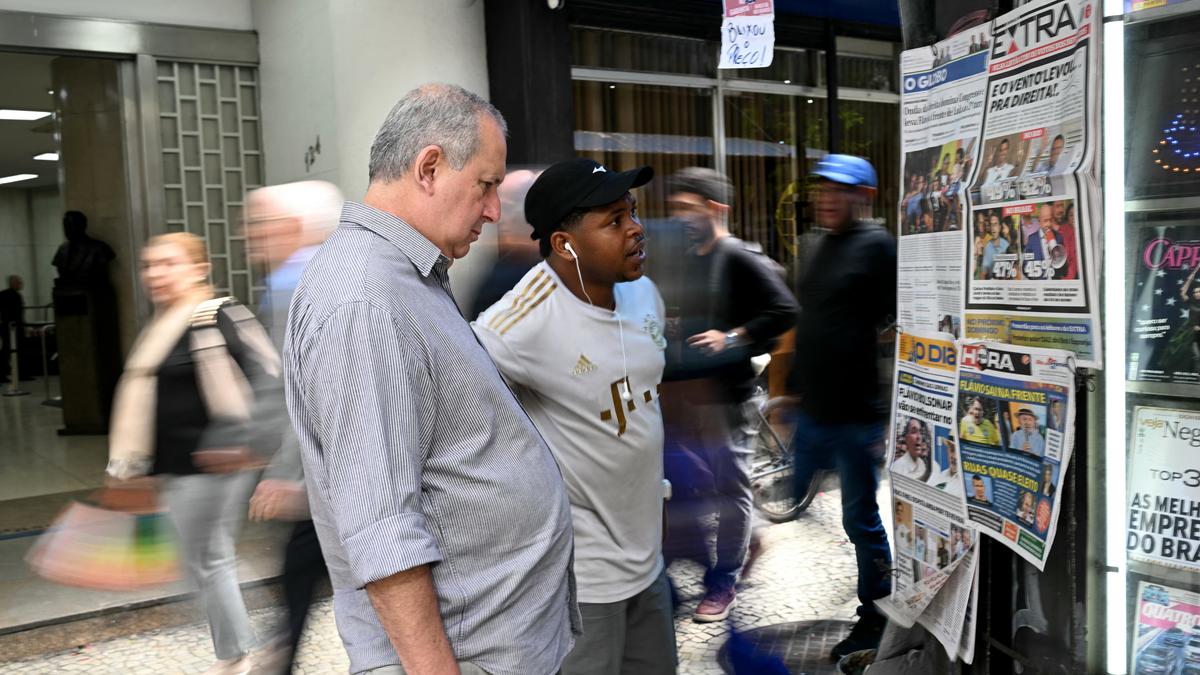
Men look at newspapers displaying coverage of Brazil’s presidential election results at a newsstand in Rio de Janeiro, Brazil, on October 5, 2026.
| Photo Credit: AFP
Sunday night was supposed to be historic for Luiz Inácio Lula da Silva, who was seeking a record fourth term as Brazil’s president. But when the results came in, the night looked gloomy. Instead of winning in the first round, as his supporters had expected, Lula trailed his challenger Flávio Bolsonaro by about 1.8 percentage points, or 2.2 million votes. With Flávio also falling short of the 50% needed for an outright victory, the election now moves to a second round on October 25 — leaving Lula’s campaign facing a tougher contest than anticipated, while Bolsonaro heads into the runoff with the momentum of having finished first.
The two candidates struck sharply different notes as the results became clear. Flávio, the eldest son of former president Jair Bolsonaro, declared that Brazilians were demanding change. “It is the end of the era of the Workers Party (PT); it is a big change in our country,” he told reporters in Brasília. Lula, speaking to supporters in São Paulo, acknowledged that the result had been unexpected. “I confess to you that I was convinced I would win the election in the first round,” he said. But Lula insisted that the contest had now entered a new phase. “The second round is a new campaign,” he said, arguing that the runoff would give voters a direct choice between the two candidates and their visions.

Political pundits agree that the second round is a new election and can go either way. But there is little doubt that, for now, the momentum is with the right. As if Flávio staying ahead of Lula in the presidential election was not shocking enough for Brazil’s left, the results for Congress, the Senate and state governors came as a big jolt too. Candidates from the Bolsonaros’ Liberal Party (PL) broke voting records in the Congress, while the party emerged as the dominant force in the Senate and made significant gains in state assemblies. Flávio’s supporters also account for a majority of the governors elected in the first round, pointing to a broad rightward shift that extends beyond the presidential race.
But the most significant feature of the rightward shift may be that the PL has not grown at the expense of Lula’s party. The far-right party has expanded its base by eating into the traditional conservative and centre-right political space. With 19 senators elected, the PL will increase its representation from 15 to 28 seats from February 2027, giving it the second-largest single-party bloc in the Senate since Brazil’s return to democracy.
While the left has maintained its position in the Chamber and Senate, the far right has grown by devouring much of the right — a trend also seen in other Latin American countries.
Another factor behind Flávio’s strong performance was the evangelical vote, which has increasingly consolidated behind the Bolsonaro family, while Lula failed to translate Brazil’s large Catholic population into the electoral advantage his campaign had expected. The contrast was particularly striking after the controversy surrounding Nossa Senhora Aparecida, Brazil’s patron saint, which became a political issue during the campaign. In municipalities with an above-average concentration of evangelicals, Flávio won 52% of the valid votes. The contrast was even sharper in municipalities with the highest concentration of Catholics. Lula’s share there fell by 11 percentage points compared with his previous performance.
Now, the second round will force both campaigns to broaden their appeal beyond their core constituencies. Flávio’s is expected to make anti-PT sentiment the central theme of its strategy, with his team hoping to attract the supporters of other right-wing candidates who failed to move to the second round. Flávio will also seek to reach the roughly 40 million Brazilians who either abstained or cast blank or invalid ballots. His campaign has already secured political support in five states where gubernatorial races will go to a second round, compared with four for Lula, giving the Bolsonaro camp an additional network of state-level allies in the runoff. Lula, too, has identified abstention as one of his biggest targets for the second round. More than 33 million Brazilians did not vote in the first round, the highest abstention rate since 1998. “We are going to appeal to the people who did not vote,” Lula said, calling on them to return to the polls because their “vote would be crucial in deciding the country’s future”.
For Lula, the challenge now is to prevent the election from becoming a referendum on the PT while rebuilding the broader coalition that carried him back to the presidency in 2022. But there are murmurs of some criticism of his campaign within the president’s party. Some reports on Monday suggested that in his seventh presidential campaign, Lula was surrounded by people who, according to former PT campaign insiders who had worked with him in previous elections, were reluctant to challenge him or tell him what he did not want to hear. If the account is accurate, the problem with the campaign was not a lack of experience at the top, but the absence of people around Lula who were willing to tell the veteran of seven elections when his strategy was no longer working.
That assessment may be a little harsh for a politician who has built his career on being seen as a man of the people and on his ability to understand the pulse of the country. “I know how to speak to the poor, I know how to speak to ordinary Brazilians,” Lula had said a day before the first round of elections. As the Sunday’s result puts his instinct to its biggest test, Lula will now have to draw on all his experience to reconnect with voters beyond his traditional base. The Brazilian president will also need to deploy all his political expertise to win the contest that could determine not only his presidency but also his political legacy.
Published – October 05, 2026 09:49 pm IST