
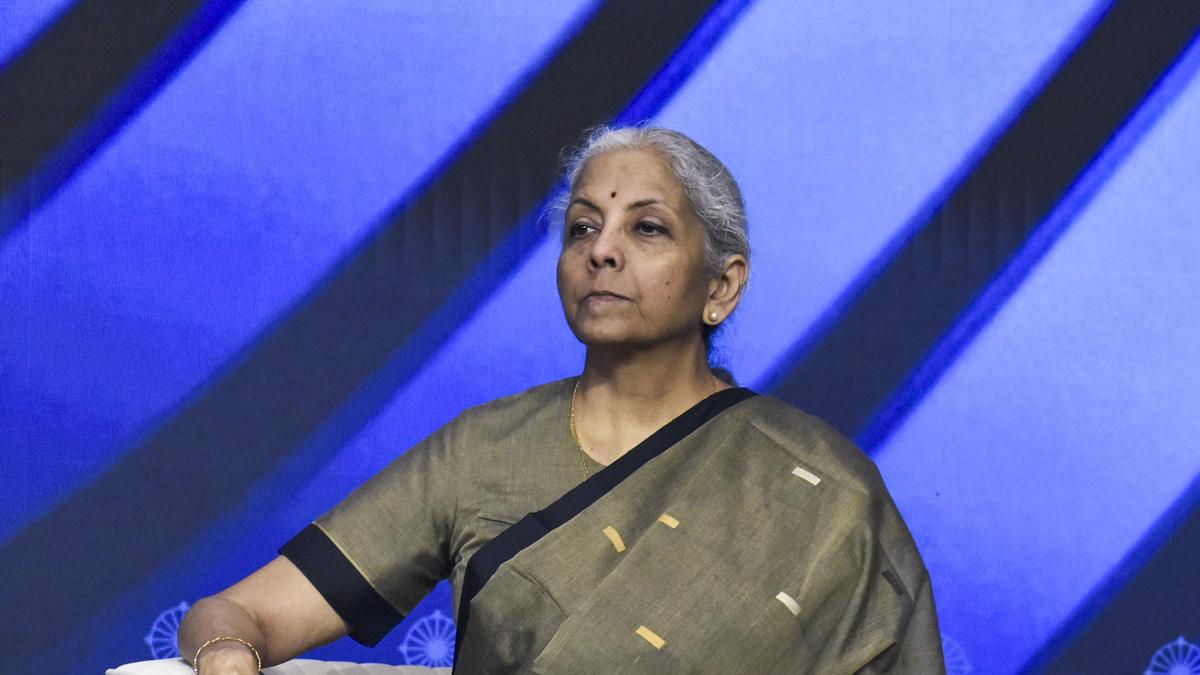
File photo of Union Finance Minister Nirmala Sitharaman.
| Photo Credit: PTI
The India-U.S. trade deal has reached a “plateau” in negotiations where it will now be “very difficult” to add to the list of demands and concessions that have been agreed to, Finance Minister Nirmala Sitharaman said on Monday (October 5, 2026).
Speaking at the Munich Security Conference, Ms. Sitharaman said that the topic of India’s imports of Russian oil did not feature as a condition during the negotiations on the Free Trade Agreement with the European Union, which is set to be signed in December this year.

“One thing about the U.S. agreement, which is yet to get finalised, it has been a hard and very rigorously negotiated agreement,” the Finance Minister said. “The negotiations are still ongoing but we would like to believe that both sides have reached a plateau beyond which giving or taking might be very difficult.”
Weaponisation of tariffs
She added that a predominant feature of the India-U.S. trade relationship is that India has a substantial trade surplus with the U.S., something the U.S. is looking to address. However, she also highlighted the change in the way that this imbalance is being addressed.
“The trade imbalance with China for India, for instance, since 2014 has been growing exponentially,” Ms. Sitharaman said. “So, when you are talking about trade imbalance being the sole criteria, to what extent beyond negotiation can you go? Negotiation used to be the only platform through which countries could highlight the discrepancies and lopsidedness.”

“Now, the imbalance is being sought to be addressed through other means,” she added. “Tariffs have become weaponised. So I can probably take the same position, can I not, with China because the trade with it is so lopsided. But no, you can’t. You will have to talk it out. You will have to negotiate and have a give-and-take.”
Strategic message of India-EU deal
Regarding the India-EU FTA, Ms. Sitharaman said that Europe does not at the moment have any legislation like the Lindsey O. Graham Sanctioning Russia and Iran Act of 2026 in the U.S., which provides for a tariff of up to 100% on countries that are the major recipients of Russia’s oil and gas exports.
A lot of things get discussed, formally and informally,” she said. “In Europe, as far as I understand it, there is no equivalent of a Lindsey Graham Bill. A lot of conversations happen but I don’t think there was a card on the table saying this [India’s Russian oil purchases] was going to determine what we do next in the negotiation.”

Also speaking at the event, Benjamin Haddad, the Minister Delegate for Europe of France said that the India-EU FTA is also sending a strong political and strategic message to the world that the two economies are loyal, predictable, and reliable partners.
“And in this moment where trade relations are being weaponised, we are showing that we are actually promoting a world of cooperation and multilateralism,” Mr. Haddad said.
“When you are in an environment where there are tariffs being imposed by allies, in this case the U.S., but also subsidised capacities coming from China that are destabilising our markets in Europe, then of course having this trade deal being signed and showing we are diversifying and derisking, and promoting cooperation and integration of our economies and aligning on norms and standards, is sending a very strong message,” he added.
Published – October 05, 2026 06:10 pm IST