





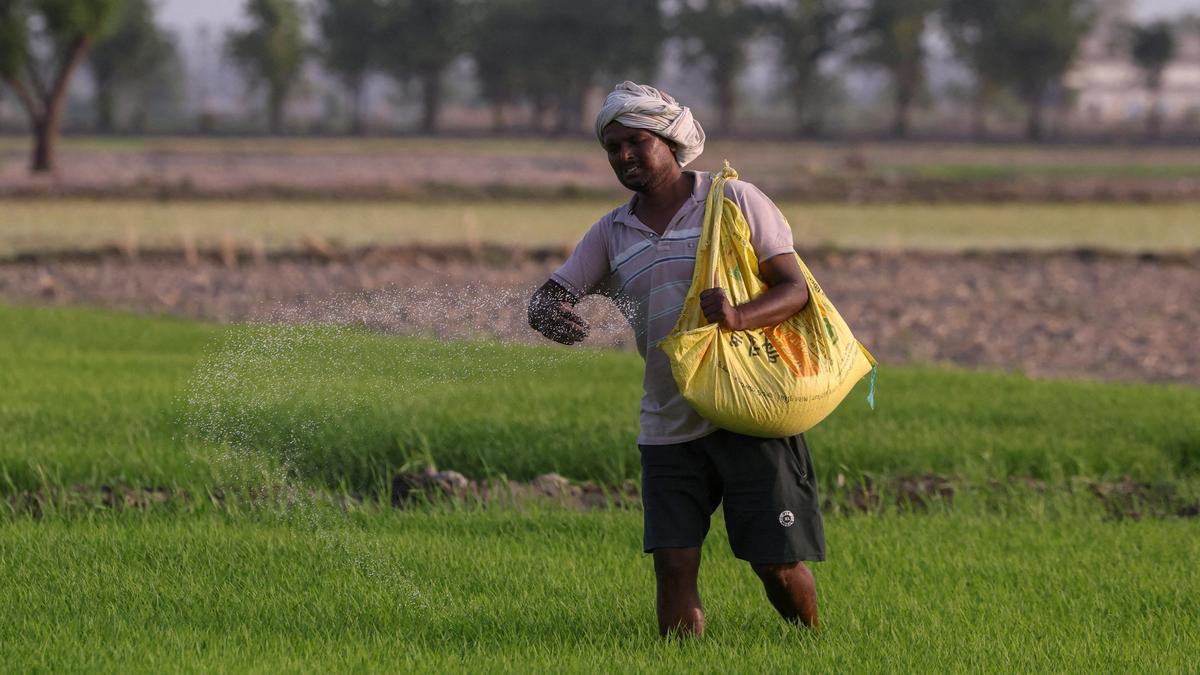
A farmer spreads fertiliser on a paddy field in Karnal, northern state of Haryana, India
| Photo Credit: Reuters
An increase in subsidy spending, particularly on fertilisers, has led to the Centre’s fiscal deficit reaching 41.9% of its budgeted target for 2026-27 as of August 2026, compared to 38.1% at this point last year.
Data released by the Controller General of Accounts on Wednesday shows that the Centre’s total revenue stood at ₹13.7 lakh crore in the April to August 2026 period of this financial year, while its total expenditure stood at ₹20.8 lakh crore during the same period.
Total receipts were largely in line with the trend of last year, making up 37.5% of the budget estimates for the year as of August 2026 as compared to 36.7% in the same period of last year.

Total expenditure, however, stood at 38.9% of the budget estimates as of August 2026, as compared to 37.1% in the same period of 2025-26. Within this, revenue expenditure stood at 38% of the full year’s target compared to 36.7% at this point last year.
“This is up mainly due to higher allocations for fertilisers, petroleum, and food distribution, which is the subsidy component,” Madan Sabnavis, chief economist at the Bank of Baroda said. “In the case of fertilisers, it was 60% of the total budget relative to 50% last year.”
However, capital expenditure also grew faster this year than last year. As of August 2026, total capital expenditure stood at 41.7% of the budgeted target of ₹12.2 lakh crore for the year. It had been 38.5% at this point last year.

“Given that the economy is expected to grow by a little over 7% in real terms and above 11% in nominal terms, the fiscal deficit ratio should largely be contained in the region of 4.5-4.6% this year assuming some slippage in non-tax revenue due to the OMCs not generating profit,” Mr. Sabnavis said.
Published – September 30, 2026 08:35 pm IST