
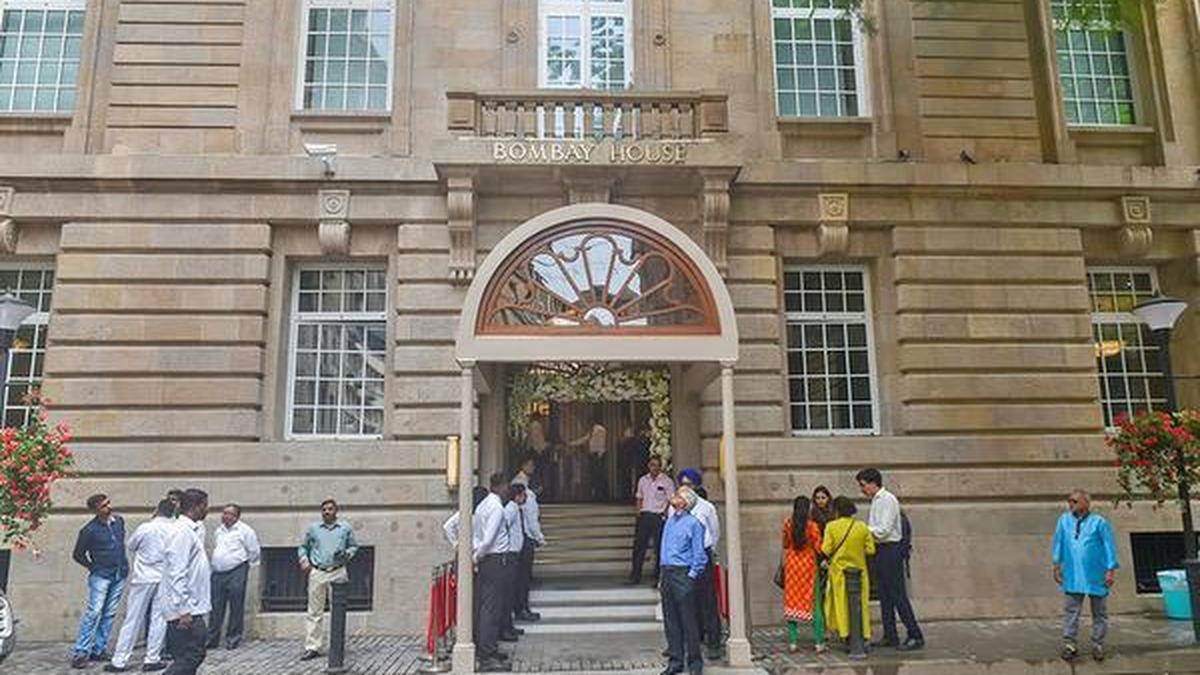
Bombay House, the headquarters of the Tata Group.
| Photo Credit: PTI
On September 17, 2026, the board of Tata Sons voted on a third five-year term for N. Chandrasekaran as Executive Chairman. Mr. Chandrasekaran abstained from voting voluntarily and the recorded result was four to one. Within hours the Tata Trusts, owners of about 66% of Tata Sons, called the decision legally void. The claim rests on how several provisions of the Articles of Association, the company’s rulebook, fit together.
With a 66% share, the Trusts could have packed the board. Instead, under Article 104B, the Sir Dorabji Tata Trust and the Sir Ratan Tata Trust act jointly and nominate one-third of the directors. So now, on a board of six, two seats are held by Noel Tata and Venu Srinivasan.
Article 121 gives these seats their weight; any matter the board decides by majority requires the affirmative vote of a majority of these nominated directors. If the votes are equal, the chairman has a casting vote.
The chairmanship is built in steps. A person must first be a director. A new Chairman of the Board is appointed under Article 118, subject to the voting requirement in Article 121 (whether it also governs a reappointment is disputed). Only a Chairman may be made Executive Chairman under Article 105(b).
On September 17, 2026, the nominees split — Mr. Srinivasan for and Mr. Tata against. Harish Manwani, an independent director chairing the item in Mr. Chandrasekaran’s place, reportedly used a casting vote in favour.

In the Cyrus Mistry litigation in 2019, the National Company Law Appellate Tribunal (NCLAT) called the nominees’ affirmative vote indispensable, which the top court later upheld in 2021. Neither court had to decide whether a casting vote can cure a split between the two nominees.
Where the readings part
Tata Sons relies on two legal opinions. Senior advocate Sudipto Sarkar has advised that a casting vote can break a tie between the nominees as well as a board tie — that whoever presides may use it because Article 121 says Chairman, and not Chairman of the Board. Justice B.N. Srikrishna, a former Supreme Court judge, agrees and advised that since no majority could be found between the nominees, the casting vote ended the deadlock. However, the Trusts referred to a contrary opinion held by former Chief Justice D.Y. Chandrachud.
The company’s reading has a textual footing: the words about equal votes do not say whose votes are meant. But Article 121 has two parts and they must be read together. The first sets a condition: a majority of the Trusts’ nominees must support the decision. The second breaks a tie when the board is evenly split. The board as a whole was not evenly divided; the only split was between the two nominees. With two nominees, a majority means both. When Justice Srikrishna says no majority could be found, it means that the condition was not met. The company’s reading uses the tie-break to make up for it. The Trusts’ reading gives each part its own role. If both nominees support a decision and the other four directors divide evenly, the board is tied three all, and the casting vote settles it.
Other parts of the rulebook support this reading. Articles 104B, 86 and 118 resolve any difference between the two Trusts by a majority of their trustees, never by the chair of a board meeting.
Defending these rules against Mr. Mistry in 2019, Tata Sons itself argued that where the Articles require the support of particular directors, a decision passes only if those directors agree. Here, those are the two Trust nominees. Mr. Manwani is an independent director; on the Trusts’ reading, his casting vote cannot stand in for their agreement. The minutes of the meeting Mr. Tata has produced record the February 2022 extension of Mr. Chandrasekaran’s tenure as made under Article 118, and Article 118 is itself subject to Article 121.
The advisers argue, with some force, that no selection committee was needed for a reappointment, and that Mr. Chandrasekaran’s August letter (wherein he detailed he did not wish to hold the post) did not bind him. Neither point changes Article 121’s arithmetic: with both nominees present, the required majority was two.
Only a director can be chairman, so directorship matters. The August general meeting was adjourned for want of a quorum before shareholders could consider Mr. Chandrasekaran’s reappointment.

The Trusts are weighing legal proceedings. A mutual settlement is preferred to a lengthy litigation, which could spiral into uncertainty about the group’s leadership.
Prasanth Raju is an advocate practising in the Bombay High Court. Views are personal
Published – September 24, 2026 01:17 am IST