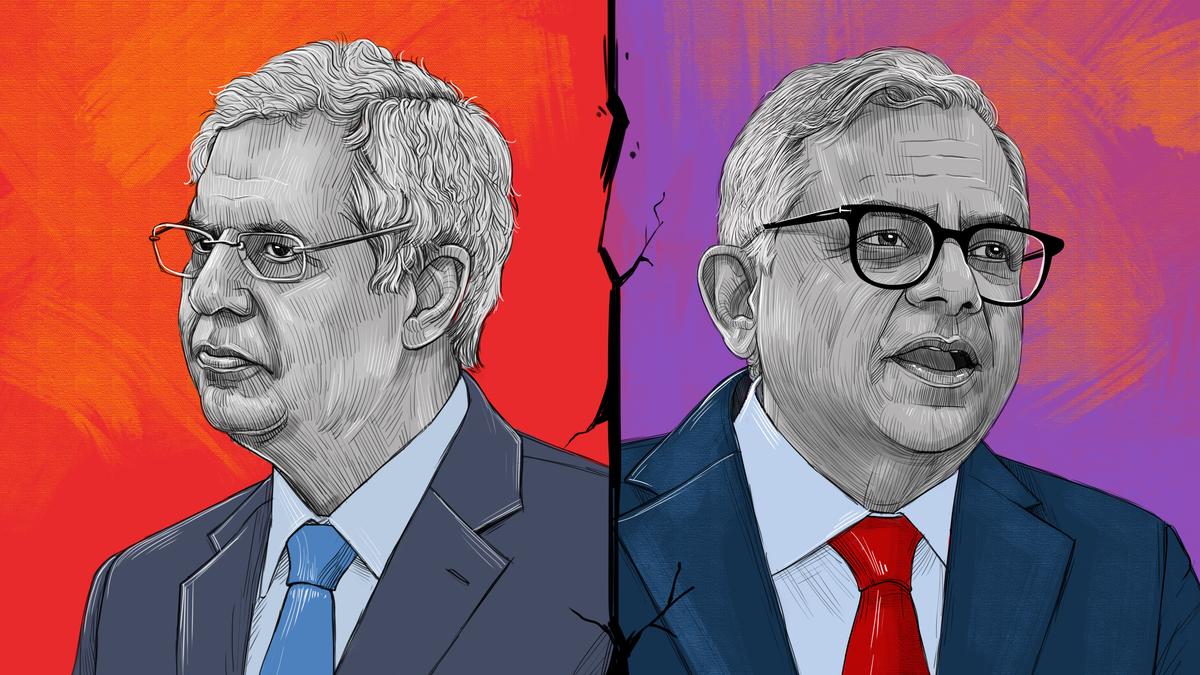
Tata Sons Pvt. Ltd., the principal investment holding company and promoter of Tata Group companies, was established in December 1917 as a trading firm to manage the profits of its operating businesses. Headquartered at Bombay House in South Mumbai, Tata Sons earns its income from dividends paid by its operating companies. It is governed by a board comprising executive chairman N. Chandrasekaran; Tata Trusts’ nominee directors Venu Srinivasan and Noel Naval Tata; independent directors Harish Manwani and Anita M. George; and executive director and chief financial officer (CFO) Saurabh Agarwal.
Today, Tata Sons, the group’s promoter company, faces questions over leadership, ownership and regularly issues amid growing differences over who should serve as its executive chairman and whether the company should be listed.
Tata Trusts, the philanthropic trusts established by contributions from members of the Tata family, own 66% of the equity capital of Tata Sons. Noel Naval Tata, as chairman, heads the Tata Trusts. Through dividend income from Tata Sons, the Tata Trusts support education, health, livelihood generation, scientific research and art and culture across the country.
Until 2017, the company was known as Tata Sons Ltd., a public company. It was made private that year and renamed Tata Sons Pvt. Ltd. Some of the large group companies in which Tata Sons has investments include Tata Consultancy Services (TCS), Tata Steel, Tata Motors, Tata Motors Passenger Vehicles, Tata Chemicals, Tata Elxsi, Titan, Trent, Tata Power, Tata Capital and Tata Consumer Products. It has several unlisted companies as well, including Tata Projects, Tata Advanced Systems, Tata Digital and Air India. In recent years, it has invested in new businesses such as semiconductors, electronics manufacturing, batteries, aviation, digital commerce, telecom equipment and defence manufacturing.

Each Tata company or enterprise operates independently under its own board of directors. An unusual business entity, Tata Sons is majority-owned by philanthropic trusts, manages independently run companies and is privately held. This distinctive structure has defined the Tata group for more than a century.
Tata Sons was established during the chairmanship of Sir Dorabji Tata, the elder son of Tata Group founder Jamsetji Tata, who served as chairman from 1904 to 1932. The other chairmen of Tata Sons included Sir Nowroji Saklatvala, J.R.D. Tata, Ratan Naval Tata, Cyrus Mistry and, currently, Natarajan Chandrasekaran.
Besides Tata Trusts, the other shareholders of Tata Sons include the Shapoorji Pallonji Group (SP Group), with an 18% holding; Tata Group companies, with about 13%; and individuals, mostly Tata family members, who hold about 3%. For FY2026, Tata Sons reported a standalone profit of ₹31,961 crore, up 22% from the previous year, while revenue increased 9.1% to ₹42,367 crore. Consolidated revenue reached ₹16.24 lakh crore, and profit rose 52% to ₹1.71 lakh crore.

Multiple challenges
While Tata Trusts, the majority shareholders, have opposed and disputed the September 17 re-appointment of executive chairman for a third term starting in February 2027, the company’s board has ratified the decision. The move has brought the board into confrontation with the majority stakeholder, led by Tata Trusts Chairman Noel Tata, raising questions over who ultimately governs Tata Sons.
There was another development that heightened the tensions within the group. In a major regulatory development, the Reserve Bank of India, on September 11, 2026, rejected Tata Sons’ application, made on March 28, 2024, for voluntary surrender of its Certificate of Registration to be classified as an unregistered Core Investment Company (CIC).
The RBI, after keeping the application under examination for nearly two and a half years, directed Tata Sons to comply with the regulations applicable to upper-layer non-banking finance companies (NBFCs), a move that has been interpreted as mandatory stock exchange listing. Under RBI rules, NBFCs in the upper layer are subject to enhanced requirements, including mandatory listing within the prescribed regulatory framework.
While the company’s board, by a majority vote, has approved a resolution to comply with the RBI’s directive, its majority owner, Tata Trusts, does not want the company to be listed. The Trusts argue that keeping Tata Sons privately held is integral to the ownership model through which dividends support philanthropy.
With these two major developments, the conflict between the Tata Sons board and Tata Trusts has become public. Both sides are preparing for a bitter legal battle, which could be a replay of what happened a decade ago.
Ten years ago, the Tata Trusts had to assert their authority to oust then Tata Sons executive chairman, Cyrus Mistry, in a boardroom battle. In October 2016, Ratan Tata, who had retired as Tata Sons chairman in 2012, returned as its interim chairman and fought a bitter battle with Cyrus Mistry and the Shapoorji Pallonji Group (SP Group).
Mr. Chandrasekaran, then TCS managing director and chief executive, was appointed executive chairman of Tata Sons in February 2017.
Until his death in October 2024, Ratan Tata retained considerable influence over the affairs of Tata Sons. Ratan Tata first became chairman of Tata Sons in 1991 and continued until 2012. He also headed Tata Trusts, leaving little scope for a conflict between the company and its shareholders.
Increasing differences
Differences have surfaced since Noel Tata, the half-brother of Ratan Tata, took over as Tata Trusts chairman in October 2024. Over the past few months, the differences have become increasingly visible. The matter has been complicated further by the SP Group’s support for a listing, as it seeks to monetise its stake to meet its financial obligations.
The Tata Trusts have offered the SP Group an opportunity to dilute its stake, valued at about ₹25,000 crore, in 18 months to avoid a listing. But in a recent statement, SP Group chairman Shapoorji Pallonji Mistry, who is Noel Tata’s brother-in-law, welcomed the RBI’s decision and backed the listing of Tata Sons.
Tata Sons is today a combination of an investment holding company, a capital allocator, a promoter of dozens of businesses and a bridge between a large commercial conglomerate and its philanthropic owners. As battle lines are drawn between the Tata Sons board and its majority shareholder, the coming months will determine whether the board or its majority owner prevails. More fundamentally, the tussle raises a question about the future of Tata’s distinctive ownership model and whether it can survive in its present form.