


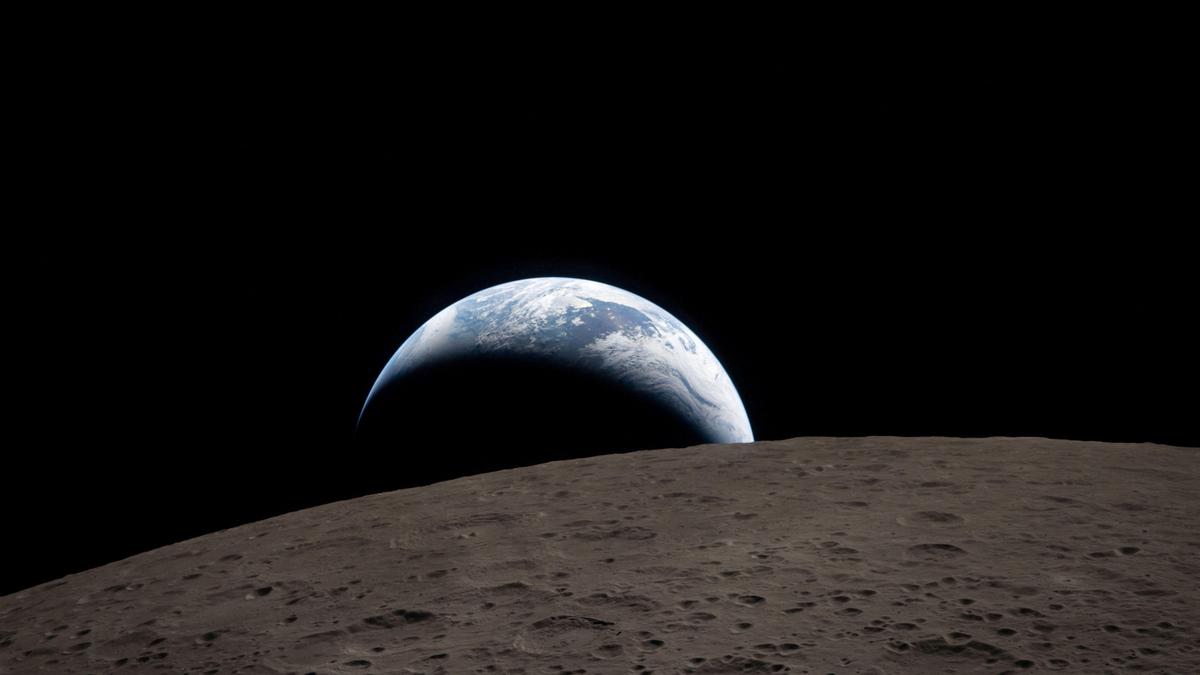
Picture this. You are standing on a rotating sphere that is revolving around another bigger sphere. You are then required to shoot an arrow at another smaller sphere, which is revolving around the sphere on which you are standing and is also rotating at its own pace. Given that both your platform and your target are moving, even the best of archers might find hitting the target a tad bit difficult.
And yet, we do this regularly these days, so much so that we don’t always pay a lot of attention to it when it happens. Some of you would have figured that the rotating sphere in which you are standing is the Earth, the bigger sphere is the sun and the smaller one, our moon. We’ve not only landed humans on the moon, but have also reached other planets and their moons in the solar system with our crafts, some of which have even entered interstellar space.
This wasn’t the case even three-fourths of a century ago, when humanity was still coming to terms with the damages inflicted during World War II. The scientific and technical advances made then, and in the decades that followed, ensured a steady growth in our space exploration. In fact, the Cold War between the Soviet Union and the U.S. was central to many of the firsts that were achieved in that period, including getting an object touched by humans to strike the surface of the moon. That first was achieved by Luna 2 on September 14, 1959.
Not all successful
Luna 2 was the Soviet Union’s second mission to the moon that achieved some degree of success. There were at least three failures in 1958 in their attempts to reach the moon, owing to different problems with their R-7 rocket. Their first success came on January 2, 1959, when their first Cosmic Rocket (retroactively renamed Luna 1 in 1963) became the first object to escape the Earth’s gravitational pull by achieving speeds greater than the escape velocity. Nearly 34 hours after launch, however, Luna 1’s probe missed the moon by a distance of about 6,500 km. That’s akin to trying to reach Mumbai, only to find yourself in Tokyo, Japan instead.
Replica of Luna 2.
| Photo Credit:
Wikimedia Commons
After another failed launch in June 1959, the Soviets had their second Cosmic Rocket (later renamed Luna 2) ready in September the same year. If the scientists and researchers of the time were just getting on top of the technology that helped them achieve these distant targets, tracking was also a work in progress.
Without a way for others to track their craft, they didn’t possess the means to convince the world if Luna 2 achieved its target, even if it did get to the moon. Speaking about this in a 2010 BBC video clip, Boris Chertok, one of Luna 2’s engineers, mentions that their “bright idea” concerned England’s Jodrell Bank, one of “the best in the world” when it came to directional antenna.
Solving the problem of tracking
Jodrell Bank was indeed the only place in the world back then that could track a probe so far out in space. The Soviets sent a coded message to them. “To our astonishment, I found on the telex machine the long message from Moscow giving complete details…” said Sir Bernard Lovell, Director of the Jodrell Bank Observatory at the time, in the BBC video. “This, of course, was a clear indication that we were meant to do something about it. We sprang into action,” he added.

“To our astonishment, I found on the telex machine the long message from Moscow giving complete details… We sprang into action.”Sir Bernard Lovell, Director of the Jodrell Bank Observatory in 1959
Launched on September 12, Luna 2 achieved escape velocity and was placed on an intercept course with the moon. Almost identical to Luna 1, Luna 2 also did something that its predecessor had done — at a distance of about 1,56,000 km, the upper stage released a kilogram of sodium gas, creating a cloud that ground-based astronomers in the Soviet Union were able to photograph.
About 35 hours from the time of the launch, Luna 2 crashed into the lunar surface, thereby becoming the first spacecraft from Earth to make contact with another celestial body. Given that the technology to slow down the rocket and achieve soft landing was yet to be invented, Luna 2 had no other option but to crash-land on the moon.
Guided by booster third stage
As Luna 2 also lacked a propulsion system, it was left to the third stage of its SS-6 booster rocket to guide it. The two separated only shortly before Luna 2’s impact. The place of impact on the moon was between Mare Imbrium and Mare Serenitatis. Twelve years later, American astronauts would land just 250 km away during the Apollo 15 mission.
In case you are wondering, the third stage of the booster rocket also hit the moon about half an hour after Luna 2. Nobody, however, celebrates it as the second object touched by humans to hit the moon.

Copy of the Soviet pennant sent on the Luna 2 probe to the moon, at the Kansas Cosmosphere.
| Photo Credit:
Patrick Pelletier / Wikimedia Commons
The scientific instruments on Luna 2 were able to detect no magnetic fields or radiation belts around the moon. It carried Soviet emblems in two metallic spheres and these were deposited on the lunar surface. Engraved with the Soviet coat of arms, they also carried the date “1959 September” on them.
Media frenzy that followed
“There was, of course, an uproar from the press because it was realised that the Russians had achieved a remarkable degree of technological expertise in doing this,” Lovell recalled in 2010, a little over half a century after his team had confirmed that they had received signals up to the time the rocket hit the moon. Nowhere was it more prominent than in the Soviet Union and the U.S., the Cold War rivals.
“Attention, Moscow speaking,” an announcer for the Moscow radio shouted at 35 minutes past midnight, when a programme of classical music was ongoing. “Today, the 14th of September, at 00:02:24, Moscow time, the second Soviet cosmic rocket reached the surface of the moon. It is the first time in history that a cosmic flight has been made from the earth to another celestial body.”
“Attention, Moscow speaking. Today, the 14th of September, at 00:02:24, Moscow time, the second Soviet cosmic rocket reached the surface of the moon. It is the first time in history that a cosmic flight has been made from the earth to another celestial body”An announcer for the Moscow radio
Once the announcer had read the bulletin from TASS, the official press agency of the Soviet Union, he followed it up by making the same announcement two more times, given the gravity of the situation. A scientific worker then came on, explaining the importance of preventing microorganisms from Earth reaching and contaminating the moon, and the measures that had been put in place to achieve the same. Once he was through, the classical music programme resumed.
Americans fear Soviets getting ahead
Given that 2 minutes and 24 seconds after midnight in Moscow was 5:02:24 P.M. Sunday evening in New York, both the news and its timing got the American reporters scrambling before their deadlines. It made the front pages of their issues on September 14, with obvious comparisons with their own failed attempts. “The time of impact was only 84 seconds later than Soviet scientists had predicted,” stated The New York Times in a front page report that also mentioned that “Soviet propaganda seized upon the event as being of special significance to the forthcoming Eisenhower-Khrushchev talks.”
Khrushchev presses his advantage
Soviet Premier Nikita S. Khrushchev’s only visit to the U.S. happened a few days after the success of the Luna 2 mission.
Given the timing of their meeting, Khrushchev definitely had to offer the event as proof of their might.
He did it subtly, presenting a replica of the spherical pennant that Luna 2 carried to President Dwight D. Eisenhower.
The pennant that Eisenhower received is still kept at the Eisenhower Presidential Library and Museum in Abilene, Kansas, and a copy of it is on display at the Kansas Cosmosphere in Hutchinson, Kansas.
In India, The Hindu carried a front page headline that read “RUSSIAN ROCKET LANDS ON MOON” on September 15. In addition to talking about the science behind the mission — the signals received and the steps to prevent contamination among other things — there were secondary reports that also carried reactions and praise from scientists in the U.K.
Asked for his comment, then Prime Minister Jawaharlal Nehru said that “It is great news, no doubt,” before jokingly adding, “In old astrology, the moon used to affect all human destiny. Now, obviously, things are reversed. The poor moon is being pursued.” Decades later, we still continue to pursue the moon and the knowledge that it can unlock.