



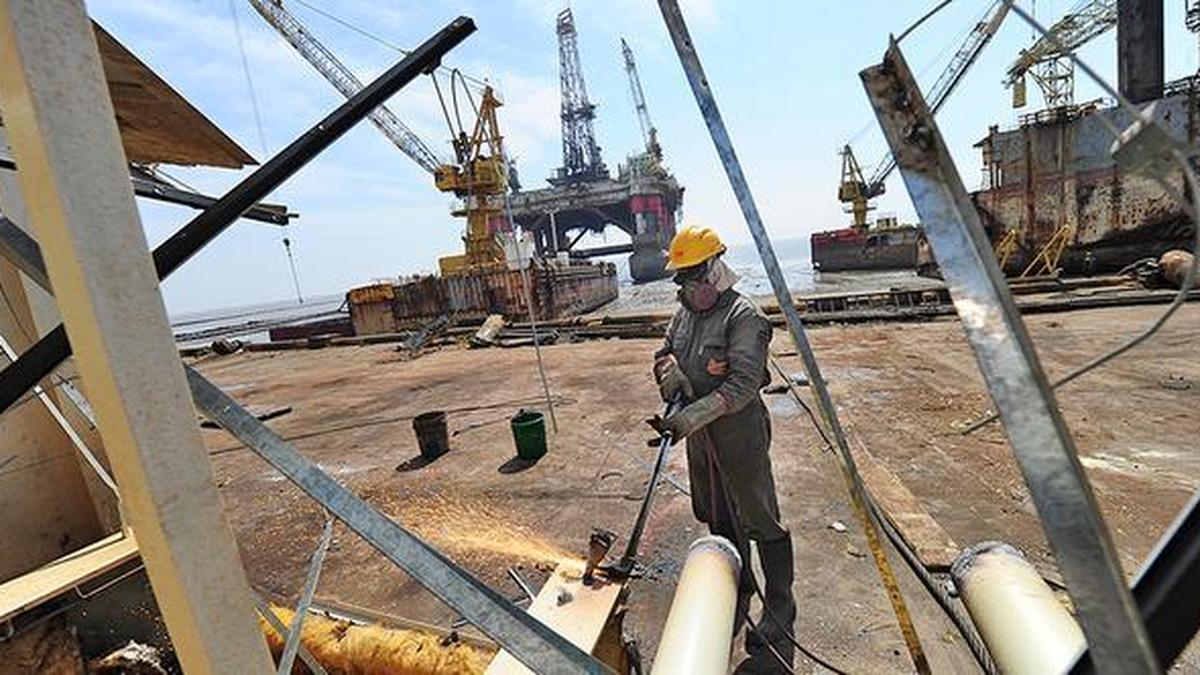
Gas cutting workers busy in dismantling ships at Shri Ram Group plot at the Alang Ship Breaking Yard.
| Photo Credit: The Hindu
During its blockade of Venezuela in December of last year, the U.S. government sought to seize several tankers that were calling on Venezuela. Among them was Marinera, which the U.S. pursued for nearly a month and seized off Iceland, and Lileo. In August, the U.S. government sold the two vessels to GMS, a leading buyer of vessels going for demolition, which has brought them to Alang in Gujarat for recycling.
Marinera and Lileo are among the more than thousand vessels sanctioned by the U.S. While these two were directly sold by the U.S. government, many sanctioned ships owned by sanctioned entities have been coming to Alang for recycling in recent months. For instance, Lloyd’s List reported on Sept. 4 that the Double In, a Very Large Gas Carrier that had been sanctioned by the U.S. for dealing in Iranian cargoes, had beached in Alang for recycling after ownership was transferred to a shell company.
It would seem that beyond just the age of the vessel, the renewed focus on such ships due to the West Asia crisis has made operating some of these ships more challenging. For instance, eight sanctioned ships identified by Lloyds List had identified as having scrapped in January and February this year, four were built well into the 2000s, which means they were not quite old enough for demolition. Blockades, interdiction of these vessels in the seas, and choking of demand are contributing to this trend, say industry sources.
“Bangladesh, which is the leading ship recycling nation in the world, as well as Pakistan, are not accepting sanctioned ships for recycling, so India is becoming the major destination for sanctioned vessel recycling,” says Anil Sharma, founder and CEO of GMS. Companies such as GMS purchase the vessel, prepare it for recycling, and bring it to the recycling yard to which they have sold the vessel.
Sanctions by the U.S. will lock the ship owner and related firms out of the mainstream global financial system. Indian banks and financial firms will therefore not accept transactions involving these entities. Industry sources say that there is typically an Indian firm in the chain so the immediate transactions of recycling are conducted in rupees but eventually the money could be routed through other channels such as the Hong Kong dollar, digital-crypto currencies, and rupee-rouble exchanges to the firms sanctioned by the U.S.
But the U.S. and other sanctioning entities are not entirely averse to scrapping of the ships they have sanctioned. They see it as a route to put the ships out of business. A U.S. treasury department official, for instance, wrote in an email to The Hindu: “To protect maritime safety, we are committed to responsible solutions to get sanctioned vessels off the water. We consider these matters on a case-by-case basis.” The European Union is considering such case-by-case approvals of demolitions of ships dealing with Russian oil it has sanctioned.
The U.S. government has put together a process for approving such demolitions for recycling. “The U.S. government may approve such demolitions if the money was going towards funding what the U.S. government had a problem with in the first place. For instance, it may approve if the money was going to repay a loan taken from a non-sanctioned bank before the sanctions or if it would go to paying unpaid crew wages and so on,” adds Mr. Sharma.
GMS has acquired six approvals from the U.S. government. The first approval took seven months while the following ones were quicker.
Indian regulations
India’s Recycling of Ships Regulations 2026 primarily updates the regulations on compliance with recent international rules such as the Hong Kong Convention. It does not specifically address the issue of ships sanctioned by the U.S. and EU. Officially, the Indian government does not recognize these sanctions and recognizes only those by the United Nations. Nevertheless, the regulations do talk about scrutinizing the documents submitted by the ship owner by the Director General of Maritime Affairs for authenticity to clamp down on fraud.
For Alang, the competent authority to handle the ships is the Gujarat Maritime Board. The 2026 regulations specify that the ship recycler shall submit to the authority the originals of: Certificate of Registry; valid third-party/oil-pollution insurance certificate; certificates of competency for master/officers/ratings; Inventory of Hazardous Materials (IHM) certificate and/or Ready for Recycling Certificate among other documents.
If any of the documents submitted is found to be unreliable, or if a submitted document is found to be fake or conceals a material fact, the shipowner shall not be given permission to anchor, enter, beach, or begin cutting, as per the regulations. Sanctioned ships often sail without proper insurance such as P&I or the Inventory of Hazardous Materials certificate. And India’s regulations specifically talk about insurance covering “third-party liability, oil pollution damage, and wreck removal”.
Published – September 12, 2026 10:19 pm IST