

The story so far: A century-old soda ash mining & production operation in Kenya, Africa that has been under the fold of Tata Group since 2005, has become the focal point of an escalating confrontation between India’s Tata Chemicals and the Kenyan government led by it’s President.
The matter has been brewing since July this year but it gained international attention last week when Kenya’s President William Ruto publicly called for the Company’s exit and told his countrymen that the concession would be handed over to new investors thus putting one of the Tata Group’s oldest businesses at risk in Africa.
What President William Ruto has stated?
Addressing a public rally on September 3, 2026 in Kajiado County, where the Tata plant is located, President Ruto reportedly said he had ordered Tata Chemicals to “pack up and go.” He stated that the Kenyan government will identify new and responsible investors to take over soda ash mining operations at Lake Magadi in Kajiado County.
He said that the current operator, Tata Chemicals, had failed to adequately modernise the plant, create sufficient employment opportunities for residents, and deliver meaningful economic benefits to the people of Kenya.
“It is unfair for one company to dominate the ownership and operations of Magadi Soda for years, yet it has done little to improve the factory or create employment opportunities for our youth,” he stated.
“Because they have been unable to do anything meaningful with the plant for more than 100 years, I have directed them to pack up and go,” he added.
How is Tata Chemicals involved?
Tata Chemicals Ltd (TCL) is the world’s third largest producer of soda ash with a capacity of about 4 million ton per annum. It has global presence, including in India, U.K., and the U.S.
The Kenyan soda ash unit came under it’s fold through an acquisition in 2005. In 2005 Brunner Mond U.K. Limited and its Kenyan subsidiary, the Magadi Soda Company were acquired by Tata Chemicals Limited and rebranded as Tata Chemicals Europe (TCE) and Tata Chemicals Magadi. TCML maintains a workforce of 537 employees, and approximately 99.6% of the workforce is Kenyan.
How important is this facility for Tata Chemicals?
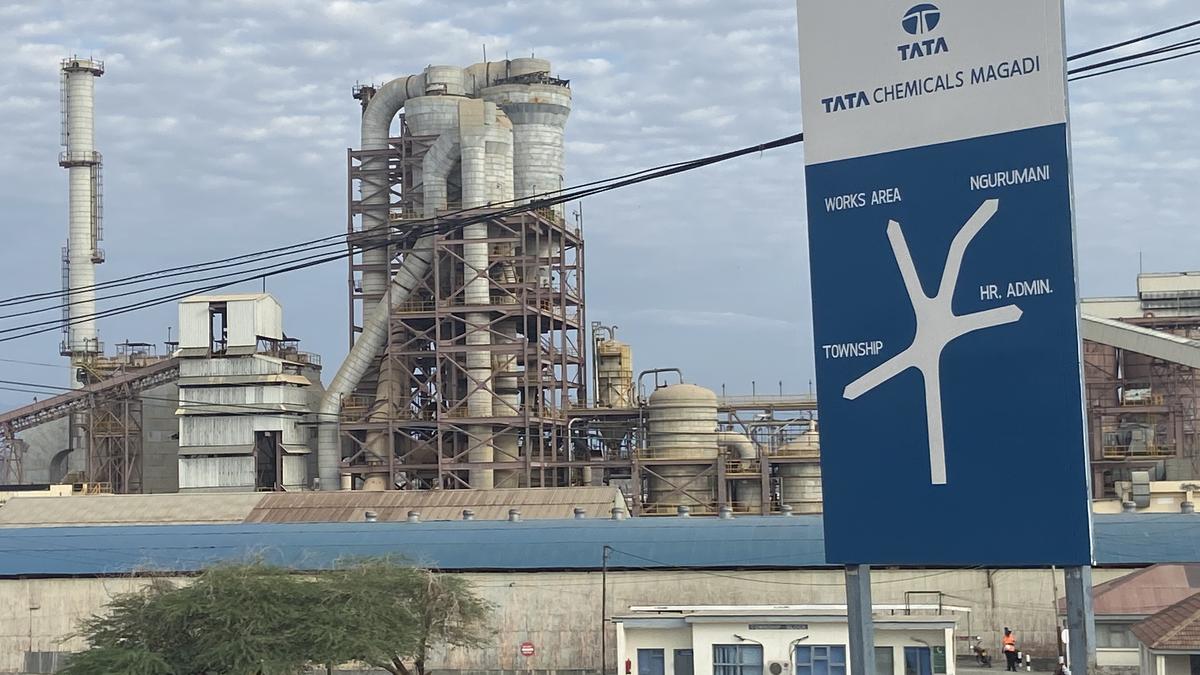
Established in 1911, the facility has been producing soda ash at Lake Magadi for over a hundred years. The site is located in Kenya’s Kajiado County, about 120 km from Nairobi, the capital city of Kenya.
TCML holds a lease of 2,24,991 acres of land in and around Lake Magadi, which has a natural resource called Trona that can be converted into soda ash.
Soda ash is an essential constituent in the manufacture of glass, detergents and other industrial chemicals.
Over 90% of the Company’s product is exported to markets in South East Asia, Indian sub-continent, Africa and West Asia.
TCML operates three facilities in Kenya. These include the plant at Lake Magadi, along with warehouses in Kajiado and Mombasa.
TCML is the largest producer of Soda Ash in Africa and one of the single largest exporters from Kenya.
Apart from Kenya, Tata Chemicals has soda ash manufacturing facilities in India, and the United States. In India at Mithapur, Gujarat it has installed Soda Ash capacity of 1,091,000 MTPA (Million Tonnes Per Annum), and in the U.S. at Wyoming it has installed Soda Ash capacity of 2,540,000 MTPA/
The Company has 17 manufacturing plants globally in different segments in basic chemistry and speciality chemicals.
Tata Chemicals is largest salt manufacturer in India and U.K.; third largest in soda ash manufacturer globally by volume (excluding China); and fifth largest in Sodium Bicarbonate globally by volume.
Revenue from Africa for FY26 was ₹649 crore, as compared to ₹ 1,461 crore coming from Europe, ₹4,936 crore from America, and ₹7,789 crore from Asia.
During FY26, Tata Chemicals Magadi Limited (TCML) achieved a revenue of ₹586 crore as against revenue of ₹612 crore in the previous year, a decline of 4%.
TCML registered an EBITDA of ₹101 crore against ₹142 crore in the previous year and a net profit of ₹48 crore as against a net profit of ₹118 crore in the previous year. The results were impacted negatively mainly due to pricing pressures, according to the company.
According to the company it is the mainstay for the surrounding community of about 40,000 people. Tata Chemicals said it supports the supply of water, medical, education facilities, employment, and infrastructural support, to the local community.
About 64% of Magadi Division population relies on water supplied by the company. The company also said it supports higher education through various bursaries available to all in the local community.
What are the allegations against Tata Chemicals?
The issue began in late July when Kenya’s Ministry of Mining, Blue Economy & Maritime Affairs sent a notice to TCML directing it to suspend its mining operations until the compliance review and submission of evidence of compliance with all statutory documentation.
Further, the company was directed to suspend exports of soda ash.
The grounds cited for suspension were related to royalty, export-reporting, beneficiation, Community Development Agreement (CDA), local-employment and environmental compliance gaps.
The government reportedly had raised concerns relating to regulatory compliance, value addition, licensing, contravening environmental regulations and failure to reach an agreement with the Kajiado County Government over a land rates dispute.
How has the company responded?
This is the first time that a major Tata company has faced such allegations in a foreign country and has been directed to pack up
The company has responded saying it is fully compliant with all requisite regulations and continues to work with all authorities and agencies to uphold the highest standards of compliance. However, it has complied with the suspension orders, and the operations are currently suspended.
On July 30, 2026 the Company approached Kenya’s High Court, arguing that the suspension was unlawful. TCML argues that it was denied an opportunity to respond to allegations, remedy any deficiencies or show cause why operations should not be suspended before the decision was taken. The matter is pending before the Court.
On September 4, 2026, after President Ruto’s remarks, TCML’s parent company Tata Chemicals Ltd issued a clarification to the stock exchanges in India stating that on August, 11, 2026 TCML had submitted all the information, reports and documentation requested by the Ministry of Mining, Blue Economy and Maritime Affairs following its direction of July 28, 2026 suspending TCML’s mining operations.
“TCML has provided a comprehensive response to the matters raised by the Ministry, including information regarding its compliance with applicable regulatory requirements. We await the Ministry’s review of our submissions and its further direction. We respect the authority of the Government of Kenya and remain committed to constructive engagement through the appropriate legal and regulatory channels to resolve the outstanding matters. Our priority continues to be the well-being of our employees, the Magadi community, our stakeholders in Kenya and continued economic development of Kenya,” it stated.
How is this matter being viewed in Kenya?
The dispute has gained political momentum in Kenya. A statement, published on X on September 3, 2026, by Members of Parliament allied to the DCP Party opposed the shutdown saying this action would economically damage the country and it’s economy.
“From the outset, we condemn reckless, economically suicidal, and legally rogue directive by the Ministry of Mining to forcefully shut down Tata Chemicals Magadi Limited. This dictatorial decree, issued under the guise of regulatory compliance, is a textbook example of state-sponsored economic sabotage that will plunge thousands of Kenyan families into absolute desperation,” the post said.
“The closure of Tata chemical will result in unprecedented job losses; it is not yet forgotten to us that this regime has single-handedly jeopardized the livelihoods of over 500 direct employees and thousands of support workers, heartlessly rendering them jobless overnight through this closure. Punishing the People of Magadi by locking the gates of this facility, the government is actively starving the local community of critical infrastructure, basic healthcare, and clean water supplies that the state itself has historically failed to provide,” it added.
However, on September 5, 2026, President Ruto reiterated his decision on X saying, “We have made the right decision to end the exploitative and extractive contract for Tata Chemicals in Magadi, Kajiado County. For nearly 100 years, Kenyans, especially the people of Kajiado, have not received their fair share of the benefits from the minerals extracted from their land. That era is over.”
“We will advertise the contract afresh and open the opportunities to greater participation. We will no longer allow one company to monopolise operations at Magadi at the expense of the people and the wider economy. We will also not allow the export of raw materials that leaves Kenya with little value while wealth and jobs are created elsewhere. Companies that win the new Magadi contracts must establish processing and manufacturing facilities here in Kenya. Our minerals must create value at home, generate wealth for Kajiado and jobs for our young people and stimulate local industries.”
Is ?
What’s next for Tata?
For now, operations at Magadi remain suspended, and the courts are yet to give a verdict. As regulators are still reviewing the company’s submissions, President Ruto has already spelt out a different future for the concession.
The dispute, for whatever reason, has moved well beyond questions of mining compliance.
For Tata Chemicals, it is a fight to preserve a long-standing business; for Kenya, it is a test of how precious natural resource must be used for the betterment of the natives; and for Indian companies operating across Africa, how their investment may be judged by a local government.