
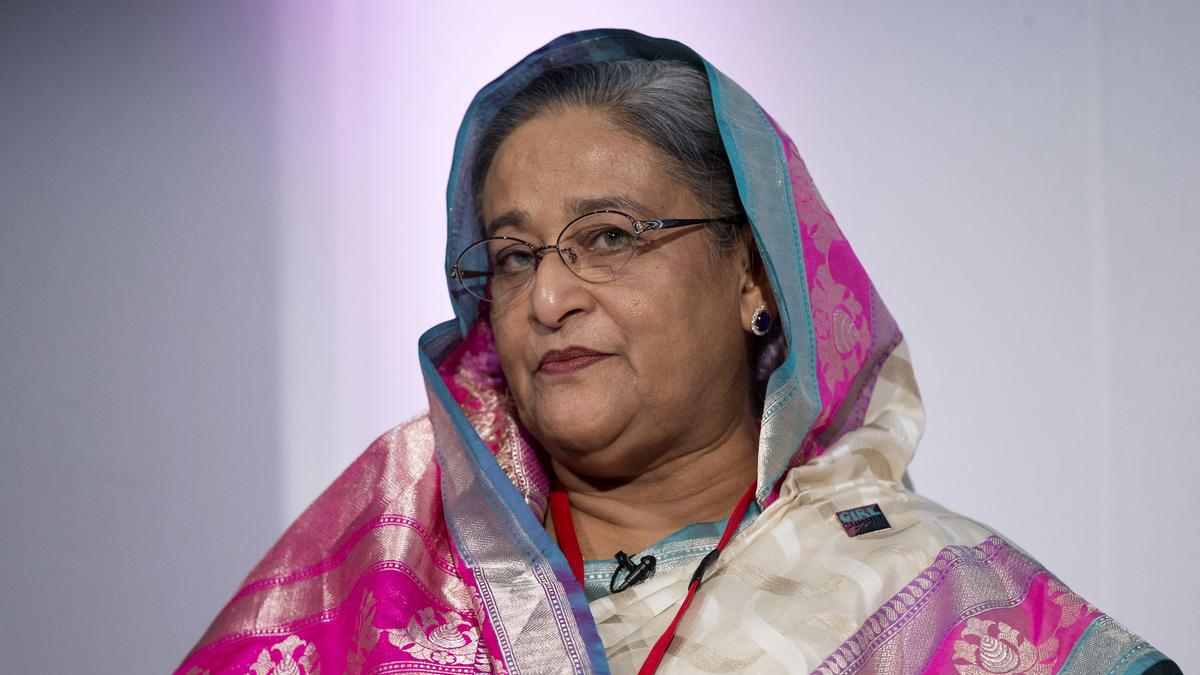
Defending her right to hold press conferences and meet her Awami League party colleagues while in India, Bangladesh’s former Prime Minister Sheikh Hasina says she had no intention of damaging India-Bangladesh ties. In an interview to The Hindu, including in written replies and an extensive telephone conversation, Ms. Hasina, who has been convicted of murder and sentenced to death in Bangladesh, says she is undeterred from returning to Bangladesh, as she has already announced. She also says that if her party decides she should step down, she would.Bangladesh’s former Prime Minister Sheikh Hasina
Excerpts from the interview:
What can you tell us about the events of August 5, 2024, when you fled from Dhaka?

Life away from home is never easy. So, leaving the country was extremely painful for me. On August 5 (2024), I did not leave Bangladesh by choice. When I heard that Tarique (Bangladesh PM Tarique Rahman) had instructed his leaders that there needed to be [more human casualties] to topple the government, I realised that killing people had become their main objective. I did not want bloodshed. They were killing people indiscriminately and putting the blame on us.
On July 18 (2024), I formed a Judicial Inquiry Commission to investigate the killings. I visited hospitals to see the victims. I met families who had lost their loved ones between July 15 and August 1 (2024). I offered condolences, gave assistance, and provided compensation to the families. I also strengthened the inquiry process by reorganising the Commission with three judges of the High Court. But the violence did not stop. The situation continued to worsen.
Police officers were being killed. Police stations were attacked and looted. Government properties and the houses of Awami League leaders were burned. At that moment, the situation around me deteriorated very quickly. My security personnel, party leaders, and family members urged me to leave the Prime Minister’s residence.
Their intention [on] that day was to kill me and my sister. Now they themselves are admitting those intentions. I was prepared to go to Tungipara (Ms. Hasina’s hometown), and I had expressed my willingness to leave and resign as Prime Minister. But I didn’t get the chance to resign. I did not even know that I was leaving the country. Only when I was in the helicopter did I learn from my staff that I was being taken to India. I said, “What?” I had no idea that was what they had planned, but they said they did it to keep me safe.
India received me on very short notice and made arrangements for my security and stay. I am grateful for that. But it was very hard for me to accept that I had been taken out of my own country.
They have tried to eliminate me several times, but I survived. This time too, I survived. Because of that, I can still speak to my people, to those who are suffering, to those who have lost family members, and to those who have been injured by the atrocities of the BNP (Bangladesh Nationalist Party) and Jamaat (Jamaat-e-Islami). I believe it is because of the wishes of the people, and by the will of Allah, that I survived this attempt as well.

When you reached Delhi on August 5, did you intend to stay in India, or was there a plan for you to travel elsewhere? Have you applied for asylum or visas in any other country?
No, I did not want to go anywhere else. I am next door to my country, as close as I can be to my people. From here, I can keep in touch with them. Where else would I go? How would I live somewhere else? I do not have any means to live abroad permanently. When my family was assassinated in 1975, I was in Germany. Mrs. [Indira] Gandhi called me and said I should come and stay in India. Then, in 1981, when I had taken shelter in India for six years, even then, [President] Gen Ziaur Rahman did not want me to return, but I did. In 2007 as well, the caretaker government didn’t want me to return, arrested me, but I went back anyway. So, I will go back again.
What about reports that you asked to travel to the U.S. and the U.K., or to a Gulf country?
No, no that isn’t true. Why would I go anywhere else?
Given your personal equations with them, have you met Prime Minister Narendra Modi, or Mrs. Sonia Gandhi during your time here?
Frankly, I did not want to try to meet them, given the circumstances. No doubt, I have good relations with them, but I decided I would only meet my party workers and relatives while here. Maybe a time will come when I will go home and then come again to India, and then meet everyone, including media (laughs).
Has any specific date, route or entry point been decided? Will other Awami League leaders return with you? Will there be any discussion with the Bangladesh government before your return?
I will tell that in due time.
Are you sure the Bangladesh government will allow you to go back, and not stop you at the border?
This is a peculiar situation. They repeatedly ask the Indian government to send me to Bangladesh [to face her sentence], but when I say they don’t need to send me, I will come myself, then that also seems to be a problem for them.
The Bangladesh government says your recent press conference (on August 5, 2026) has damaged the atmosphere for India-Bangladesh relations. Do you think your public remarks are affecting bilateral ties?
When I heard this, I was surprised. How can a press conference damage India-Bangladesh relations? I did not know that I was so powerful that one press conference of mine could damage Bangladesh’s foreign policy.
In 2007, Tarique Rahman gave a written undertaking that he would never engage in politics. But when he was in London and took up the BNP leadership, he gave online speeches, held video conferences and spoke at press conferences. Did my government write to the British government raising this issue? No. We did not ask another country to silence him.
My intention was never to damage anything. I wanted to tell the truth. Freedom of speech and expression is part of democracy. But since Muhammad Yunus took power illegally, and after the sham elections of 2026, freedom of speech and expression has not merely declined, it has been destroyed. Since August 2024, 50 media houses have been vandalised or set on fire. Thirteen journalists have been killed, 38 journalists have been jailed, and more than 300 journalists face cases, including murder cases. So, the real question is not whether my press conference damaged relations. The real question is why truth and free speech are being feared so much.
In your time as PM, you also did ban the Jamaat-e-Islami. Was that a mistake? They are now the main Opposition in the country…
Jamaat-e-Islami members were war criminals — they worked with the Pakistani army during the occupation, they were convicted of rape, murder and genocide. That is why they were banned. But later, they would be part of coalitions with other parties. In 2013, the courts cancelled their registration, and they could not stand for elections.
All that was years ago. Today, even the Indian High Commission and India’s Foreign Secretary (Vikram Misri) meets with them…
If that is so, I have no comment on that.
Has the Indian government conveyed to you that you should not hold any more press conferences? What kind of support do you expect from India and the international community?
It is important for the world to understand what Bangladesh is going through today. The largest political party, the party that brought independence to Bangladesh, has been banned. Political prisoners, detained in false cases, are being kept in horrible conditions. Today, bail is denied to most Awami League leaders. War criminals sit in Parliament. Freedom of speech is gone.
My demands are simple. I ask the international community to support the lifting of the ban on the Awami League, the release of political detainees, the withdrawal of false cases, the safety and security of every citizen, especially women and girl children, freedom of movement, and freedom of speech and expression.
If the Bangladesh government were to revoke the ban on the Awami League on the condition that you step down as President, would you agree?
Awami League is the only party in Bangladesh that works according to a Constitution. It is the party that decides who will be the leader. I was made President when I was in exile in India in 1981, when the party councillors decided that. I am prepared to step down, but who is the government or the BNP to decide who will lead the Awami League?
Has the government placed any restrictions or asked you not to hold more press conferences? I ask because, recently, on August 31, the police cancelled another event in Delhi where Awami League leaders were due to attend a conference.
There was some misunderstanding over that event. Awami League was not involved in it.
Hundreds were killed during July-August 2024. It is alleged that these deaths occurred during police action ordered by you. Do you accept personal responsibility? Would you apologise to the families of those who died?
When police are working in the field, how can they contact the Prime Minister for every action? Police operate under standard operating procedures. They are trained to handle emergencies, crowd control and violent situations. When police personnel were attacked and killed, and police stations were set on fire, they responded according to the situation. How could I personally order officers in those circumstances?
Nearly 10,000 of our party workers have been killed, forcibly disappeared, or had their houses burned and vandalised. On July 16, Chhatra League leader Sabuj Ali was killed. Since then, our workers have been killed or arrested every day. Police personnel, journalists, cultural activists, freedom fighters, teachers, students, lawyers, judges, Awami League leaders and workers were targeted. Public buildings were destroyed and houses were burned.
Have they apologised? No. They were given indemnity by Muhammad Yunus. The vandals have also publicly accepted that without burning down metro stations and killing police personnel, the movement would not have succeeded. So, who should apologise?
I left the country on August 5. My people have faced brutal persecution since then. Who bears responsibility for that? Even now, the killings have not stopped. Women and children are tortured and raped in front of their family members, and videos are shared. Victims are not allowed to lodge complaints at police stations. Police stations also do not accept FIRs (First Information Reports) from Awami League workers. During the interim government, orders were given for arrests without cause. Murder cases and cases under the Explosives Act are filed so that bail cannot be obtained.
You refer to ‘them’ and to ‘my’ people. But you were PM for 15 years — aren’t all Bangladeshis your people? Many young protestors said they felt alienated when you called them ‘Razakars’…
When I say my people, I mean my party workers — more than six lakh have had cases filed against them; so many have been arrested or harassed, tortured in jail without any legal procedures being followed. How can I forget them? Of course, the common people are all my people.
Do you still believe that U.S. agencies or foreign powers played a role in your ouster? In the context of your earlier remarks on St. Martin’s Island, what is your position now?
When Muhammad Yunus went to the United Nations in September 2024, he attended a programme hosted by the Clinton Foundation. There, he proudly said that what happened in Bangladesh was not a spontaneous student protest, but a meticulously designed plan led by a mastermind. The so-called mastermind later also clarified in a news interview that the movement was not a student movement, but a movement to overthrow the government. Those words are important. They confirm what I had been saying: this was not an ordinary student protest.
The Bay of Bengal and the Indian Ocean routes are peaceful and non-controversial routes. They are among the busiest routes for maritime trade and commerce. They have remained peaceful for a long time, and they should remain so. Bangladesh is a sovereign, independent country, and it must remain so. Our land, sea, islands and resources must serve the interests of the people of Bangladesh. Bangladesh must not become a field for geopolitical competition.
How do you view the recent youth protests in India? Looking back, could your government have handled the protests in Bangladesh differently?
I will not comment on India’s internal matters. India is a democratic country, and its people and institutions will deal with their own issues.
In Bangladesh, the quota system began after the War of Liberation. The Father of the Nation, Bangabandhu Sheikh Mujibur Rahman, introduced the quota system in government jobs to rehabilitate them. It also included freedom fighters and their families, disabled persons, and ethnic minority groups.
In 2018, students, mainly final-year university students and those preparing for government jobs, demanded the abolition of the quota system. Even women agreed. So, the quota system was abolished. In 2024, a writ petition was filed to reinstate the quota system. The High Court ruled in favour of the writ, but the government appealed.
No matter how differently I would have handled it, their [protesters’] sole motive was to remove me. There was no compromise with them. One of the advisers of the interim government also said that they were prepared to go into an armed rebellion if I did not resign.