




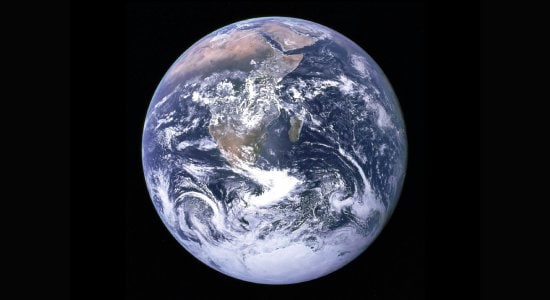
The slow rotation of the orbits of Earth and Mars, recurs every 2.4 million years. (Representational)
Our existence is governed by natural cycles, from the daily rhythms of sleeping and eating, to longer patterns such as the turn of the seasons and the quadrennial round of leap years.
After looking at seabed sediment stretching back 65 million years, we have found a previously undetected cycle to add to the list: an ebb and flow in deep sea currents, tied to a 2.4-million-year swell of global warming and cooling driven by a gravitational tug of war between Earth and Mars. Our research is published in Nature Communications.
Milankovitch cycles and ice ages
Most of the natural cycles we know are determined one way or another by Earth’s movement around the Sun.
As the German astronomer Johannes Kepler first realised four centuries ago, the orbits of Earth and the other planets are not quite circular, but rather slightly squashed ellipses. And over time, the gravitational jostling of the planets changes the shape of these orbits in a predictable pattern.
These alterations affect our long-term climate, influencing the coming and going of ice ages. In 1941, Serbian astrophysicist Milutin Milankovitch recognised that changes in the shape of Earth’s orbit, the tilt of its axis, and the wobbling of its poles all affect the amount of sunlight we receive.
Known as “Milankovitch cycles”, these patterns occur with periods of 405,000, 100,000, 41,000 and 23,000 years. Geologists have found traces of them throughout Earth’s deep past, even in 2.5-billion-year old rocks.
Earth and Mars
There are also slower rhythms, called astronomical “grand cycles”, which cause fluctuations over millions of years. One such cycle, related to the slow rotation of the orbits of Earth and Mars, recurs every 2.4 million years.
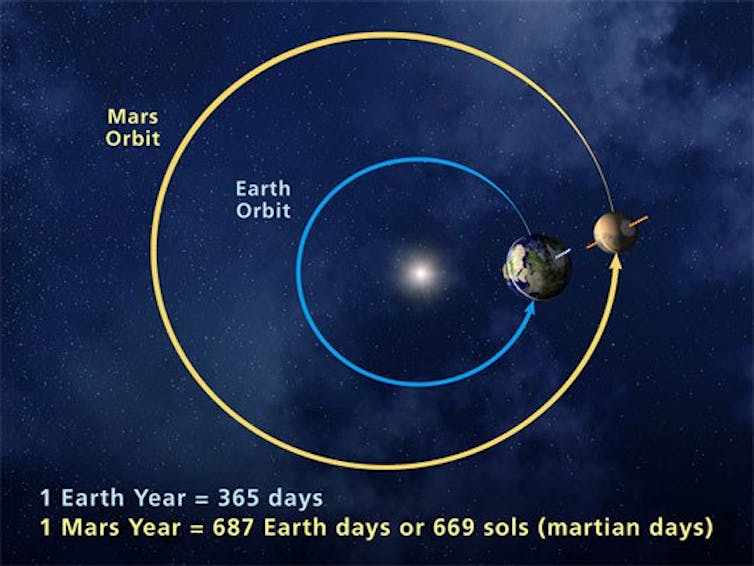
The cycle is predicted by astronomical models, but is rarely detected in geological records. The easiest way to find it would be in sediment samples that continuously cover a period of many millions of years, but these are rare.
Much like the shorter Milankovitch cycles, this grand cycle affects the amount of sunlight Earth receives and has an impact on climate.
Gaps in the record
When we went hunting for signs of these multimillion-year climate cycles in the rock record, we used a “big data” approach. Scientific ocean drilling data collected since the 1960s have generated a treasure trove of information on deep-sea sediments through time across the global ocean.
In our study, published in Nature Communications, we used sedimentary sequences from more than 200 drill sites to discover a previously unknown connection between the changing orbits of Earth and Mars, past global warming cycles, and the speeding up of deep-ocean currents.
Most studies focus on complete, high-resolution records to detect climate cycles. Instead, we concentrated on the parts of the sedimentary record that are missing — breaks in sedimentation called hiatuses.
A deep-sea hiatus indicates the action of vigorous bottom currents that eroded seafloor sediment. In contrast, continuous sediment accumulation indicates calmer conditions.
Analysing the timing of hiatus periods across the global ocean, we identified hiatus cycles over the past 65 million years. The results show that the vigour of deep-sea currents waxes and wanes in 2.4 million year cycles coinciding with changes in the shape of Earth’s orbit.
Astronomical models suggest the interaction of Earth and Mars drives a 2.4 million year cycle of more sunlight and warmer climate alternating with less sunlight and cooler climate. The warmer periods correlate with more deep-sea hiatuses, related to more vigorous deep-ocean currents.
Warming and deep currents
Our results fit with recent satellite data and ocean models mapping short-term ocean circulation changes. Some of these suggest that ocean mixing has become more intense over the last decades of global warming.
Deep-ocean eddies are predicted to intensify in a warming, more energetic climate system, particularly at high latitudes, as major storms become more frequent. This makes deep ocean mixing more vigorous.
Deep-ocean eddies are like giant wind-driven whirlpools and often reach the deep sea floor. They result in seafloor erosion and large sediment accumulations called contourite drifts, akin to snowdrifts.
Can Mars keep the oceans alive?
Our findings extend these insights over much longer timescales. Our deep-sea data spanning 65 million years suggest that warmer oceans have more vigorous eddy-driven circulation.
This process may play an important role in a warmer future. In a warming world the difference in temperature between the equator and poles diminishes. This leads to a weakening of the world’s ocean conveyor belt.
In such a scenario, oxygen-rich surface waters would no longer mix well with deeper waters, potentially resulting in a stagnant ocean. Our results and analyses of deep ocean mixing suggest that more intense deep-ocean eddies may counteract such ocean stagnation.
How the Earth-Mars astronomical influence will interact with shorter Milankovitch cycles and current human-driven global warming will largely depend on the future trajectory of our greenhouse gas emissions.
(Authors:Adriana Dutkiewicz, ARC Future Fellow, University of Sydney; Dietmar Müller, Professor of Geophysics, University of Sydney, and Slah Boulila, Associate lecturer, Sorbonne Université)
(Disclosure Statement:Adriana Dutkiewicz receives funding from the Australian Research Council. Dietmar Muller and Slah Boulila do not work for, consult, own shares in or receive funding from any company or organisation that would benefit from this article, and have disclosed no relevant affiliations beyond their academic appointment)
This article is republished from The Conversation under a Creative Commons license. Read the original article.
(Except for the headline, this story has not been edited by NDTV staff and is published from a syndicated feed.)
Waiting for response to load…