



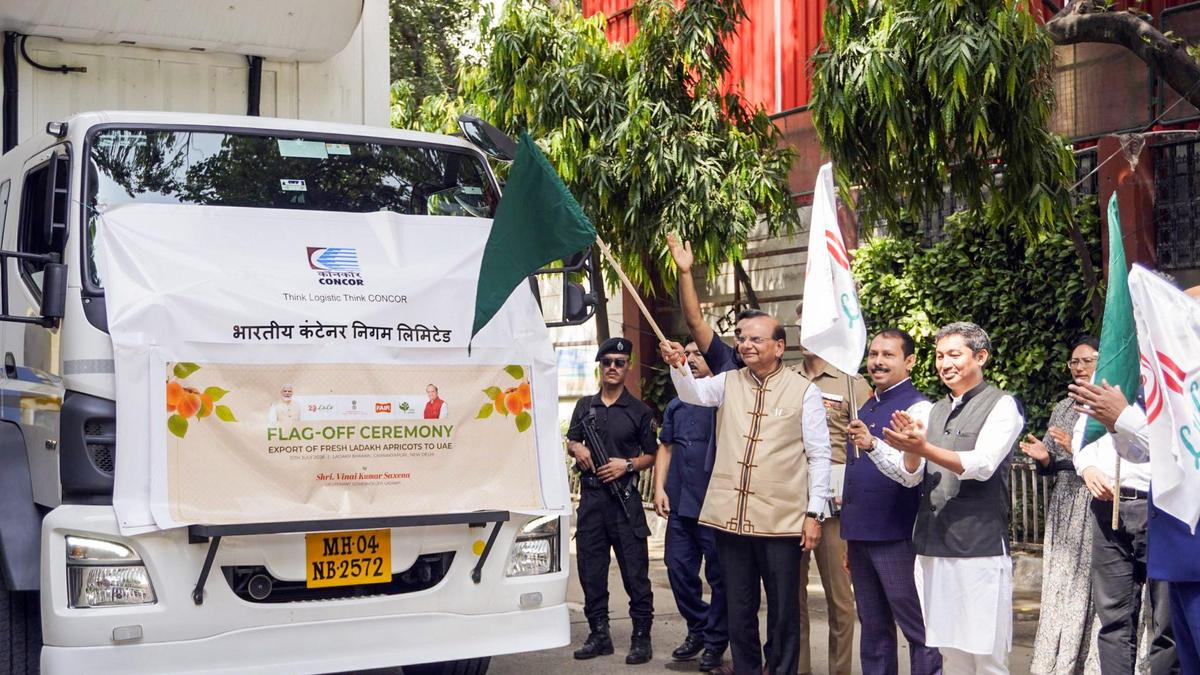
Ladakh Lieutenant Governor Vinai Kumar Saxena flags off the first five-metric-tonne consignment of Ladakh’s apricots for export to the United Arab Emirates through the MoU with the UAE-based Lulu Group at Ladakh Bhawan, in New Delhi on July 16, 2026.
| Photo Credit: ANI
Apricot from Ladakh is finally on its way to hit the global map of the fruit market. This season, the Ladakh administration was scaling up the export to over 1000 metric tonnes, “a monumental leap from just 1500 kg export in the previous two years.
Ladakh Lieutenant Governor Vinai Kumar Saxena on Wednesday (July 15, 2026) said the first five metric tonnes of organic apricots consignment was flagged off to the United Arab Emirates (UAE).
“Through our strategic Memorandum of Understanding (MoU) with the Lulu Group, the hardworking farmers of Ladakh now have direct access to international markets. This season, we are scaling up the export to over 1000 MT – a monumental leap from just 1500 KG export in the previous two years,” said Mr. Saxena., hoping that the export initiative will act as a bridge between Ladakh and the global consumers. “This giant stride would go a long way in strengthening the local economy, creating sustainable livelihoods and establishing Ladakh as a premier export hub,” he added.
Ladakh has 80 varieties of apricots

A woman sells apricot and other dry fuits at a main market in Leh, Ladakh. File.
| Photo Credit:
Imran Nissar
Ladakh is home to 80 unique varieties of apricots, which include Khante, Ngarmo, Raktsey Karpo, Nyarmo, Raktsey Karpo and Halman varieties. It produces 15,789 tonnes of apricots across more than 2,000 hectares in areas like the Sham belt, Nubra Valley and Kargil. Kargil tops the list at 10,656 metric tonnes.
Officials said Ladakh witnessed a high wastage of almost 40-50% of the total harvest, which has severely and adversely impacted the potential of the industry due to lack of global supply chains.
“Ladakh apricots mature later in mid-July and early September as compared to apricots from other parts of the world that are harvested between late June to early July and August. Apricots of Ladakh, therefore, have a competitive advantage as their season does not coincide with the main apricot season in the market,” said a senior official.
The disadvantage for Ladakh’s apricots is limited season, short shelf life and the region’s connectivity to the outside world. This forced local farmers to sell sun dried apricots, which is now part of Ladakhi and Kashmiri culture. Weddings are incomplete without sun dried apricots. For ages, the seeds are cold pressed into apricot oil.
Sajjad Kargilli, a local leader, urged the L-G to “acknowledge the aggregators or the specific areas from which the produce was sourced”. “Kargil is India’s largest producer of apricots, yet more than four years have passed without the UT Administration securing a Geographical Indication (GI) tag for the Helman Apricot and Karkitchoo Apple,” said Mr. Kargilli.
He said the delay is particularly concerning when compared with several other regions where GI status has been granted for multiple products within a much shorter timeframe.
“Although apricot has been identified as Kargil’s One District One Product (ODOP), the UT Administration chose to establish the Centre of Excellence for apricot cultivation in Nimoo, Leh, rather than in Kargil, the district that is the principal producer. Equally concerning is the absence of a dedicated research centre for apricot and apple cultivation in Kargil, despite the district’s immense contribution to horticulture,” said Mr. Kargilli.
Published – July 16, 2026 09:52 am IST