


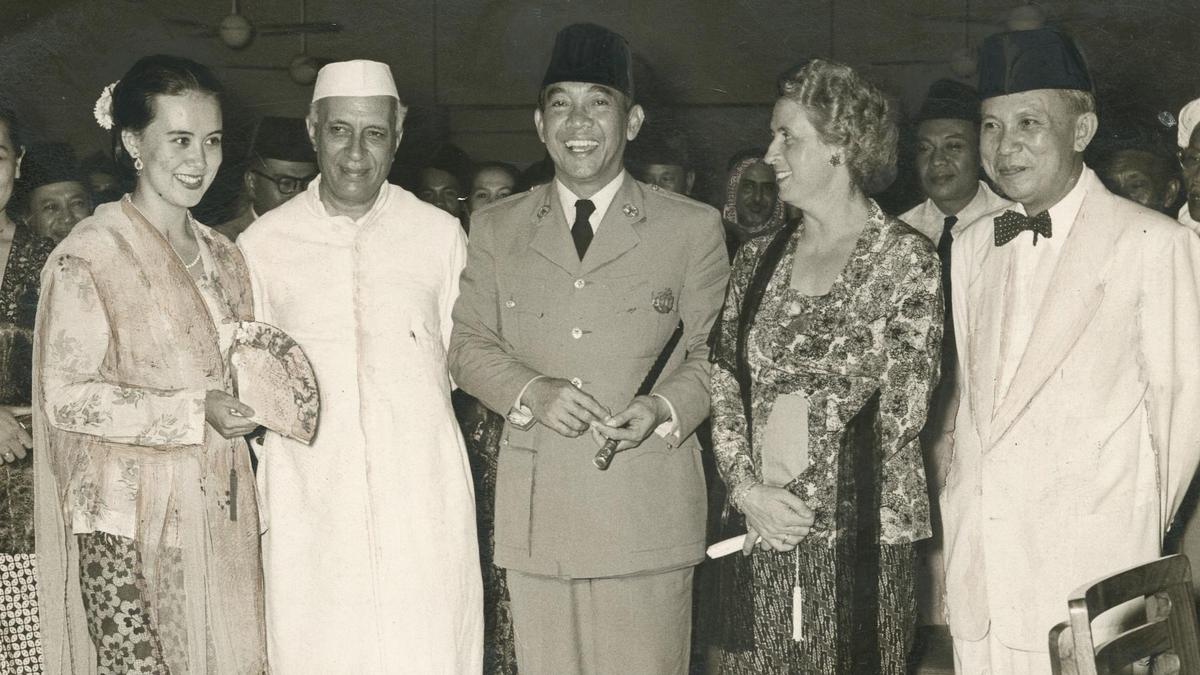
Soekarno, then Indonesian President, arrived at Palam Airport, New Delhi on July 19, 1955. Then Indian Prime Minister Jawaharlal Nehru received him at the Airport.
| Photo Credit: The Hindu Archives (PIB)
In his speech before the Indonesian Parliament, Prime Minister Narendra Modi referred to India’s support to Indonesian freedom movement and said that India championed Indonesian freedom at the United Nations. He further referred to the role of Biju Patnaik, then a civilian aviator and entrepreneur for flying anti-colonial leader Sutan Sjahrir to New Delhi in 1947. India and Indonesia attained freedom within a span of two years but the circumstances that they faced were unique.
How Indonesia attained independence
Much of the events of India and Indonesia in the early to mid-1940s were related to the World War II. In India, the war was very unpopular and caused huge public distress and led to the Bengal famine of 1943. The nationalist leadership was arrested and sent to prison when the Quit India movement started as a protest for dragging India into the war.

In Indonesia, the war quickly led to dislodgement of the Dutch colonial power who were defeated by the imperial Japanese forces who by 1942 had established their authority over most of Indonesia. The Japanese Army tried to bring the Indonesian nationalists to their side and with the help of Soekarno and Mohammad Hatta set up on March 9, 1943 an all inclusive Central National Organisation, the POETARA (Peasant Tenega Rajkat – Centre of People’s Power). Though European media often presented the POETARA as a puppet of the Japanese government, Japan promised that self-government would be granted to Indonesia in the near future. With surrender of Japan on August 14, 1945, Indonesian nationalists of the Dutch East Indies led by Soekarno, Hatta and Sutan Sjahrir declared independence on August 17.
How did India help Indonesia with its independence?
Indonesia declared independence but it was a very fragile situation for the country as the end of the World War II triggered a number of related dynamics that threatened Indonesia’s freedom. After having defeated Hitler’s army in Europe and Africa, British Indian forces were now free of military responsibilities in the western hemisphere and the British government in an opportunistic move decided to send the Indian and Gurkha soldiers of Nepal under British command to quell the nationalists in Indonesia.

The 23rd Indian division of the British Army was sent first and they reached Batavia (later Jakarta) on September 29, 1945. A large number of Indian and Nepali soldiers arrived in Soerabaya on October 25, 1945. According to late Indian diplomat P.R.S. Mani who was attached with the 49th Infantry Division of the British army the Indonesians met the foreign soldiers with “vigilant indifference” and it was obvious from the beginning that the Indonesian nationalists would fight if the British command tried to bring back European colonial rule by using Indian soldiers. “Merdeka” (freedom) and “Azadi ya Kunrezi” (Freedom or bloodshed) were the slogans that were raised everywhere wherever foreigners were spotted. As expected, a major battle broke out after the “irregulars” attacked Indian troops in Soerabaya. Many Indian soldiers perished in the attack and the British command bombed Soerabaya extensively. The ‘Battle of Soerabaya’ was one of the most striking episodes of the World War II that unfortunately pitted Indians and Indonesians against each other.
In the meantime in India, the nationalist leaders such as Jawaharlal Nehru and others released from prison as the World War II ended and preparation began for the formation of an interim government. There was outrage among people that Indian troops were being used to re-colonise Indonesia and nationalist leaders called for withdrawal of Indian soldiers from Soerabaya.

Nehru also called upon the King Tribhuvan of Nepal to bring back Gurkha soldiers from Soerabaya. The interim government took charge in September 1946 and Nehru demanded that British command should withdraw Indians from Indonesia latest by November 1946. Against this backdrop, the Asian Relations Conference was organised in March 1947 by Nehru where the Indonesian delegation led by Sutan Sjahrir attended. P.R.S. Mani in his authoritative account of the Indonesian Revolution (The Story of Indonesian Revolution 1945-1950) said the Indonesian delegation was the “star attraction” at the Asian Relations Conference.
What was the rice diplomacy between India and Indonesia?
Indonesia’s independence was precarious during the first few years and Prime Minister Sutan Sjahrir wanted ‘de jure’ international recognition for his country. On the other hand, India was dealing with severe food shortage as the after effects of the Bengal famine was lingering in India and several parts of India had scarcity of food. At this time, Mani had ended his military stint and returned to Indonesia as a journalist with the Free Press Journal.
In an interview with P.R.S. Mani, Sutan Sjahrir offered one million tonnes of rice and asked India, in return, to supply textiles. Indonesia had bumper crop that year and could spare one million tonnes. In the summer of 1946, the rice offer of Sutan Sjahrir made through the pages of Free Press Journal of Bombay [now Mumbai] gradually materialised as Indian officials signed agreement with the Indonesian authorities. The deal broke the economic blockade that the Dutch and British intervention had tried to impose and made Indonesia appear like a ‘de facto’ independent state.
What was the role of then Prime Minister Jawaharlal Nehru in Indonesia’s freedom movement?
Nehru had an international network of anti-colonial friends whom he corresponded with over decades and the nationalist leaders of Indonesia were among them. In a letter to Mohammed Hatta in 1939, Nehru had talked about sending him his books and also enquired about Hatta’s nephew who was then studying in Karachi. “I hope he will profit by his studies. Karachi is very far from Allahabad and it is not easy for me to meet him. But sometime or other I shall go there and have a look at him,” Nehru had written to Hatta in 1939. This old connection helped when Indonesia declared independence and Nehru was the leader of the interim government in 1946 and the Indonesian delegation was invited to the Asian Relations Conference in March 1947.
Subsequent to the rice agreement, Indonesian leaders lobbied hard for recognition from India. Following the Linggadjati Agreement of March 25, 1947, the Dutch gave de facto recognition to Indonesia and therefore Soekarno, Sjahrir and Hatta wanted India to be the first country to give ‘de jure’ recognition.
How did Biju Patnaik came into the picture?
Though Linggadjati Agreement paved the way for international recognition for the republic, there were lots of restrictions and obstacles that the Dutch administration tried to place before the Indonesian leaders to derail the full process of stabilisation of independence of Indonesia. Against this backdrop, Sutan Sjahrir and Vice-President Mohammad Hatta had to be present in Delhi to sign diplomatic agreement to make India’s recognition possible. The Dutch had placed a blockade on his movement but the interim government in India was adamant to send a political message as India’s independence was also being formalised at the same time and erosion of Indonesia’s independence could negatively impact India’s course as well. It was against this backdrop that Biju Patnaik and his wife Gyan flew into Indonesia disregarding warnings from the Dutch authorities and brought Vice-President Hatta to Delhi secretly.
In Delhi, Nehru’s team included Biju Patnaik, and P.R.S. Mani who was still a journalist. Hatta was brought to the Ministry of External Affairs where an Indian citizen by protocol had to “introduce” the government of Indonesia. Nehru asked Mani to make the formal recommendation for recognition of Indonesia. It was in this meeting that India promised to Indonesia that it would receive all possible help including advocacy in the United Nations, in securing independence. As per the Ministry of External Affairs’ annual record of 1948-49, India started advocating the cause of the Indonesian government of Soekarno-Sjahrir-Hatta at the United Nations Security Council starting from 1947. In 1950 Soekarno became the first foreign leader to be the Guest of Honour at the first Republic day celebrations in New Delhi that further strengthened relation paving the way for Nehru-Soekarno leadership for the Bandung conference of 1955.
Published – July 08, 2026 03:33 pm IST