



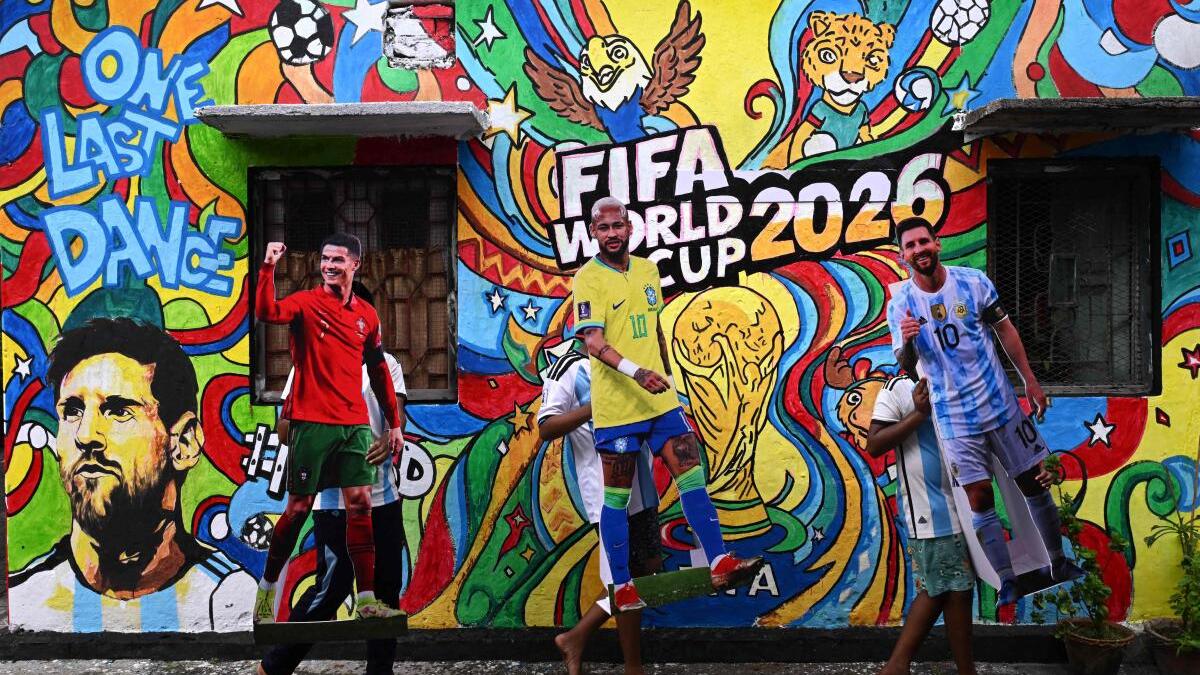
Lionel Messi has never walked down College Street. Cristiano Ronaldo has never stood beneath the floodlights of the Maidan. Neymar has never argued over tea at a North Kolkata adda. Yet all three have lived in Kolkata for years.
They have travelled on the backs of buses, appeared on school notebooks, stared down from posters above study tables and accompanied generations of Bengalis through board exams, first jobs, heartbreaks, surgeries, marriages and midnight arguments.
Murals of Cristiano Ronaldo, Neymar and Messi in Kolkata
| Photo Credit:
Special Arrangement
For nearly three decades, Kolkata has adopted them with the intensity it usually reserves for poets, political ideologies and football clubs.
Now, as the possibility of one final World Cup looms over Messi, Ronaldo and Neymar, the city finds itself confronting a thought it has carefully avoided.
What happens when these three men suddenly become memories? For this is not merely the retirement of footballers. It is the fading of an era that came of age alongside them, a generation watching its own memories walk slowly toward the touchline.
The last gods of a generation
Former striker for the Indian football team, Bhaichung Bhutia remembers that he was lucky enough to witness Maradona. “These three players have been the best footballers we have seen in our generation. Messi and Ronaldo have dominated world football for the last two decades and inspired an entire generation of young players. My son plays football and his inspiration has been Messi,” says the ‘Sikkimese sniper’ as he is fondly called.

Bhaichung Bhutia with Pele
| Photo Credit:
Bhaichung Bhutia/ X
“If you speak to kids across the North East or in the eastern part of India, including Calcutta, and ask them to name their favourite player, it will be either Messi or Ronaldo,” says Bhaichung.
Speaking about their retirement, Bhaichung notes, “In my generation, we had Maradona, then Zidane, then Brazilian Ronaldo, then Messi and Ronaldo. There will be a new generation of great stars who will inspire people. But for the last two decades, these players have been icons and great ambassadors for football.”
The boy who fell in love with Neymar
Strength and conditioning coach for United Kolkata Sports Club, Aakash Dave was a football prodigy. In 2011 he was selected by Bayern Munich to attend a football camp organsied by Bajaj Allianz in Germany. His first brush with Neymar was here. Bored one afternoon, he stumbled upon an old Brazil Under-17 match. A teenager wearing yellow caught his attention. When he returned home, Aakash changed his Facebook name to Aakash Neymar Dave.

Aakash Neymar Dave
| Photo Credit:
Special Arrangement
“Football looked fun when Neymar played. It looked free. It looked creative. Every time he got the ball, you felt like something special could happen. He made difficult things look effortless, and there was a joy to the game that I don’t think I’ve seen in many other players.”
“The way he moved, the confidence, the flair, the creativity — that’s everything I loved about him. I’ve followed him from Santos to Barcelona, PSG and back to Santos. I still buy Brazil shirts with Neymar’s name on the back. People make fun of me and call me ‘Neymar Paglu’, but I don’t care,” says Aakash. )

The memories he treasures most are not goals or trophies. They are moments of recovery.
Having suffered two ACL injuries ( a sprain or tear of the anterior cruciate ligament) himself, Aakash understands rehabilitation intimately; the loneliness, uncertainty and the fear that the old version of oneself may never return.
“When I watched Neymar fight back from injury, I wasn’t just watching as a footballer. I was watching as somebody who understood his struggle,” he pauses before arriving at a thought shared by countless football fans of his generation.
“When Neymar retires, a part of that football journey retires with him, “ says Aakash.
The man who taught her vulnerability
For Pratyasha Sarkar, a sports content writer, Lionel Messi has been a companion through heartbreak, a lesson in resilience and, in some strange way, a guide to understanding herself and her ‘reason for being’ as she puts it.
“Messi always felt like a very safe presence to me. He has a vulnerability and softness about him that made me, as a woman, feel included in football, a space that is often dominated by machismo. It feels like I know him personally. That’s how parasocial relationships and fandom work, “ says Pratyasha.
“Leo is a big reason behind a lot of my personality being shaped. I understood vulnerability and heartbreak through him before I experienced them in my own life, “ says the Argentina fan.

Pratyasha is dreamy when she says, “ I genuinely believe in magic because of Messi. Harry Potter couldn’t do that for me. Messi is the reason I believe in magic.”
As she speaks, the conversation drifts towards December 18, 2022 — the night Argentina won the World Cup. Pratyasha rolls up her sleeve and points to a tattoo on her arm bearing the date.

Pratyasha Sarkar
| Photo Credit:
Special Arrangement
“I have the date of Argentina’s World Cup victory — 18 December 2022 — tattooed on my arm. People ask if it’s a birthday or an anniversary. I tell them it’s the day Messi won the World Cup, ‘ she says.
The possibility of retirement, however, is harder to discuss. For the first time in the conversation, words seem inadequate. Her voice falters and tears cloud her eyes. She says, “I honestly don’t know what I will do if he retires. I can’t dare imagine it.”
Hope In white and blue
Photographer and illustrator, Prathama Mukherjee says, “We all have stress and troubles in our lives and when we see incredible talent like Messi play somewhere, it gives us tremendous hope.”
That hope accompanied her into one of the most frightening moments of her life. In December 2024, while preparing for a life threatening operation, she arrived at the hospital wearing an Argentina jersey.
“Somehow that white and blue of the Argentina jersey gives me tremendous hope. I went to the hospital wearing the jersey and came back in it,” she says.

At Prathama’s home, Messi’s photograph sits alongside images of revolutionary Che Guevara, saints Swami Vivekananda and Sarada Devi.
| Photo Credit:
Special Arrangement
At Prathama’s home, Messi’s photograph sits alongside images of revolutionary Che Guevara, saints Swami Vivekananda and Sarada Devi. When she goes to tutor a student, she points to a photograph of Messi and says: “Look at that man in the photo, he will teach you how to fight.”

Argentina’s flag hangs from Prathama’s balcony
| Photo Credit:
Special Arrangement
Like many football fans in the city, she struggles to imagine a game without Messi. Yet she also understands something fundamental about Kolkata’s relationship with football. The city has survived the departures of Pele, Maradona and countless other heroes. It will survive Messi’s retirement too.
Passing on the baton
For Cristian Ronaldo fan and software development engineer, Arkaprabha Mahata, the passing of footballing eras is as much about style as it is about players. He remembers being captivated by the Cristiano Ronaldo of 2008 to 2014. “What I loved was the flair in his game. Later, his style became more direct and efficient. The numbers remained extraordinary, but there were fewer skills and moments of improvisation,” he says.

Over time, Arka found himself gravitating towards Neymar, whose football felt rooted in a different tradition. “Effective football is important, but a little showmanship makes the game more enjoyable.” He points to joga bonito a Portuguese phrase which means “play beautifully” — a philosophy championed by Brazilian players in terms of playing with creativity, freedom and imagination and traces its roots back to ginga, the fluid, unorthodox movement style that emerged from Afro-Brazilian culture and shaped generations of Brazilian footballers.
For Arka, younger players may inherit the spotlight, but they inherit a different game.
Messi, Ronaldo and Neymar economies
If fandom has an address in Kolkata, it may well be the narrow lanes of Maidan Market, where rows of jerseys hang like flags of distant nations.
Mohammed Aquif Shaikh, who has been selling jerseys and retro football shirts from the Maidan after years of running a T-shirt shop in New Market, says demand for Messi and Ronaldo merchandise has surged. “Since Ronaldo and Messi might retire this year, a lot more Messi-Ronaldo jerseys are selling this year and most of our jerseys remain out of stock. Unable to point to precise number of jerseys sold he says that demand depends on which fans are visiting his shop on which given day,” he says, pointing to a phone crowded with missed calls from customers who follow his online jersey business.

Mohammed Aquif Shaikh
| Photo Credit:
Shreya Banerjee
A few shops away, Md Sajid, whose family has been in the jersey trade for more than 50 years, estimates that Messi, Ronaldo and Neymar account for nearly half his sales. “Oder-e toh niye cholche (They are the ones pushing sales),”he says with a laugh. Argentina, Brazil, Spain, Portugal and Germany remain his strongest sellers, with Brazil, Argentina and Spain leading the pack.

Md Sajid
| Photo Credit:
Shreya Banerjee
Sajid speaks of retirement with the calm of a man who has watched footballing generations pass through his shop. “Football will remain, only the players will change. When they retire, a new generation will take their place.”

Jerseys on display at Esplanade market, Kolkata
| Photo Credit:
Shreya Banerjee
The names waiting in the wings are Mbappé, Yamal, Vinícius Júnior, Bellingham. Whether they can inspire the same devotion as the trio that has dominated the imagination of football fans for two decades is a question that neither statistics nor trophies can answer. In Kolkata, the first clues may arrive on the racks of Maidan Market.
Kolkata and football
In August 2024, as the RG Kar protests swept Kolkata, supporters of arch rivals East Bengal and Mohun Bagan set aside a century of animosity to stand together in solidarity with the rape victim. For a day, the stadium became a page of the city’s history. The derby was abandoned, but something more enduring took its place: a reminder that in Kolkata, football is not merely a game but a language through which the city expresses its conscience.
That is why the eventual departures of Messi, Ronaldo and Neymar will not leave the city bereft. But Kolkata’s relationship with football has always outlived its heroes. The stars may leave the stage, but their light will go on finding new eyes to dream through.