
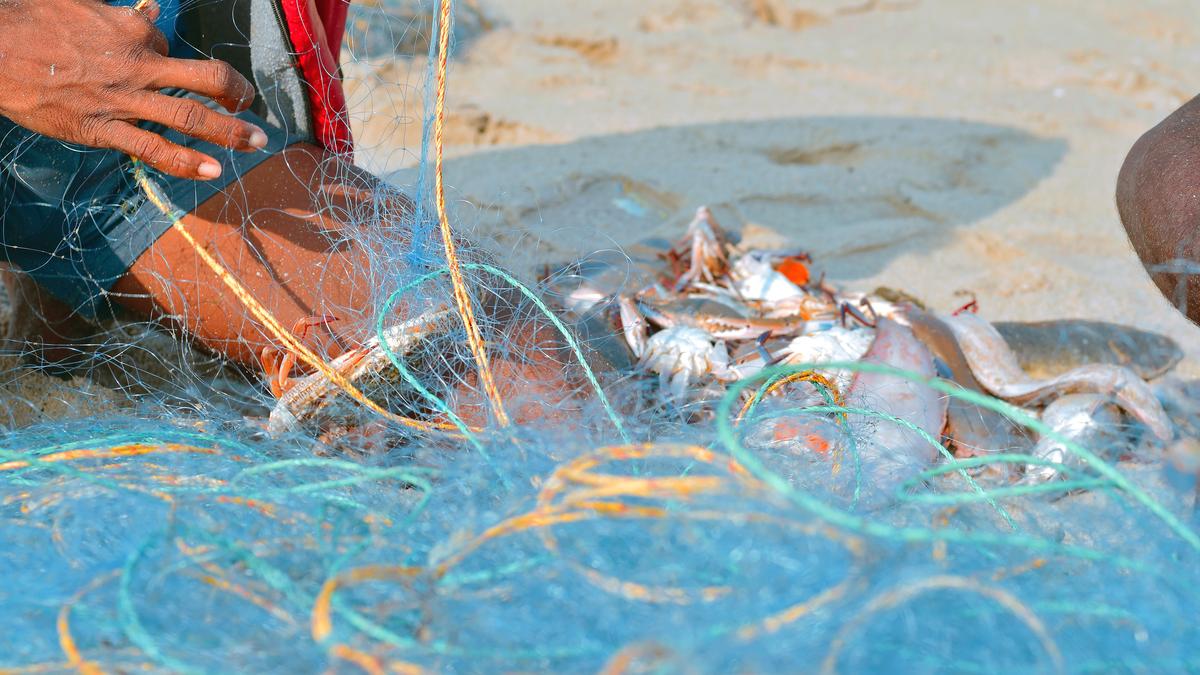
India has a very large and old marine fishing population. Every day, both small-scale and mechanised trawl fishers go out to earn a living and provide the nation with food.
The Government of India recently released its latest prognosis of the country’s ocean fisheries (February 11, 2026). Its press release emphasised that Indian marine fisheries are largely sustainable, suggesting the country has avoided the bane of international fishing, namely overfishing.
Official claims
Drawing on figures compiled by the Central Marine Fisheries Research Institute (CMFRI), the government said that most commercial fish stocks “are in good health”. Furthermore, it stated that “91.1% of the 135 fish stocks evaluated in different regions during 2022 were found sustainable.” If this assessment is accurate, it would be good news. However, there are good reasons to doubt whether it is indeed correct.
For one, the Food and Agriculture Organization (FAO) is far more reserved in its assessment of the condition of Indian marine fisheries than the Indian government seems to be. India’s country profile argues that “India’s marine fisheries production reached a plateau as most major stocks are fully exploited. […] Unregulated access to these fisheries resulted in significant overcapacity, especially of medium and small trawlers that compete over dwindling fishery resources with mostly impoverished small-scale fishers.” This message is not half as buoyant as the one published by the Indian government.
I will not dispute CMFRI’s conclusions or its methodology for calculating ‘sustainability’. After all, most of its procedures are veiled in secrecy. What is known, however, is that compared with many other fishing nations, CMFRI continues to rely primarily on landing data rather than stock assessments.
In other words, it calculates the availability of fish stocks in India’s Exclusive Economic Zone (EEZ) — which includes up to 200 nautical miles (371 km) of sea area around the country — based on what fishermen catch. Even a layperson can understand that finding a certain number of shells on the beach does not necessarily predict the quantity of shells in the sea.
Other nations, therefore, make use of stock assessments at sea itself, thereby calculating how much aquatic life is available in certain waters. This is obviously the more reliable method to determine the health of fish stocks.
The Government of India cannot be blamed for not yet adopting this more costly form of stock assessment. But it does raise suspicions that the race to catch up with China, which is also infecting the fisheries sector, may also be inducing a hidden bias in the figures.
The decline of inshore ecosystems
Among the fishers I have spoken to over thirty years along the Tamil Nadu coast, the consensus is that catches have consistently gone down and that many species that were formerly available have disappeared. The government, however, seems to continue on the path of amplifying fish production figures from one year to the next.
Overfishing, however, is not the central issue here. The more pressing concern is the decline, if not the destruction, of the inshore benthic environment. Over the past year, numerous fisheries scientists and policymakers have described the inshore fishing environment as “destroyed”. What exactly do they mean?
India is surrounded by a relatively narrow continental shelf, where fishing is always the most productive. This continental shelf is broadest in Gujarat and a part of Maharashtra, but remains quite narrow along the rest of the sub-continent.
Generally speaking, one can assume that the territorial seas — a legal category referring to waters that lie within 12 nautical miles (or 22 km) from shore — largely overlap with the continental shelf. These waters provide favourable ecological conditions for commercially valuable species such as shrimp to feed, breed and grow.
But why do senior experts conclude this is no longer the case?
This is a complex question with many answers. Thus, one can point to the construction of dams in major rivers, which disallow land-based nutrients from entering the sea. One can also point to the ongoing destruction of mangroves, where fish breed, and to pollution that is entering the sea from various industrial, agricultural, and urbanising sources. Many scientists, and fishers too, point to such changes to explain the decline of fisheries. These factors obviously affect the inshore fishing zone more than they do distant waters.
Mechanised trawling and its cost
One of the many factors contributing to this decline is the dramatic and largely uncontrolled expansion of mechanised trawling.
It is good to remind ourselves first of all that semi-industrial trawling is not an Indian fishing method. It was introduced from abroad around 1960 and has since expanded to gigantic proportions.
According to the same government press release, India now has 64,414 mechanised fishing vessels. These numbers are growing day by day as there are practically no restrictions on new entries. Moreover, existing vessels are continuously being extended and fitted with more powerful Chinese engines, enabling them to catch even more fish.
This oversized fleet of mechanised trawlers ploughs the inshore seabed in a continuous fashion. In heavily trawled areas, this results in a decline of all animal and plant life. It has also resulted in major conflicts with the numerous population of small-scale fishers who see their livelihoods imperilled. The problem is that regulations to protect the inshore fishing zone are almost non-existent. Yes, mechanised boat fishing is closed for two months every year, so as to allow for the rejuvenation of fish stocks. But the main tool to prevent unwanted trawling — the prohibition for mechanised boat fishers to operate within a geographic zone of 5 NM — lacks forcefulness.
There are two main reasons for this. First, coastal States lack sufficient staff or craft to patrol the inshore waters. Second, governments have precluded fishers from playing a helpful role in management. The result is that the ecology of the inshore fishing zone is continuously being degraded, and all fishers — small-scale and mechanised — are being pushed out to the offshore and the deep-sea fishing zones.
Rethinking fisheries policy
The Indian government is optimistic about the potential of deep-sea fishing and is encouraging fishers to make a shift. But the question is whether that potential, which is also being tapped by other fishing nations, is as bountiful as expected. The FAO estimates that “at best, only a marginal increase can be realised through exploitation of deep-sea resources.”
More fundamentally, India’s current fisheries policy is wasting the enormous potential of inshore waters. For one thing, it imposes extra expenses for fuel and technology on fishers so that they can actually travel to more distant waters. At the same time, it is closing its eyes to the dire need for proper management of inshore waters. Aside from addressing the problems of marine pollution, it also means curbing, if not reducing, mechanised boat fishing. This is more than a technical issue. Mechanised boat fishers, by way of their numbers and their political influence, now often stand in the way of proper management. This is witnessed, for example, in the case of the Palk Bay, which is located between India and Sri Lanka. There, the Indian fleet of mechanised boat fishers now pirates Sri Lankan waters to the detriment of small-scale fishers on the other side of the international border. Ownership of the island Katchatheevu does not make any difference in this respect.
The way forward
While the government’s assessment paints an encouraging picture of Indian fish stocks, a more fundamental concern remains. The larger issue is that fishers, scientists and policymakers continue to decry the degradation of the inshore fishing grounds. A viable and truly sustainable fishery can only be realised if governance of the so productive inshore waters improves. For this, the government must adjust its perspective. This is in line with FAO’s view that: “Strenuous efforts are needed at federal and state levels to upgrade the country’s capacity to manage its marine fisheries.” In this context, CMFRI might also want to devote effort to studying what the condition of the benthic environment is actually like. This would provide a basis for deliberating on the best way forward.
(Maarten Bavinck is emeritus professor of coastal resource governance, University of Amsterdam, email: j.m.bavinck@uva.nl)