



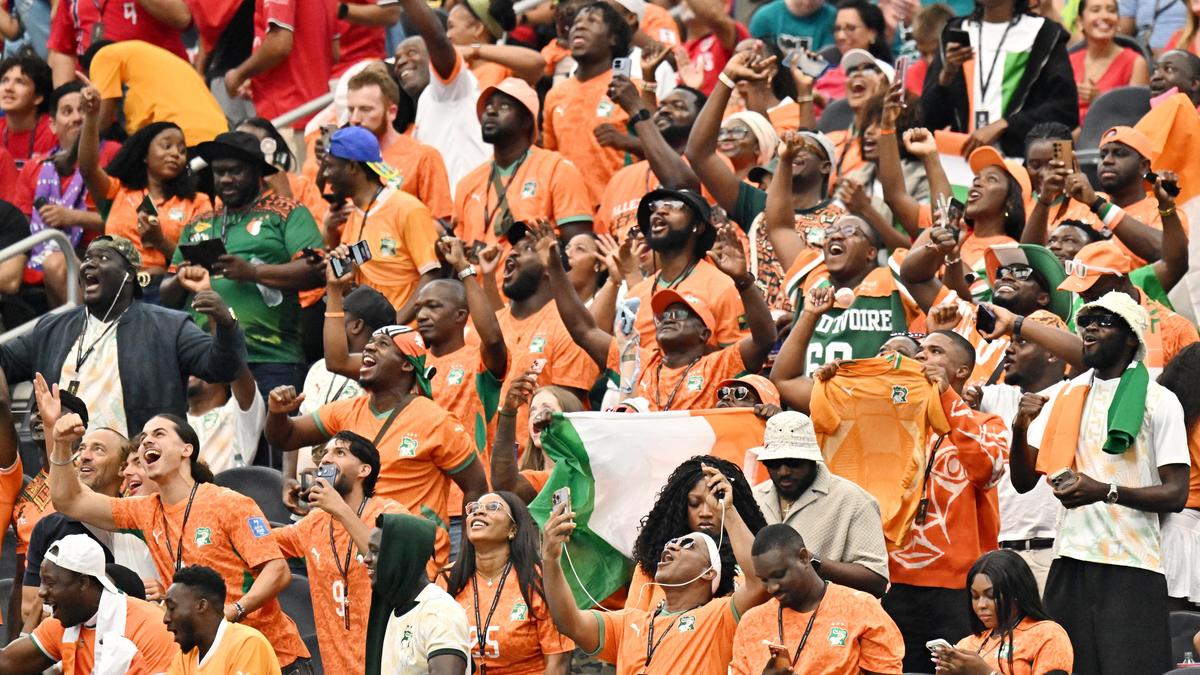
Ivory Coast fans cheer their team during the round of 32 match against Norway.
| Photo Credit: REUTERS
For 90 minutes in Philadelphia, Haitians were home again.
Outside the Lincoln Financial Field, vendors sold griot and patties from food trucks while Creole floated through the humid afternoon air. Families arrived wrapped in blue and red flags. Children who had never lived in Haiti knew every word of the ‘La Dessalinienne’, the national anthem.
The team eventually lost to Brazil, but the result almost felt beside the point.
For a country that has endured political violence, earthquakes and humanitarian crises, simply returning to the World Cup had become a celebration of survival. Many of those in the stands had travelled not from Port-au-Prince but from Brooklyn, Miami, Boston and Montreal. They carried two homes with them — one that they had left behind and the one they had built in the United States of America.
The expanded 48-team World Cup has not just introduced new footballing nations, but it has reunited immigrant communities scattered across North America. Every match has become a family reunion of sorts, where flags stored away for years have reappeared.
Dallas, home to one of the largest and most active West African populations in the US, welcomed the Ivory Coast team with the Abidjan Farot Welcome Party on the eve of its round of 16 clash. “My son has never been to Abidjan or anywhere in Ivory Coast. So, I brought him here so that he could feel to be part of the nation. We are incredibly proud of our team who has connected us in this World Cup,” said N’Guessan, who had travelled from Atlanta with his four-year-old son and was frantically waving a ‘Welcome to Dallas’ sign as the likes of Amad Diallo and Yan Diomande happily posed for selfies and signed autographs.
Tanya Marie surprised his mother Chilemb Munung with World Cup tickets to see the Democratic Republic of Congo play Portugal at the Houston Stadium. “I can’t even express to myself what I was feeling there, but it was like oh my God,” Chilemb said after the match.
For 90 minutes, football has dissolved the distance between where these communities came from and where they live now.
Published – July 02, 2026 05:57 pm IST