



Nine years ago, the first FIFA tournament hosted in India offered a glimpse into football’s future.
Packed stadiums in New Delhi, Kolkata, Kochi, Navi Mumbai, Goa and Guwahati watched teenagers chasing their dreams. But many have disappeared into the game’s vast, unforgiving talent vortex. But 18 of those youngsters are now back on football’s biggest stage, representing their countries at the 2026 FIFA World Cup.
No nation has produced more graduates than Japan.
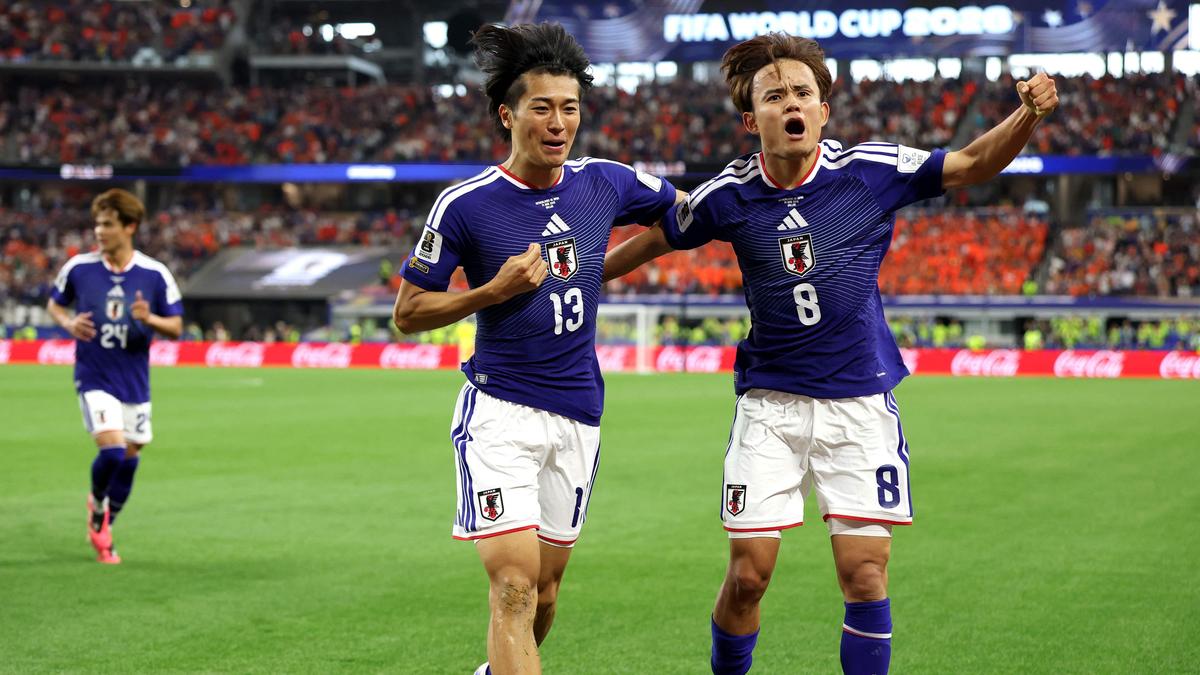
Five members of Hajime Moriyasu’s squad – Keito Nakamura, Takefusa Kubo, Zion Suzuki, Yukinari Sugawara and Ayumu Seko – first experienced FIFA competition in India. And among the 18 players to have made that remarkable leap, none has, so far, left a greater mark on this World Cup than Nakamura, who has already contributed to two goals in this tournament with an assist and a strike.
His equaliser against the Dutch, however, cannot be separated from the man who has supplied him throughout almost every stage of his international career.
“It was moving,” Nakamura said after scoring from another Takefusa Kubo assist against the Netherlands. “My first goal for the senior national team was also from Kubo’s pass, and today again he assisted me. We’ve played together since our youth days. In certain situations, I know the pass is coming without us saying anything.”
It is a partnership that has evolved over almost a decade.
In Guwahati, during Japan’s opening match of the 2017 FIFA U-17 World Cup, Nakamura scored a first-half hat-trick in a 6-1 victory over Honduras. His first goal came from a Kubo corner before Kubo added one of his own before half-time.
Nine years later, the script remains familiar.
Against the Netherlands, Kubo burst into the left side of the penalty area before cutting the ball back into what Japanese media have long called the “Keito Zone” – an area where Nakamura has always proved to be lethal since his days at the Mitsubishi Yowa youth academy.
But Kubo and Nakamura’s journey to the top has been far from similar.
Kubo’s name was known across world football before he was old enough to drive. Dubbed the “Japanese Messi”, he joined Barcelona’s famed La Masia academy at the age of 10 before FIFA regulations on the recruitment of foreign minors forced him to return home. But the label has followed him everywhere.
“I don’t like being compared to Messi, but one day I hope to be like him,” Kubo, who now plays for Real Sociedad, had said after he became the second-youngest debutant in J-League history in May 2017.
He has also spoken openly about the difficulties of living abroad at such a young age, after scouts from the Catalan giant were impressed by his skills during a Barcelona Soccer Camp in Yokohama in 2009.
“When I was little and went to Barcelona, I didn’t think much about it. I just always wanted to go to Barcelona at any cost,” he told Japan’s Soccer Digest magazine. “I tried my best not to be bullied as much as possible with my small body. However, sometimes I was beaten by the bigger kids with their fists. It was a very harsh environment.”
Nakamura’s rise was less glamorous and testing but perhaps more representative of modern Japanese football. A product of Mitsubishi Yowa’s academy, he moved from Gamba Osaka to Dutch side FC Twente on loan in 2019-20. After playing in the Netherlands, Belgium and Austria, he now represents Reims in France.
Japan’s remarkable performance in recent years – it has lost one of its last 15 matches – can be attributed to the continuity and seamless progression it has achieved from youth to senior football.
The 2017 under-17 World Cup introduced Indian fans to a generation that is now reaching its peak. Nine years later, many of those teenagers – like Nakamura, Kubo, Aurelien Tchouameni (France), Eric García and Ferran Torres of Spain – have become the faces of their national teams, proving that football’s youth tournaments are remembered for the careers they set in motion.
Players from the 2017 FIFA U-17 World Cup in India now at the 2026 FIFA World Cup (18)
Japan (5): Keito Nakamura, Takefusa Kubo, Zion Suzuki, Yukinari Sugawara, Ayumu Seko
France (2): Aurelien Tchouaméni, Maxence Lacroix
Spain (2): Eric García, Ferran Torres
United States (2): Sergino Dest, Tim Weah
New Zealand (2): Bill Tuiloma Just, Liberato Cacace
Turkiye (1): Yunus Akgun
Haiti (1): Wilson Isidor
Algeria (1): Amine Gouiri
England (1): Marc Guehi
Ivory Coast (1): Seko Fofana
Published – June 27, 2026 07:25 pm IST