


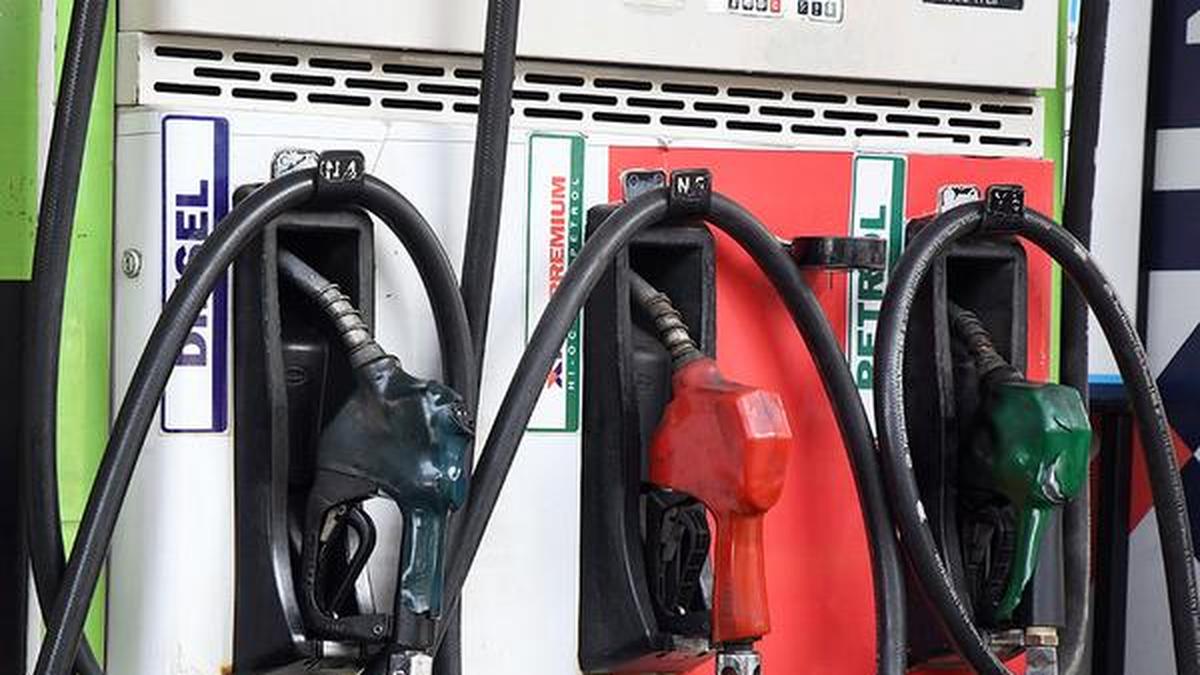
Representational image only. File
Profitability at State-run oil marketing companies (OMCs) is set to improve as falling crude oil prices lift fuel marketing margins, although rising debt levels and uncertainty over fuel taxes could limit the sector’s longer-term earnings outlook, according to a JP Morgan report.
“Composite margins on petrol and diesel sales at State-run refiners and fuel retailers are now above levels seen before the recent Middle East [West Asia] conflict, with gains driven by lower crude prices and reduced central excise duties,” it said.
The start of the West Asia conflict triggered a surge in global oil prices but retail pump rates in India remained steady for large parts and rising only by a fraction of the required increase. Even after the ₹7.50 per litre increase in petrol and diesel prices in May, retail pump rates were lower than the cost.

“Our estimates for OMC composite margins on petrol and diesel are now higher than pre-war levels. Losses on LPG are still elevated, but should also start to track oil down soon,” JP Morgan said adding earnings in April-June — the first quarter of current fiscal year — will likely be hurt by large inventory losses, but 2Q profitability should be better.
“Two issues limit our excitement around this improvement in margins: the OMC will have acquired material debt during the last few months — affecting valuations, and a major part of the restoration of profitability is on account of the reduction in excise duties,” it said. “It is possible that the government keeps taxes low for some time — permitting debt repayment at the OMC. The risk of an eventual increase in excise duties remains.”

The government had cut excise duty on petrol and diesel by ₹10 per litre each in March to avoid an immediate increase in retail prices. The duties may be restored once global oil prices fall to pre-war levels and stabilise.
Among the three State-run OMCs — Bharat Petroleum Corporation Limited, Indian Oil Corporation and Hindustan Petroleum Corporation Limited — BPCL and IOC are expected to benefit the most in the near term if oil prices continue to ease.
The brokerage estimated that the current composite petrol and diesel margins for BPCL and IOCL are higher than pre-conflict levels, while HPCL’s margins have largely returned to or exceeded levels seen before the recent oil price spike. The improvement reflects stronger combined refining and marketing economics, even as standalone fuel marketing margins remain below historical averages.

The stronger margin environment could support earnings from the second quarter onwards, particularly if crude prices remain below $80 per barrel and refining margins stay elevated.
However, first-quarter earnings are likely to remain under pressure due to inventory losses stemming from the recent decline in crude prices. Analysts also expect the three OMCs to report elevated borrowings after absorbing losses on the sale of petrol, diesel and liquefied petroleum gas (LPG) over recent months.
While losses on LPG remain significant, they are expected to moderate as lower oil prices feed through to the sector.

A key factor behind the recovery in fuel margins has been the government’s decision to keep excise duties lower, allowing a larger share of retail fuel prices to accrue to OMCs. Analysts estimate the reduction in excise duties has cost the government roughly ₹1.8 lakh crore annually in forgone revenue. That has raised questions over the sustainability of current profitability levels.
“The government may allow OMCs to retain higher margins for some time to help reduce debt accumulated during recent periods of under-recovery,” analysts said. However, pressure to raise fuel taxes could re-emerge, particularly as the government faces higher expenditure commitments over the next two fiscal years.
As a result, JP Morgan expects OMCs could report strong earnings in the December and March quarters if crude prices remain subdued, but caution that visibility on fuel marketing margins beyond fiscal 2028 remains limited.
The sector is therefore likely to remain a tactical play tied closely to movements in crude oil prices and government tax policy, with BPCL and IOC viewed as the preferred bets in the current environment.
Published – June 22, 2026 04:26 pm IST