

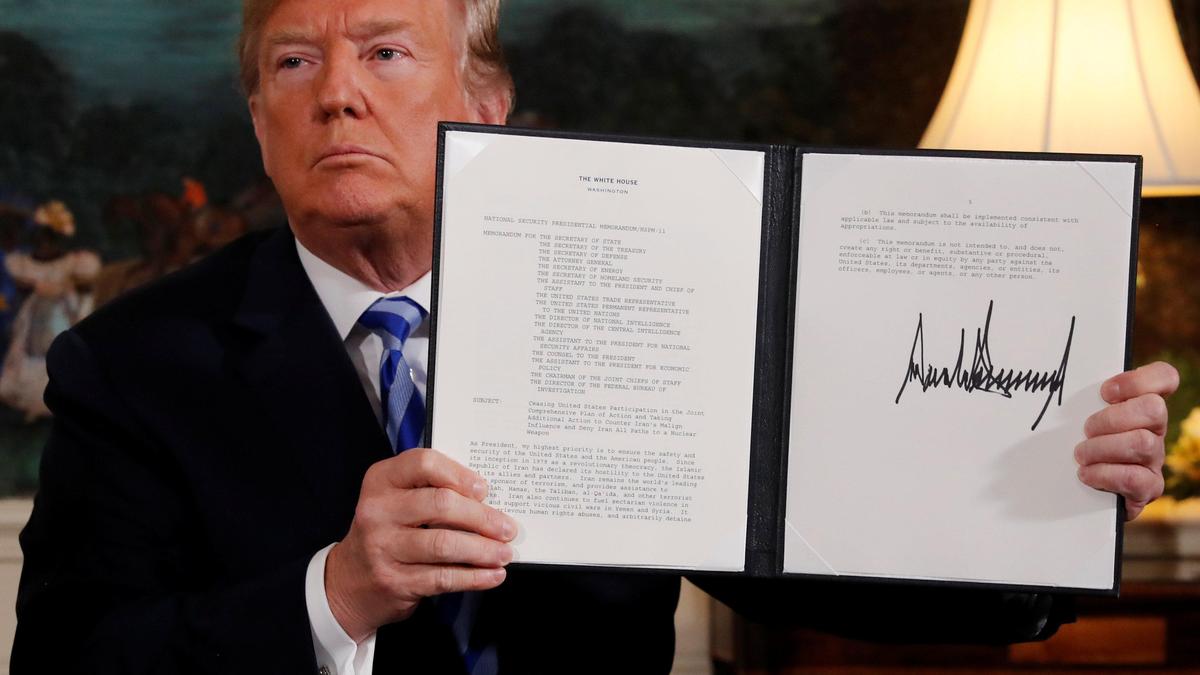
In 2018, U.S. President Donald Trump withdrew the country out of the JCPOA (Joint Comprehensive Plan of Action), labeling former President Barack Obama’s landmark nuclear deal as one of the worst agreements made in the history of international negotiations. Eight years later, following military threats, crippling economic sanctions, and renewed hostilities in West Asia, the United States is back exploring talks with Iran.
It may come off as a paradox.
How could the President, who recently abandoned the deal by former President Obama, even consider making negotiations of his own?
That is because there has been a recurring trend in America’s foreign policy throughout the last couple of decades. Despite any difference in ideologies, political affiliations or strategies, every U.S. administration comes to the realisation that Iran cannot be bullied with airstrikes, sanctions or diplomatic isolation.
Starting from George W. Bush to Mr. Obama, and then from Mr. Trump to Joe Biden and Mr. Trump yet again, the administration in Washington has experimented with various approaches to coercion. However, the final outcome seems to be rather predictable: diplomacy. What is noteworthy is that this trend is more indicative of structural realities of power in the contemporary international system rather than of Iran alone.
‘Axis of evil’
In 2002, when former President George W. Bush designated Iran as part of the “Axis of Evil”, many believed that Iran would be the next target of America’s military intervention following Afghanistan and Iraq.
This, however, did not occur, and there were straightforward explanations for this.
In contrast to Iraq, Iran is not a small Arab nation with weak forces. It is an example of a civilisation-state with a dense population, a huge area that stretches from the Persian Gulf to the Caspian Sea, and a strategically positioned nation connecting West Asia, South Asia, and Central Asia.
Most importantly, Iran lies across the Strait of Hormuz, which is one of the most important oil chokepoints in the world, with a significant share of internationally shipped barrels of oil passing through it. Like we witnessed in the recent conflict in West Asia, any large scale conflict involving Iran will have instant repercussions for the international oil market.
The American policy makers were well aware of this truth. In spite of being at the pinnacle of their military superiority, the cost of occupying or invading Iran was considered prohibitive. Their experience in Iraq made this realisation stronger. If the stabilisation of Iraq itself was not an easy task, handling a crisis in Iran would have been an even bigger challenge.
This was the point where the choice was made and the first lesson was learned: Iran was too important to be neglected, but too expensive to be conquered.
Under Obama’s aegis
When Mr. Obama became the President, he inherited the Iran dilemma, a problem that previous administrations had failed to solve despite years of trying.
By the late 2000s, Iran continued to develop its nuclear programme at a steady pace. Sanctions had harmed the country’s economy significantly, yet they had not stopped Iran from enriching uranium. The belief that sanctions would automatically make Iran change its stance proved incorrect.
On the contrary, the Obama administration saw sanctions as tools that could be used to get Iran to negotiate. This insight is what eventually shaped the JCPOA.
It aimed neither to change Iran’s regime nor settle all the issues between the two countries. Instead, the agreement was intended to put verifiable limits on Iran’s nuclear programme, increase the period necessary to build a nuclear weapon and create a completely new inspection regime.
Advocates viewed the agreement as an achievement while critics argued that it settled too few things, especially with regards to Iran’s missile programme and actions in the region. However, both supporters and opponents recognised that sanctions alone were unable to stop Iran’s nuclear development. The agreement was not a perfect solution, but a recognition of the failure of coercion in achieving what was intended.
Trump’s stance
Mr. Trump entered office intending to prove that Mr. Obama had conceded too much, and eventually withdrew from the JCPOA in 2018. His central argument for leaving the deal was quite simple. The deal involved temporary limitations, sanction relief and ignored the rest of Iran’s behavior. Mr. Trump believed that he could achieve a better deal through maximum economic pressure.
The resulting sanctions regime was unprecedented as Iran saw its oil export industry devastated. Its banking sector was restricted. The country was forced into even greater economic distress.
Yet the administration still hoped that such a level of pressure would make Iranian leadership return to the negotiations. But the effects were less decisive than they anticipated.
The sanctions have indeed impacted the Iranian economy negatively. However, they did not manage to achieve the desired results for Washington.
On the contrary, the JCPOA compliance became more difficult for Tehran. The country has increased the enrichment rate and nuclear stockpiles. The nuclear programme has made significant strides compared to the times of the original deal.
Thus, one of the major paradoxes of the maximum pressure strategy revealed itself.
While Mr. Trump’s sanctions were intended to limit the country’s advance towards a nuclear status, in fact, after the JCPOA’s demise, the Iranian nuclear programme progressed significantly.
This mainly highlighted that economic sanctions may impose penalties on another country, but they may not necessarily dictate the outcome politically.
One of the reasons why successive U.S. governments have had to engage in diplomacy once again is because of the fact that military intervention alone will not solve their problems. Such intervention is capable of destroying facilities, of destroying infrastructure, and of postponing programmes, but cannot obliterate knowledge.
Once a nation state has gained the kind of knowledge, technical capacity, and industry needed to develop nuclear capability, they cannot be destroyed by military intervention.
This is the main reason why nuclear crises have existed all over the world. While policymakers might differ on strategy, ultimately they all recognise that negotiated agreements are required to sustain nuclear restraints.
Recent crisis
This latest crisis between the United States, Israel and Iran is just another iteration of the same old narrative.
While the conflict has evolved from a sequence of military strikes and Iranian responses to a ceasefire and renewed attempts to negotiate sanctions, maritime security and Iran’s nuclear programme, the situation reveals a strange twist. President Trump withdrew from the JCPOA in 2018 arguing that diplomacy gave Iran too much and demanded too little from the country. However, the recent developments have shown the world that military pressure alone will never achieve a long-term resolution.
This new ceasefire reflects such considerations. Instead of solving all the conflicts at once, it focuses on addressing the most pressing dangers, including the possibility of escalation, disruptions in the energy market, and the threat of a wider regional war. The most controversial topics, like Iran’s long-term nuclear programme, its missiles, and regional role, are left for future discussions.
This way, the current accord is more of a return to an old balance rather than an attempt at breaking one. As time passes, both sides understand that there are higher stakes involved in escalating this conflict further than continuing to talk about it.
As tough as the rhetoric of maximum pressure or military engagement may sound, the latest clash has reaffirmed what has been clear in the United States’ relationship with Iran for more than two decades: Washington can pressure Tehran, weaken it, and even threaten it, but it cannot avoid negotiations with it.
The Iran dispute can also be seen as an ongoing struggle between competing Presidents and rival schools of thought.
Was Mr. Obama correct to engage? Was Mr. Trump correct to disengage? Was maximum pressure better than engagement? While these are valid concerns, they are not the most valid ones. The real question here involves the limitations of power.
Each administration assumes that it can alter the strategic environment by employing some mixture of pressure, deterrence, and diplomacy. However, they eventually find themselves running into those same limitations.
Iran still remains too big, too strategically situated, and too resilient to be neglected. It cannot be defeated easily and it cannot be isolated permanently. Neither can it be eliminated from the wider geostrategic equation of West Asia. This is the reason why Washington ends up back at the negotiation table time and again.