


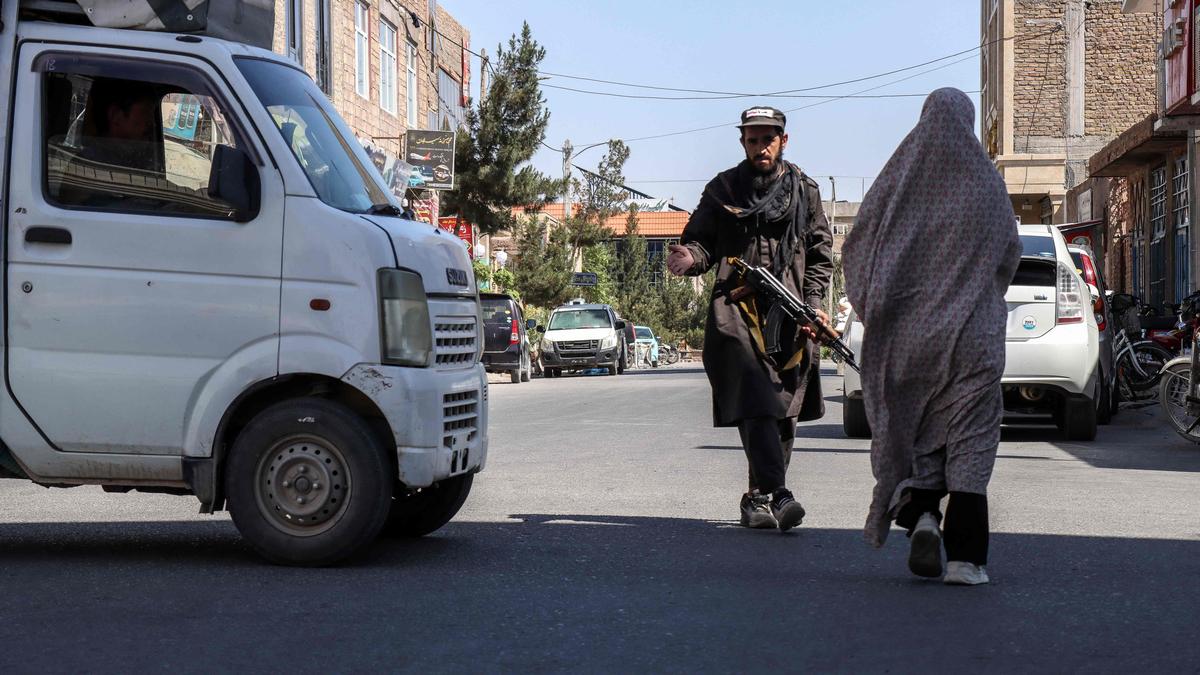
The chants were familiar. But this time, they echoed not in Tehran, but in Herat.
In mid-June, Afghanistan’s western city of Herat witnessed a rare display of public defiance against the Taliban. Women, and this time, men too, marched through the streets chanting “Women, Work and Freedom”, a slogan probably inspired by Iran’s 2022 “Woman, Life and Freedom” movement that emerged after the death of the 22-year-old Mahsa Amini.
The protests did not unfold overnight.
The spark in Herat
According to Zan Times, an exiled media organisation run by Afghan women journalists, the latest crackdown appears to have been planned days in advance. On June 4, Herat’s governor Noor Ahmad Islamjar reportedly met with a group of morality enforcers.
On the afternoon of June 5, Taliban officials used the end of Friday prayers to announce that women who failed to comply with the Islamic dress code would be arrested. The following morning, the arrests began.
On June 6, dozens of women were detained across several neighbourhoods, including Darb-e-Malik, Shahr-e-Naw, Ab Burda, Jibrayil and Haji Abbas. By June 7, the United Nations had confirmed that at least 30 women were in custody for alleged dress code violations. “Dozens more women reportedly received verbal warnings,” United Nations Assistance Mission in Afghanistan (UNAMA) said.
Then came the backlash.
On June 9, men and women took to the streets together in a rare act of collective defiance. The Taliban’s response was swift; within minutes, they reportedly opened fire on demonstrators, killing at least two people, including a child according to some reports, and injuring more than 20 others.
Four days later, on June 13, demonstrators returned to the streets.
Abdul Salam Hanafi, the Taliban Deputy Prime Minister for administrative affairs, praised the performance of Herat’s local administration amid widespread protests over the detention of women in the province, according to Afghanistan International.

The immediate trigger for the unrest was a series of arrests carried out by the Taliban’s morality police. Women and girls were detained for allegedly violating the regime’s dress code in a city that has historically been regarded as one of the country’s more progressive and culturally vibrant centres.
Under Taliban regulations, women should cover their entire bodies, usually with a burqa, and are prohibited from wearing perfume or anything capable of ‘attracting’ public attention.
Witnesses described women being pulled into police vans, including some who were already fully covered. Among those detained were reportedly pregnant women. The Taliban initially dismissed reports of the arrests as rumours before later defending the operation as the enforcement of Islamic law.
The Sharia law
To understand about these arrests, one has to understand the role Sharia plays in Taliban-ruled Afghanistan.
The Taliban returned to power in 2021. Since then, it has governed through its interpretation of Sharia, or better known as Islamic law. While Afghanistan has historically followed the Hanafi school of Sunni jurisprudence (fiqh), often regarded as one of the more flexible traditions within Sunni Islam, the Taliban has adopted a far stricter, Deobandi-influenced interpretation.

Under this system, women face extensive restrictions on education, employment and public life. Girls are barred from secondary and higher education. Women face severe limitations on work opportunities and are often required to travel with a male guardian. Even ordinary social interactions and movement outside the home are heavily scrutinised.
The morality police enforce these rules through patrols, arrests and detentions.
Since 2021, when the Taliban returned to power in Afghanistan, women across the country have lived under a system of surveillance and punishment over both their dress and their presence in public. What began as verbal guidance evolved into a decree by the Taliban’s Supreme Leader in 2022, Mawlawi Hibatullah Akhundzada, declaring burqa the preferred form of hijab. In 2024, it was codified through the Law on the Propagation of Virtue and Prevention of Vice, giving morality police sweeping powers to detain, intimidate and punish women whose appearance failed to meet Taliban standards.
Earlier this year, as Zan Times reported, morality police established checkpoints across the city, pulling women from taxis and detaining those wearing a manto (a traditional long coat worn by generations of Afghan women) instead of the Taliban-approved black chador or burqa.
Supporters of the Taliban argue that these measures represent a return to authentic Islamic governance after decades of war, corruption and foreign intervention. But critics, including many Muslim scholars, argue that the Taliban’s interpretation represents an extreme and selective reading of Islamic law.
Human rights organisations estimate that millions of Afghan girls remain locked out of secondary education. Large numbers of women have lost employment opportunities. Restrictions on movement, healthcare and public participation have deepened both economic hardship and social isolation across the country.

But in the latest Herat demonstrations, perhaps the most striking element was not the slogan but the people. Since the Taliban takeover, public protests have been rare and led by women. One of the examples being the nationwide protests against the closure of women’s beauty salons. This time, however, many Afghan men appeared willing to publicly challenge the authorities as well.
A rare act
As one Zan Times newsletter observed, that they (men) did so this time says something important. What is being done to Afghan women is no longer viewed as a women’s issue alone. It has become unbearable for entire families and entire communities.
The June 5 story, however, does not end with the arrests. While some of the women detained in Herat have since been released, little is known about what they experienced inside Taliban detention facilities. What happened inside the detention centres? How were they treated? Activists and rights groups are now seeking answers as they attempt to document the experiences of those who were taken into custody.
International organisations were quick to condemn the crackdown. The United Nations, along with UN Women and the UNAMA, expressed concern over detentions, restrictions on freedom of expression and the use of ‘excessive force’ against demonstrators. They also called for the release of detainees and urged the Taliban to respect basic rights.
Yet there is little indication that the Taliban intends to alter course.
The Herat protests were relatively small, with estimates ranging from 70 to 150 participants. On the face of it, the protests were triggered by the arrest of dozens of women accused of violating the Taliban’s dress code. But it is one of the clearest signs yet that frustration with Taliban rule is no longer confined to private conversations.