


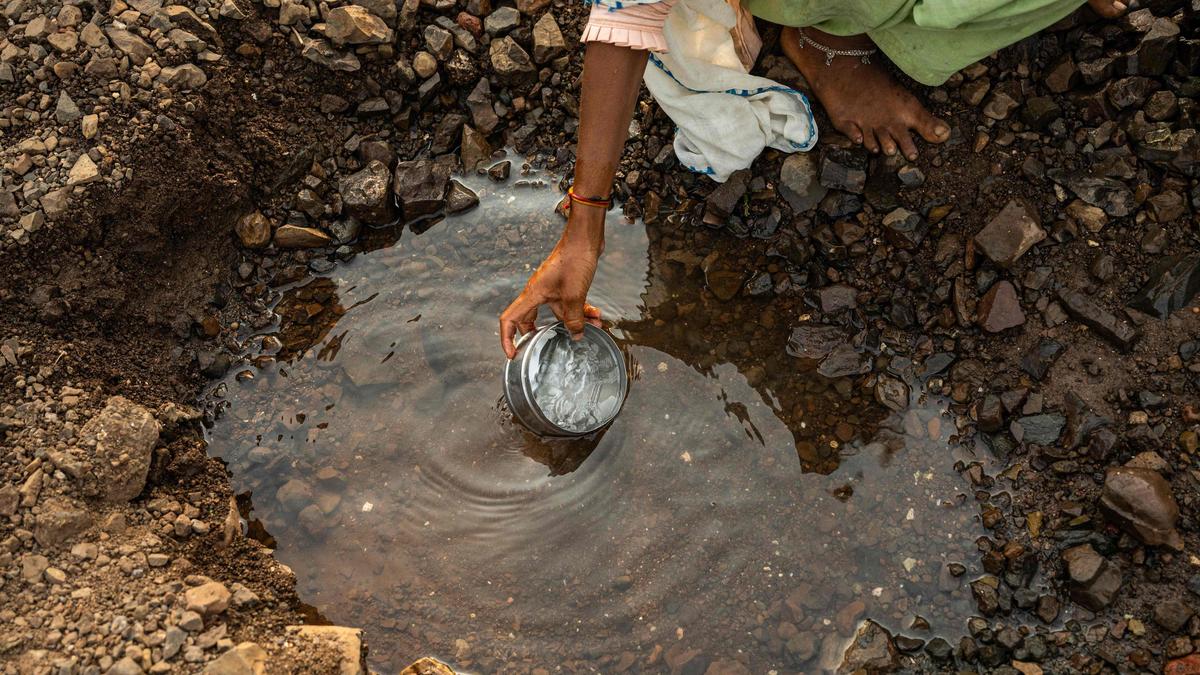
Droughts can increase the levels of antibiotic resistance in soil, a new study by researchers from the California Institute of Technology (Caltech) has reported. Published in Nature Microbiology, the study revealed that when soil dries due to drought stress, the concentration of natural antibiotics increases, favouring the survival of resistant bacteria.
The study also projected that by 2050, several parts of India and other drought-prone countries will grapple with severe antibiotic resistance (ABR).
Soil has been an important source of antibiotics. Previous studies have also established the evolution of antibiotic resistance from microbes in the soil.
“The current study spotlights a broader ecological perspective where climate-driven environmental changes might also influence resistance,” the study’s authors, postdoctoral research scholar Xiaoyu Shan and the Gordon M. Binder/Amgen professor of biology and geobiology Dianne Newman, wrote in an email interview.
Using computational analysis of soil DNA datasets from the U.S., China and Europe and across cropland, wetland, grassland, and a forest site, the team found that drought increased the prevalence of genes that both produce antibiotics and help organisms resist them.
The researchers also replicated the findings using synthetic soil samples inoculated with soil bacteria and treated with a known antibiotic. When the soil was dried, antibiotic-resistant bacteria better survived the adverse conditions than sensitive bacterial species.
“Previous studies have documented antibiotic resistance genes in wastewater, rivers, and soils, but these patterns have largely been interpreted as consequences of anthropogenic contamination, such as antibiotic overuse in medicine and agriculture,” the two co-authors wrote.
“Our work asked a fundamentally different question: could environmental stress, independent of direct antibiotic pollution, actively shape the evolution and enrichment of resistance?”
Dual threat
Today, the links between climate change and ABR are becoming more prominent. In one recent study, scientists found that subjecting experimental grassland plots to warming conditions over 11 years resulted in a 23.9% increase in the abundance of ABR genes. Droughts are also becoming more severe due to climate change. In 2022 alone, moderate and extreme droughts affected 30% of the world’s land area, up from around 10% in the early 1900s.
The study’s authors also examined hospital data in 116 countries and found that drier regions reported more infections due to antibiotic resistance. Previous research has shown ABR can move from the environment to humans through horizontal gene transfer, where genetic elements carrying antibiotic resistance are transferred to human pathogens, and bacterial transmission via aerosols, polluted soil and water, and agriculture.
“India is vulnerable because it simultaneously faces several challenges relating to increased frequency of droughts, heavy antibiotic use in humans and livestock, wastewater irrigation, dense human-animal-soil interactions, and heavy agricultural dependence,” G. Ravikanth, senior fellow and convenor, Ashoka Trust for Research in Ecology and the Environment (ATREE), Bengaluru, said.
Per a 2024 report on flood and drought risks in India, 91 districts are in the ‘very high’ drought risk category while 188 districts face ‘high’ drought risk. More than 85% of these districts are in some of India’s most populated States. While reports have revealed that about 20 lakh people in India could lose their lives to antimicrobial resistance by 2050, a similarly reliable estimate for ABR could not be found.
“India’s drought-prone regions overlap substantially with the rural districts where access to formal healthcare is weakest,” Erta Kalanxhi, fellow and director of partnerships at One Health Trust, a global health research organisation, said. “In this context, climate change may intensify the selection pressure on ABR in the populations least equipped to manage the clinical consequences. The droughts themselves, and the adaptive practices that follow, are likely to amplify the resistance burden and deepen health inequalities.”
Role of vaccines
The experts all said that the study called for urgent monitoring and mitigation. For India, Dr. Ravikanth emphasised the need for long-term monitoring stations in arid regions to track microbial community shifts, drought intensity, and antibiotic resistance. He added that existing Krishi Vigyan Kendras, especially in arid areas, could be mobilised for data on antibiotic residues in agricultural soils, poultry and dairy farms, and understand the spread of resistant microbes.
“The key takeaway here is that we must treat ABR as a climate adaptation issue and start integrating its impacts in our climate models,” he said.
Dr. Kalanxhi stressed the need to mitigate ABR by preventing infections. In a recent One Health Trust policy brief, in collaboration with Christian Medical College, Vellore, the authors underscored the role of vaccines to address the issue.
“Apart from concentrating natural antibiotics in soil and intensifying resistance, droughts also create the conditions under which enteric pathogens such as Salmonella typhi thrive — limited and contaminated water sources, poor sanitation, and overstretched health systems,” she said. “Scaling up vaccination suppresses the disease burden that drought amplifies and reduces the empirical antibiotic demand that drives resistance selection in clinics.”
The authors Drs. Shan and Newman also said prioritising developing and disseminating more rapid diagnostics in hospitals is also crucial for future research. “This can help keep pace with the evolution of antibiotic resistance, regardless of where it arises,” they said.
The duo also said the study encourages a deeper exploration of how these natural products shape the environments in which they reside — including understanding if antibiotics in soil have other functions or control the development of microbial communities near the roots of plants.
They emphasised that integrated approaches that, for example, combine microbiome sampling and sequencing of soil, airborne dust, and the human body, epidemiological monitoring of exposed human populations, and longitudinal drought and climate records can help provide actionable insights for public health policy and monitoring.
Sharmila Vaidyanathan is an independent writer from Bengaluru.
Published – June 11, 2026 09:00 am IST