



Skip to content
  • Facebook
  • X
  • Linkedin
  • WhatsApp
  • YouTube
  • Associate Journalism
  • About Us
  • Privacy Policy
  • 033-46046046
  • editor@artifex.news
Artifex.News

Artifex.News

Stay Connected. Stay Informed.

  • Breaking News
  • World
  • Nation
  • Sports
  • Business
  • Science
  • Entertainment
  • Lifestyle
  • Toggle search form
  • Quad Is Here To Stay, Here To Do And Here To Go
    Quad Is Here To Stay, Here To Do And Here To Go Nation
  • Access Denied Sports
  • Rupee slumps 25 paise to all-time low of 88.53 against U.S. dollar
    Rupee slumps 25 paise to all-time low of 88.53 against U.S. dollar Business
  • Pakistan’s new President Zardari to not take salary; cites economic hardship of people
    Pakistan’s new President Zardari to not take salary; cites economic hardship of people Business
  • Pentagon chief denies U.S. facing munitions stockpile shortage
    Pentagon chief denies U.S. facing munitions stockpile shortage World
  • Rupee rises 12 paise to 89.51 against U.S. dollar in early trade
    Rupee rises 12 paise to 89.51 against U.S. dollar in early trade Business
  • Access Denied Sports
  • Delhi Man Dies Weeks Before Wedding As Wagon R Goes Up In Flames
    Delhi Man Dies Weeks Before Wedding As Wagon R Goes Up In Flames Nation
China is building launch pads near its nuclear missile silos: report

China is building launch pads near its nuclear missile silos: report

Posted on May 30, 2026 By admin


In a remote Chinese desert, a vast military complex is taking shape that some security scholars say appears built to ensure no American first strike on China’s nuclear arsenal could reliably ​knock out Beijing’s ability to hit back.

China’s nuclear missiles can already reach any city in the United States. Now, satellite images reviewed by Reuters show Beijing is building a sprawling web of launch pads, bunkers and communications nodes near ‌the isolated nuclear silos that hold the Chinese military’s longest-range missiles.

The images reveal more than 80 pads for possible use by China’s expanding fleet of mobile ​missile launchers and air-defence batteries. They also show facilities that may serve electronic warfare, satellite communications and command operations, according to three security analysts, who assessed the imagery for Reuters.

The scale of the construction, which hasn’t been previously reported, points to a sweeping expansion of hardened infrastructure designed to protect and operate China’s land-based nuclear forces. Taken together, the network signals a significant upgrade in Beijing’s efforts to ensure second-strike capability, underscoring intensifying nuclear competition with the United States as tensions rise over issues such as Taiwan’s sovereignty.
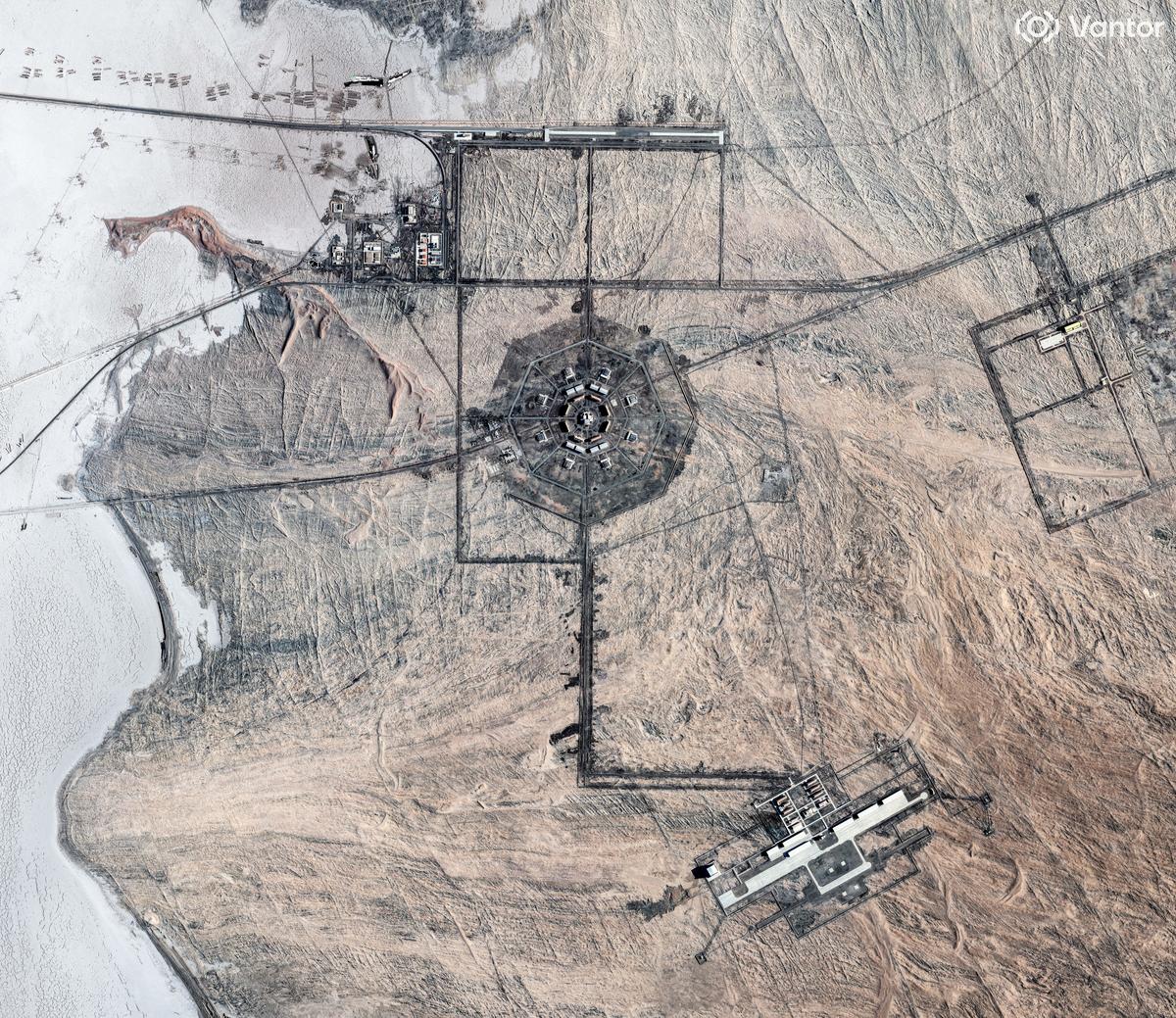
A satellite view shows one of the two Xinjiang octagon-shaped military facilities, which analysts say are likely supporting the nearby Hami silo fields, near an airfield to the south and a rail terminal to the north, in the Xinjiang Uyghur Autonomous Region, China.

A satellite view shows one of the two Xinjiang octagon-shaped military facilities, which analysts say are likely supporting the nearby Hami silo fields, near an airfield to the south and a rail terminal to the north, in the Xinjiang Uyghur Autonomous Region, China.
| Photo Credit:
Vantor via Reuters

China forging nuclear deterrent

“We can see this infrastructure is being built on a grand scale, covering thousands of square kilometers of desert ‌beyond the silo fields,” said Alexander Neill, an adjunct fellow at Hawaii’s Pacific Forum think tank. Depending on the precise capabilities, he said, “we’re looking at a very considerable enhancement and diversification of China’s strategic nuclear deterrent.” The ability to protect its desert silos is key to China’s stated goal of forging a minimal but credible nuclear deterrent — a policy grounded in the ‌capacity to retaliate if it is struck first. While the People’s Liberation Army (PLA) can fire nuclear weapons from submarines and aircraft, the silo fields in the northwestern Xinjiang region and Gansu province ‌are ⁠the core of its nuclear forces. China’s nuclear build-up is among the most scrutinized facets of President Xi Jinping’s military modernisation because of what some foreign diplomats describe as Beijing’s lack ⁠of transparency and failed efforts by the United States to engage the Chinese leadership on its evolving nuclear capabilities and intentions.

A cornerstone of China’s doctrine is its “no first use” policy, meaning its forces wouldn’t initiate a nuclear exchange. But some senior Western diplomats and analysts say China would possibly resort to nuclear coercion to limit outside involvement in a conflict over Taiwan. Mr. Xi this month warned U.S. President Donald Trump that mishandling of their countries’ disagreements over Taiwan, which China claims as its territory, could lead them ​to a “dangerous place.” Taiwan’s government rejects China’s sovereignty claim.

China’s Defence Ministry didn’t respond to questions ‌about its nuclear program and the developments revealed in the satellite imagery. The Pentagon said it wouldn’t comment on intelligence-related matters.

New desert infrastructure

The new desert infrastructure is centered on two octagon-shaped installations built over the past six years in eastern Xinjiang. Both are southwest of the Hami nuclear silo fields – one is about 140 kilometers away, the other some 230 kilometers.

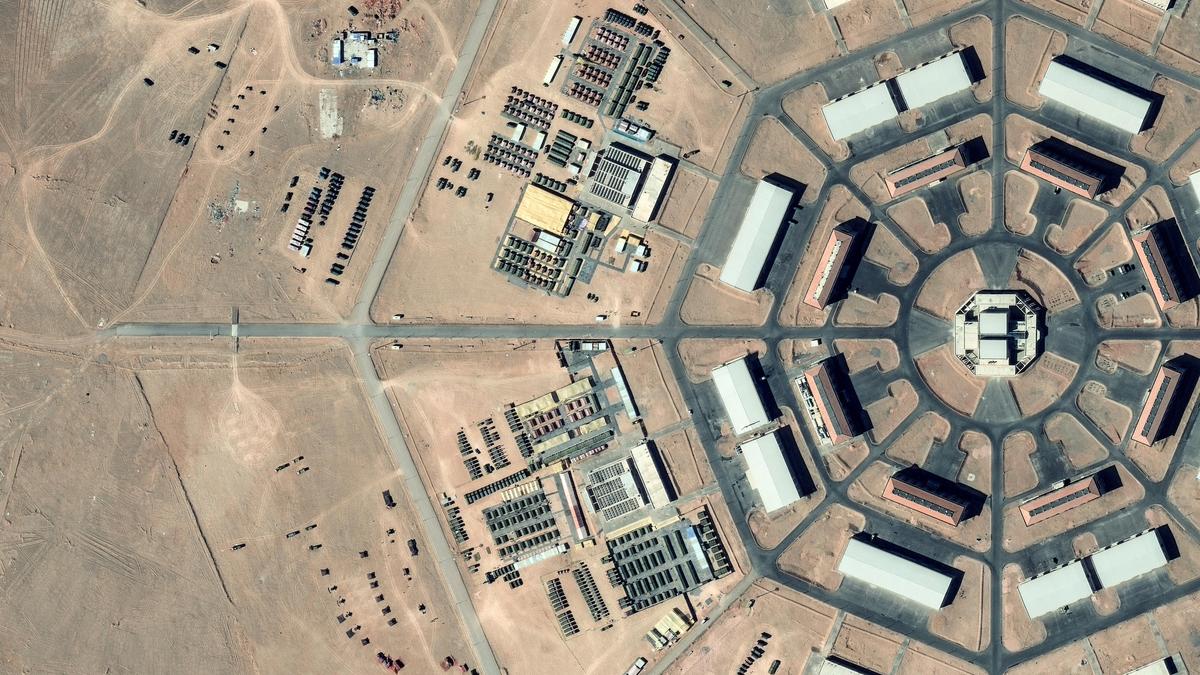
Satellite images show the octagon structures contain housing for personnel and large military vehicles. They are flanked by armored bunkers and fortified weapons-storage areas, as well as airfields and railheads that link the octagons to the Hami silos.

Exercises involving ‌large military vehicles occurred around the northern octagon this month and during April, the images show. Also evident in recent images are large tents and what two analysts said appear to ​be camouflaged launch sites cut into the desert, some with air-defence missile batteries.

The existence of the octagons has been documented previously. But Reuters is the first to report the extent of the launch-pad network linked to the octagons; recent military activity around one of the facilities; and analysts’ assessments that the pads could field mobile missile ⁠launchers and electronic-warfare operations.

Five security scholars interviewed by Reuters agreed the infrastructure broadly could support China’s nuclear program, as well as other military purposes. But they cautioned that key details remain unknown — including the weapons China might deploy at the launch pads and whether the octagon structures house truck-mounted ballistic missiles or facilities for fitting nuclear warheads.

The PLA displayed nuclear-capable weapons during a parade in Beijing last September to mark the 80th anniversary of ‌the end of the Second World War. These included silo-based and truck-mounted intercontinental ballistic missiles (ICBMs). U.S. officials and arms-control analysts say China is expanding and improving its nuclear weapons capabilities faster than any other nation. The latest Pentagon report on China’s military modernisation says the country’s warhead production has slowed but it is on track to field 1,000 warheads by 2030. The December report estimated China is likely to have loaded 100 ICBMs across its three main silo fields.

China has also been strengthening its early-warning system, underpinned by its Huoyan-1 satellites, according to U.S. officials. The system can detect an incoming ICBM within 90 seconds of launch and alert a command center within three to four minutes, according to the Pentagon — sufficient time for China to fire its own silo-based weapons before they are hit.

Significantly, each octagon sits at the core of a network of dirt roads and conduits that stretch far into the desert. These routes connect to the concrete pads, which are nestled among rocky outcrops and dry creekbeds.

The pads could be used to deploy ‌mobile air-defence missiles, electronic warfare nodes or, from some of the larger ones, road-mobile ICBM launchers, three security scholars said.

Hans Kristensen, director of the Federation of American Scientists’ Nuclear Information Project, said while it was difficult to conclude how the various ​installations would be used, “it is hard to rule anything out” given the scale of the infrastructure in such a hostile environment.

Published – May 30, 2026 11:36 pm IST



Source link

World Tags:China nuclear capabilities, China nuclear launch pads, missile silos china

Post navigation

Previous Post: School academic calendar nearly finalised
Next Post: Building collapses near Saket metro station; 8 persons rescued, several feared trapped

Related Posts

  • At least 100 illegal miners died while trapped in South African mine, group says
    At least 100 illegal miners died while trapped in South African mine, group says World
  • U.S. military used laser to take down Border Protection drone, say lawmakers
    U.S. military used laser to take down Border Protection drone, say lawmakers World
  • Ex-Pakistan PM Nawaz Sharif To Return Home Today After Four Years Of Self-Exile
    Ex-Pakistan PM Nawaz Sharif To Return Home Today After Four Years Of Self-Exile World
  • When PM Once Told Obama
    When PM Once Told Obama World
  • France’s Macron announces Bill for assisted dying
    France’s Macron announces Bill for assisted dying World
  • Russia warns U.S. against Ukraine arms sales in Manila meeting
    Russia warns U.S. against Ukraine arms sales in Manila meeting World

More Related Articles

Star Health Faces ,000 Ransom Demand After Major Data Leak, Launches Probe Star Health Faces $68,000 Ransom Demand After Major Data Leak, Launches Probe World
Netanyahu denies denigrating Jesus by comparing him to Genghis Khan Netanyahu denies denigrating Jesus by comparing him to Genghis Khan World
Icelanders head to polls after government collapse Icelanders head to polls after government collapse World
Access Denied World
South Korea says North Korea has again launched trash-carrying balloons across the border South Korea says North Korea has again launched trash-carrying balloons across the border World
Israeli airstrike on southern Lebanon kills 7 people, Lebanese state media say Israeli airstrike on southern Lebanon kills 7 people, Lebanese state media say World
SiteLock

Archives

  • September 2026
  • August 2026
  • July 2026
  • June 2026
  • May 2026
  • April 2026
  • March 2026
  • February 2026
  • January 2026
  • December 2025
  • November 2025
  • October 2025
  • September 2025
  • August 2025
  • July 2025
  • June 2025
  • May 2025
  • April 2025
  • March 2025
  • February 2025
  • January 2025
  • December 2024
  • November 2024
  • October 2024
  • September 2024
  • August 2024
  • July 2024
  • June 2024
  • May 2024
  • April 2024
  • March 2024
  • February 2024
  • January 2024
  • December 2023
  • November 2023
  • October 2023
  • September 2023
  • August 2023
  • July 2023
  • June 2023
  • May 2023
  • April 2023
  • March 2023
  • February 2023
  • January 2023
  • December 2022
  • November 2022
  • October 2022
  • September 2022
  • August 2022
  • July 2022
  • June 2022
  • May 2022

Categories

  • Business
  • Nation
  • Science
  • Sports
  • World

Recent Posts

  • Israeli settler killed in West Bank, suspect arrested
  • Number of drought-hit taluks in Karnataka may cross 200
  • OFC menace persists in Bengaluru as new GBA regulations remain pending
  • Manal bounces back after failing to make it to u-19 WC team
  • Old era of jingoism, equating Nepali nationalism with anti-Indianism, is over: Nepal Finance Minister

Recent Comments

  1. Frankenrib on UP Teacher Who Asked Students To Slap Muslim Classmate
  2. Frankenrib on UP Teacher Who Asked Students To Slap Muslim Classmate
  3. Anthonylop on UP Teacher Who Asked Students To Slap Muslim Classmate
  4. Anthonylop on UP Teacher Who Asked Students To Slap Muslim Classmate
  5. TimmyMEs on UP Teacher Who Asked Students To Slap Muslim Classmate
  • Southwest Airlines Flight Makes Hair-Raising Drop To 400 Feet From Ocean
    Southwest Airlines Flight Makes Hair-Raising Drop To 400 Feet From Ocean World
  • Heavy rains in Belagavi and surrounding areas
    Heavy rains in Belagavi and surrounding areas Nation
  • Washington Post ordered to rehire fired columnist
    Washington Post ordered to rehire fired columnist World
  • Playing with ‘defending champion’ tag the biggest challenge for RCB
    Playing with ‘defending champion’ tag the biggest challenge for RCB Sports
  • Access Denied
    Access Denied Nation
  • Access Denied
    Access Denied Nation
  • Duleep Trophy Squads: No Virat Kohli, Rohit Sharma But Ishan Kishan Makes Comeback, This Star Misses Out
    Duleep Trophy Squads: No Virat Kohli, Rohit Sharma But Ishan Kishan Makes Comeback, This Star Misses Out Sports
  • “Same Team Defeated India”: Imran Khan’s Social Media Rant After Pakistan’s Loss To Bangladesh
    “Same Team Defeated India”: Imran Khan’s Social Media Rant After Pakistan’s Loss To Bangladesh Sports

Editor-in-Chief:
Mohammad Ariff,
MSW, MAJMC, BSW, DTL, CTS, CNM, CCR, CAL, RSL, ASOC.
editor@artifex.news

Associate Editors:
1. Zenellis R. Tuba,
zenelis@artifex.news
2. Haris Daniyel
daniyel@artifex.news

Photograher:
Rohan Das
rohan@artifex.news

Artifex.News offers Online Paid Internships to college students from India and Abroad. Interns will get a PRESS CARD and other online offers.
Send your CV (Subjectline: Paid Internship) to internship@artifex.news

Links:
Associate Journalism
About Us
Privacy Policy

News Links:
Breaking News
World
Nation
Sports
Business
Entertainment
Lifestyle

Registered Office:
72/A, Elliot Road, Kolkata - 700016
Tel: 033-22277777, 033-22172217
Email: office@artifex.news

Editorial Office / News Desk:
No. 13, Mezzanine Floor, Esplanade Metro Rail Station,
12 J. L. Nehru Road, Kolkata - 700069.
(Entry from Gate No. 5)
Tel: 033-46011099, 033-46046046
Email: editor@artifex.news

Copyright © 2023 Artifex.News Newsportal designed by Artifex Infotech.