




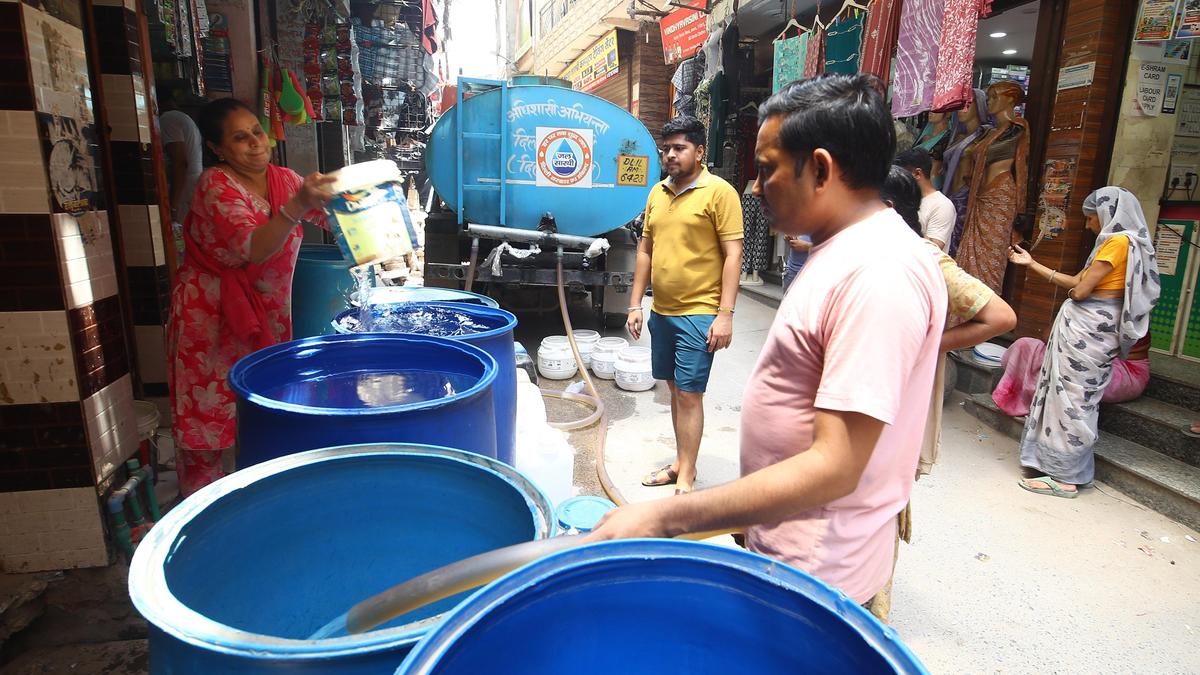
Amid the ongoing water shortage that has left several parts of the city reeling, residents admitted they have reconciled themselves to the reality of relying on tankers and water jars. The crisis has disrupted daily life and household chores, and worse, some residents complained of contaminated water after supply resumed.
The crisis has hit larger families more severely. Maya, 40, from Bijwasan, fumed: “I have seven members in my family. How can we manage with a 20-litre water jar? Cooking and cleaning also need to be done properly.” Members of her family have skipped baths for days, she said.
In Shastri Nagar, Sushant Rai, 28, recalled a complete disruption of water supply for 48 hours. “We just bought water for drinking and waited,” Mr. Rai said.
There is a shortfall of about 90 MGD (million gallons per day) against an expected production of 990 MGD of treated water, a Delhi Jal Board official said. The supply areas of the Wazirabad Water Treatment Plant (WTP) are the worst affected, as production is down by about 35%, while at the Chandrawal WTP, production has dropped by 10% to 15%. “The situation was the same as on Wednesday and is unlikely to improve on Friday as well,” the official said.
This is despite Haryana releasing about 30 MGD of additional water through the canal system. However, the water level in the Yamuna is very low, affecting the overall availability of raw water for treatment and supply, the official added.
Dependence on tankers
For the past two weeks, tankers have become a regular sight at the Rajiv Gandhi Hostel for Girls at Delhi University’s North Campus. Reema, a 23-year-old hostel resident, said many students have stopped using toilets at night because there is no water. “We keep buckets filled only for emergencies,” she said.
For areas such as Adarsh Nagar, Burari, Timarpur and Narela, which have been witnessing erratic water supply, North Delhi RWA Federation president Ashok Bhasin said, “Even getting tankers is not easy, and residents are increasingly relying on 20-litre water jars.” The jars cost between ₹30 and ₹110, depending on demand, he said.
Divya Moharana, 24, a PhD scholar at Jamia Millia Islamia living in Okhla Vihar, said residents in her lane faced severe water shortage last week, with no supply for three consecutive days. The pipeline repair work that disrupted the connection remains incomplete.
While supply has since resumed, Ms. Moharana alleged that the water is dirty, with visible white particles. “Water now comes only once a day,” she said, adding that residents on higher floors have been forced to purchase drinking water separately, which costs ₹60 for 10 litre a jar.
Disruption in studies
Apart from daily chores, the supply also disrupted academic preparations for a few. Harsh Yadav, 22, a UPSC aspirant from Uttar Pradesh residing in Old Rajendra Nagar, said the shortage in the area lasted 15 to 20 days in the lead-up to his preliminary examinations on May 24. “Water didn’t come for weeks right before prelims, the peak time for preparation. Many aspirants had to go back home because they had neither water nor cooking gas,” he said, adding that when supply did return, the water was yellow in colour and unfit for use. While water bottle prices rose upto ₹160 from ₹40 during the shortage, only few could arrange private tankers, he added.
“Changing your study area during peak preparation days wastes time and disturbs your routine, that costs a lot,” Mr. Yadav said.
Meanwhile, AAP attacked the BJP government over the water shortage and alleged that thousands of families have been struggling for the past month amid soaring temperature. Senior AAP leader Manish Sisodia said, “Look at what the BJP has done to Delhi. All its engines are busy looting money. For the last one month thousands of people have been suffering without water. Women are being forced to bath at their offices. This is extremely shameful.”
By Mahima Rao and Shubhangi Kshitiza Saurav
Published – May 29, 2026 12:33 am IST