
Last year, around this time, I was in Iran. In the religious city of Mashshad, in the northeast, I stood stunned by the charm of the shrine of Imam Reza, the eighth Imam of Shia Islam. Built and expanded over the years starting the 9th century, the shrine is now a vast complex, comprising the qabar of the Imam, a large mosque, four seminaries, a museum and a university. Inside the mausoleum, whose walls and dome-shaped roof are studded with priceless stones that shine through its large corridors, one sees believers whispering prayers and wailing towards the qabar. Outside, in the vast courtyards that lead to the complex’s many arch-shaped portals, thousands are waiting for their turn.
I stood there, among the believers, as a student, having lost myself in the wonders of mediaeval minarets, golden domes and azure tympanums with Persian artworks. I have spent years trying to learn about this part of the world. Still, while standing inside the shrine, I shamelessly realised how little I knew about Persia, the Safavids, the Imams, their culture, architecture and history.
While walking down the well-paved streets of the old city of Bukhara in Uzbekistan last weekend, it was a moment of déjà vu. The Ark, a massive fortress in Bukhara whose foundations go back to the 5th century and which had been the seat of power of the Shahs, Khans and Emirs of the ancient state for centuries, is still an intimidating wonder in the city. From the top of its ancient walls, parts of which were destroyed when the Soviets attacked the Emirate of Bukhara in 1919, two years after the Bolshevik Russian revolution, one can see the Kalyan Masjid in the east, the 15th-century mosque, and the Kalyan Minaret beyond its dome.
A view of the Kalyan Minaret in Bukhara.
Both the masjid and the minaret were originally commissioned in the 12th century. But when Genghis Khan, founder of the Mongol Empire, attacked Bukhara in 1220, his forces laid siege to the city for weeks, burning it down and massacring its inhabitants. “I am the punishment of God. He sent me upon you for you committed great sins”, the conqueror is recorded to have said in Bukhara after entering the city. The Kalyan mosque was destroyed by the Mongol Army, but the local legend is that Genghis Khan was so captivated by the beauty of the sand-coloured minaret that he spared it from destruction. It still stands tall in Po-i-Kalyan, a public square, between the masjid, which was rebuilt in the 15th century, and the Mir-i-Arab Madrasa, another 15th-century complex, which is still operational.
Bukhara, home for some of Islam’s greatest thinkers, including al-Bukhari, the 9th-century compiler Hadith, and Baha-ud-Din Naqshband Bukhari, the 14th-century founder of the Sufi order Naqshbandi, had been a centre of learning for centuries in the east. Along with Samarkand, it was one of the key locations of the ancient Silk Road, a network of trade routes across Eurasia that linked the East with the West in the first century BC. The name Silk Road, popularised by the German explorer Ferdinand von Richthofen in the 19th century, derives from the large volumes of trade in silk that took place along these networks. The silk, made in China, was very popular in Europe, especially in Rome. Samarkand and Bukhara thrived as bridge cities on the Silk Road between the East and the West for centuries.
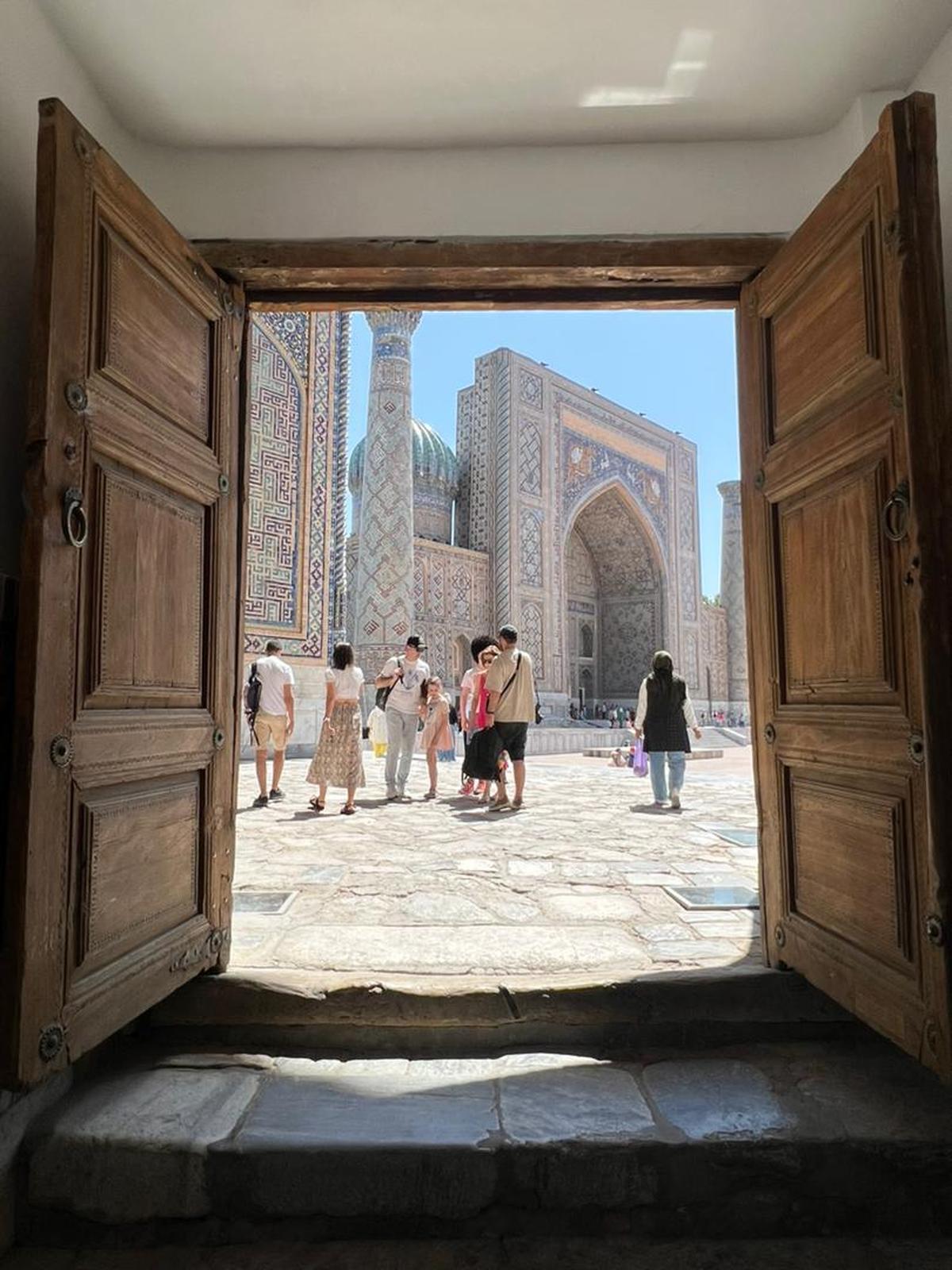
The portal of Sher-Dor Madrassa at Registan Square, Samarkand.
The walk through the old city bazaar, with masjids, madrassas and mausoleums awaiting you on the flanks (and the remaining ponds built by the Khans), is a stride through the richness of history and Islamic architecture. Even Jerusalem, a city I always want to go back to, would be dwarfed by the enchantment of Bukhara. Inside the Ark, the courtyard where the Emir met his noblemen, has been kept intact, with a replica of his throne. The museum has the clothes the last Emir, Said Mir Mohammed Alim Khan, wore, along with his pictures. “He was not a big man and he used to wear several coats to look bigger in size,” our interpreter told me. Inside the courtyard, she gestured towards the throne and said, “this is where our Emir used to sit,” and added after a pause, “until 1920”.
“Then what happened,” I asked inquisitively. “Then the Russians came.”
In 1920, the Red Army, under the command of general Mikhail Frunze, attacked the Emirate. The Ark was partially destroyed. The Emir fled to Kabul, where he died in 1944. After capturing the city, the Bolsheviks raised the red flag at the Kalyan MInaret.
The tomb of the butcher
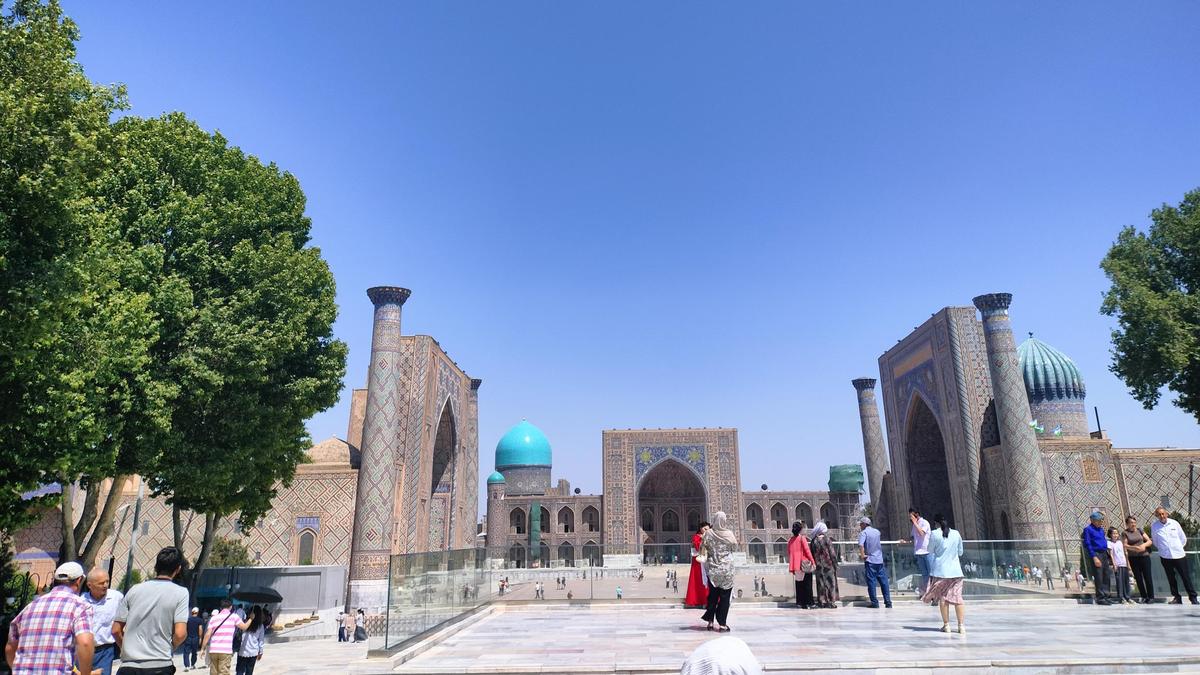
Registan in Samarkand, the seat of power of Emir Temur, the founder of the Temurid Empire, would leave one breathless. It has three madrassas with four minarets and four domes–one of which is emerald green which left even a partially colour-blind person like me hooked to mysterious elegance for minutes under Samarkand’s scorching Spring Sun. The Ulugh Beg Madrasah on the left was built by Ulugh Beg, Temur’s grandson, who also built the Emir’s tomb, Gur-i-Emir, in Samarkand. The Tilya-Kori Madrasa is in the middle and on the right, stands the Sher-Dor Madrasa.
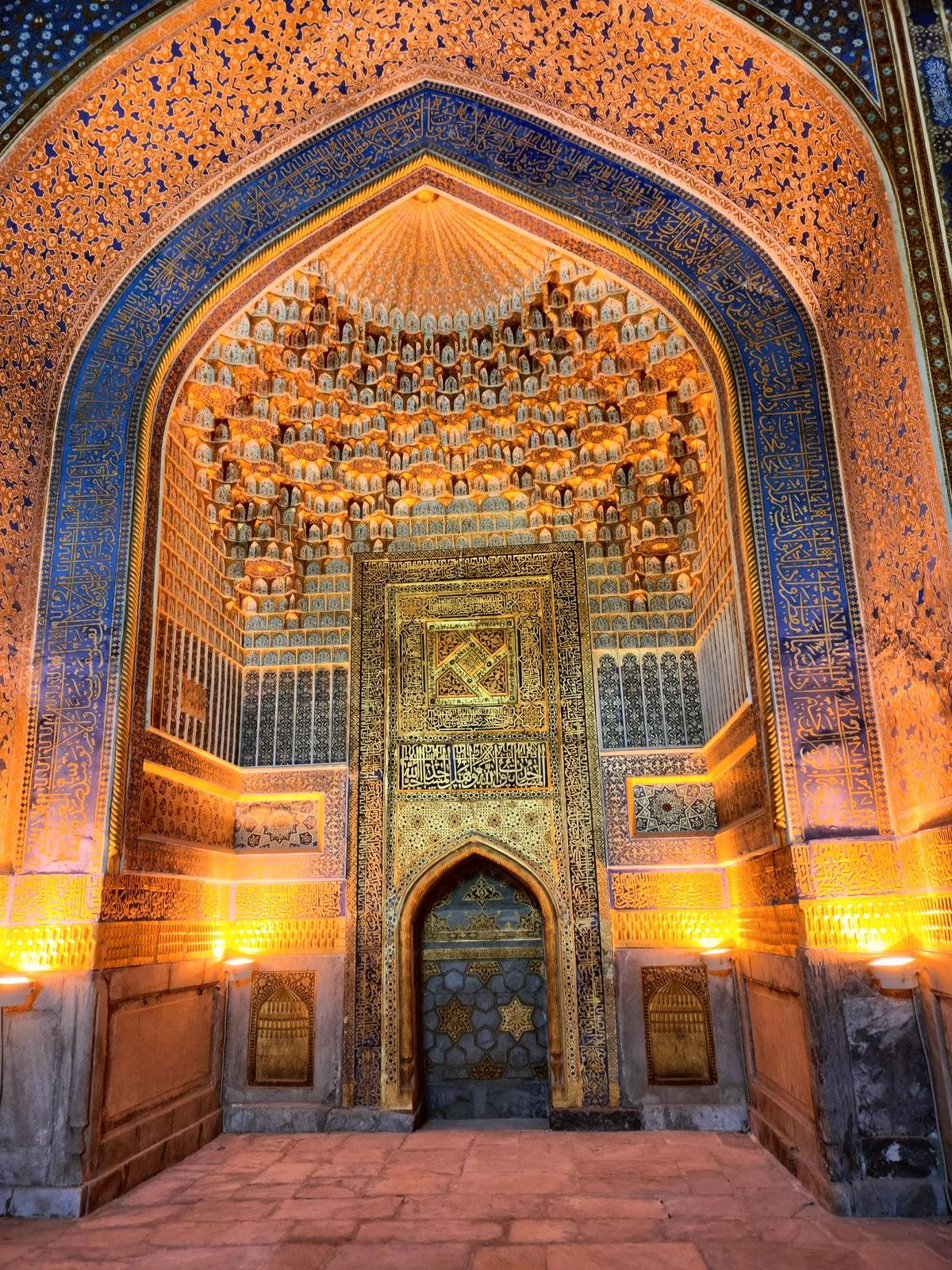
The masjid inside the Tilya Kori madrassa in Registan.
Besides the architectural beauty of the buildings, which has by now become a cliche, two things particularly grabbed my eyeballs. One was a tomb right in front of Sher-Dor–in the large square which has three historical madrassas on three sides, there’s only one tomb. The legend is that when Sher-Dor was being built in the 17th century, a butcher in the bazaar, which is now the Registan Square, used to give meat for free to the labourers. One day, the Emir, impressed by the butcher’s magnanimity, asked him what did he want in return? The butcher wanted eternity. He said he wanted to be buried in front of the madrassa, and the Emir agreed. So the butcher of Samarkand sleeps alone in the Registan Square, a few metres from Gur-i-Emir, the Tomb of the King.
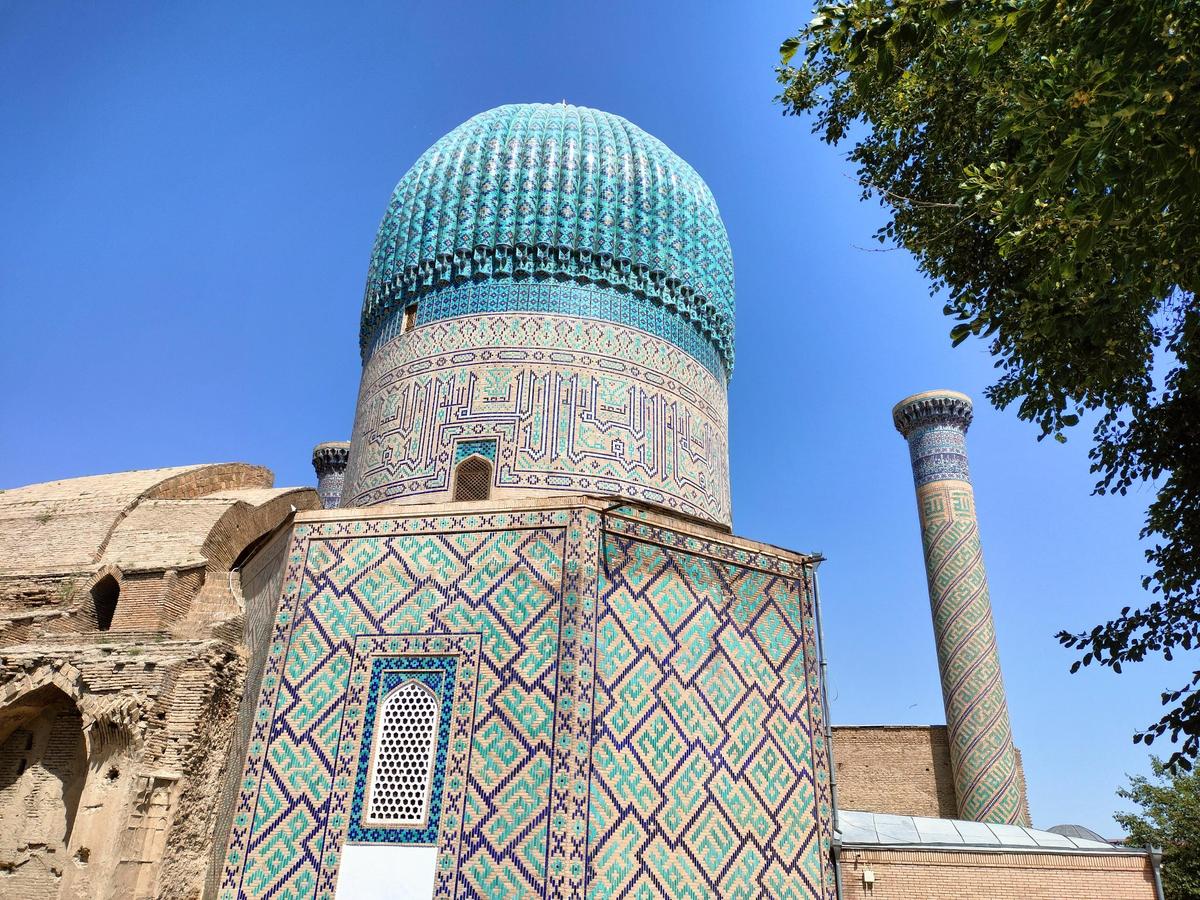
A view of Gur-i-Emir.
Second, Sher-Dor means the ‘Abode of Lions’. “It came from Persian,” our interpreter said. On the tympanum of the madrassa’s portal, there is a depiction of two beasts hunting deers in the rays of the shining sun, which has the face of a woman. Locals say the lion is the student and the deer is knowledge. Still, an artful depiction of animals under the watchful eyes of Sun with a female face on an Islamic madrasa was new to me. “Isn’t it shirk (idolatry)?” I asked the translator. “It could be, based on which part of the world and time you stand in. Clearly, it wasn’t in mediaeval Samarkand,” he said.
The Tomb of the King
The turquoise dome that leaps into Samarkand’s clear sky and the mediaeval pylons at Temur’s tomb, built in the 15th century by Ulug Bek, are visible from all sides of the city. “The blue tiles were a Persian creation. But Temur liked the colour and used it extensively in what he built,” the interpreter at the State Museum of the Temurids in Tashkent told me.
Both the museum and the tomb have displayed the family tree of Temur, who invaded northern India in 1398, captured Delhi from the Sultanate, destroyed the city and killed tens of thousands of local inhabitants. More than a century later, Temur’s descendant and ruler of Fergana in present-day Uzbekistan, followed the path of his great-great-grandfather and invaded India and established the Mughal Dynasty.
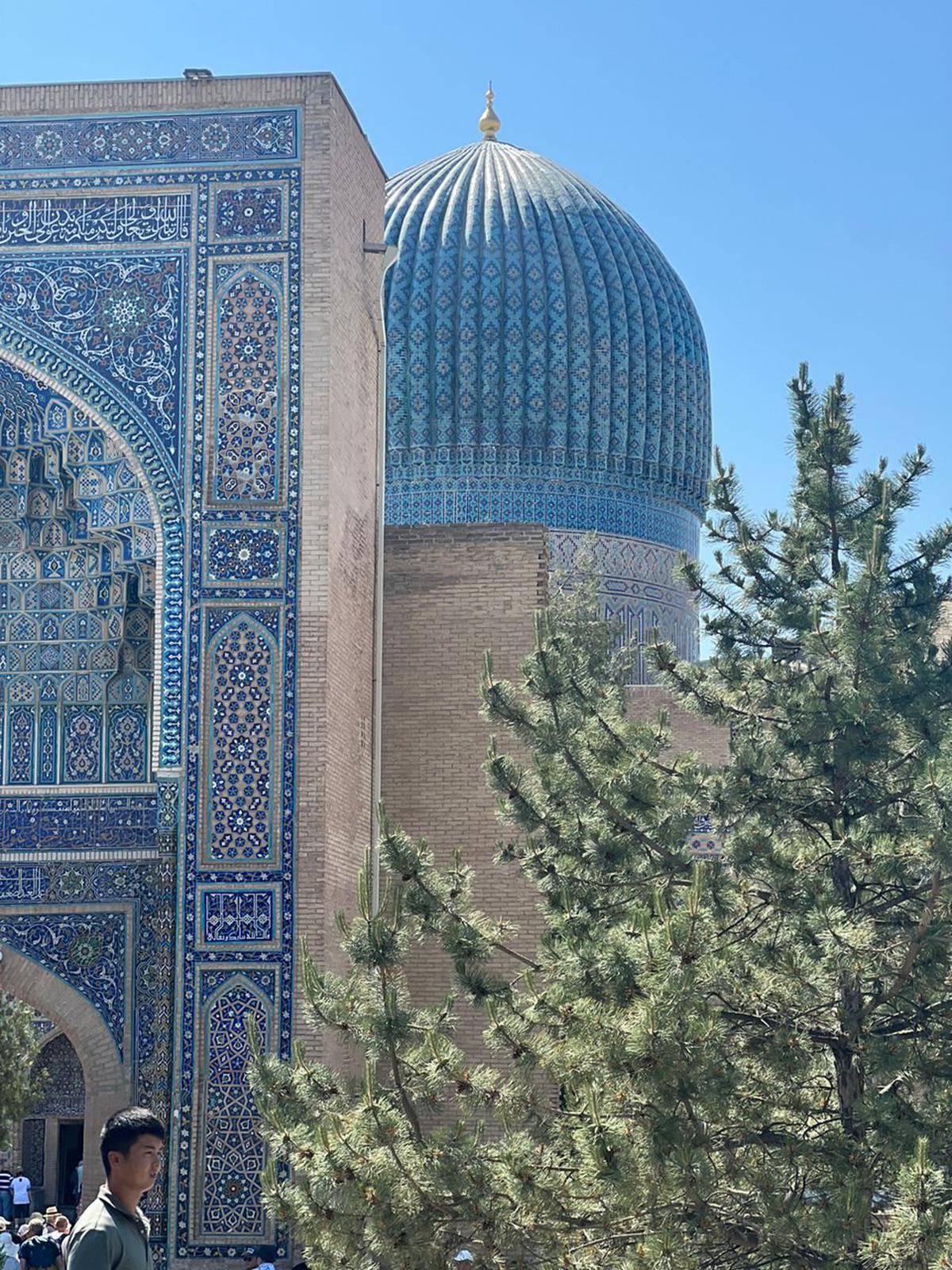
A view of Gur-i-Amir, the mausoleum of Temur in Samarkand.
Inside the tomb in Samarkand, Temur sleeps along with his sons, grandsons and favourite guru Sayyid Baraka. Temur’s tomb, in the middle of the hall, has been decorated with a black jade tombstone. After Uzbekistan became independent in 1991, Temur was resurrected as a national icon and hero. In Tashkent’s central park, Uzbeks have built a huge statue of the conqueror riding a horse, with his slogan, ‘Strength in Justice’, engraved on its pedestal. In Samarkand, all the visitors are welcomed by another large statue of Temur sitting on a throne.
“Termur’s face was not known to the world until the 1940s,” Sevinch, one of our interpreters, told me. In 1941, under Stalin’s command, the Soviets reopened his grave and his face was reconstructed from the skull found in the grave. According to one legend, the tomb had an inscription, rather a warning: “When I rise from the dead, the world shall tremble”. But the godless communists went ahead with their plan. The tomb was opened on June 20, 1941. Two days later, Hitler ordered the invasion of the Soviet Union.
The Taliban’s neighbour

Uzbekistan is a neighbour of Afghanistan. Both are Muslim-majority countries, but the social conditions in both countries cannot be more different. In the Taliban-ruled ‘Islamic Emirate’ of Afghanistan, even young girls are not allowed to go to school. Women are barred from the workforce. There are growing restrictions on women’s movements and a dress code has been imposed on them. In contrast, in Uzbekistan, 44% of the labour force is women. In Tashkent, Bukhara and Samarkand, I hardly saw women with religious hijab (I didn’t see anyone in Burqa). The Indian-style dress is very popular among young girls.
In public spaces, government offices, polling stations and colleges, women make a lively presence. Uzbekistan remains a patriarchal society, but the 70 years of rule by communists played a crucial role in transforming the country’s social relations. After independence, Uzbekistan rediscovered its national and cultural identity with its own historical heroes, but stayed true to its modern history as well.
The new Constitution, which came into effect on May 1 after voters overwhelmingly supported the reforms proposed by President Shavkat Mirziyoyev in a referendum, promises gender equality and criminalises domestic abuse, giving a special focus to women’s empowerment. “For the first time, there is a lot of chatter in Uzbekistan about women’s rights,” Dilfuza Oilmava, who teaches translation studies at Bukhara State University, told me. When neighbouring Afghanistan, under the Taliban, is systematically keeping women away from public life in the name of Islam, Uzbekistan, another Sunni Muslim-majority country, a “legal secular republic” as per the Constitution, is working towards bettering women’s rights.
The love for Bollywood
Tashkent is a green, modern city with relatively light traffic, beautiful restaurants and a vibrant nightlife. Almost everyone I met in the capital loves Hindi movies and is a fan of Shahrukh Khan. Ozoda, a student at Tashkent State University who was accompanying us, speaks fluent Hindi and sings Hindi songs. When I failed to recognise a song from DDLJ (Dilwale Dulhania Le Jayenge), she called it sacrilege. I had to tell her my Hindi was not too good. Ilkhom, another Tashkent resident, says he watched Indian Idol regularly and can sing popular Hindi songs, even though he doesn’t understand the language.
In the old part of the town, along the wide roads, one can see the Soviet-era apartments. The new Tashkent is buzzing with magic cities and skyscrapers built by Islam Karimov and Mirziyoyev. While driving to Tashkent Botanical Gardens from our hotel, we passed through a dense residential area. I asked my interpreter what type of people are living in the area — rich or poor?
“Ordinary people,” he replied. “Middle class or upper middle class?” I asked again. ‘We don’t have such distinctions in Uzbekistan,” he said. I didn’t want to press him further.
Uzbekistan has a very good rail service. Bukhara is some 570 km from Tashkent. In the express train, this distance is covered in less than four hours. I was telling the son of a diplomat who I met in Tashkent that it’s almost the distance between the place I work and the place where my mom lives; it takes me 10 hours (an overnight train journey) to travel from one place to the other. He said he was surprised to hear that as his idea of India, as one of the economic engines of the world, was different.
My idea of Uzbekistan was also different until I arrived here, I told myself.
A shot of the Registan Square in Uzbekistan