

Nuclear reactions are processes that alter the identity of an atomic nucleus. Atoms in itself are incredibly small, and the atomic nucleus occupies less than one ten-trillionth of an atom’s volume, despite containing almost all of its mass. While chemical reactions involve the rearrangement of electrons, nuclear reactions alter protons or neutrons. Be it fission (splitting heavy nuclei) or fusion (combining light nuclei), nuclear reactions are accompanied with the release of tremendous amounts of energy, along with the transmutation of elements.
It is this energy that countries across the world are trying to tap into. Nuclear power plants are now operating in around 30 countries and the electricity that they generate is slowing inching towards the double digit mark — as a percentage of the world’s total electricity supply.
While harnessing nuclear energy for peaceful purposes is one thing, using it for arming a country is quite another. There are only nine countries at the moment that possess nuclear weapons and India is one of them. India’s entry onto the nuclear stage was announced to the world on May 18, 1974.
Picture from a 2021 flight test of a nuclear capable ballistic missile Agni-P. India is now one of nine countries to possess nuclear weapons.
| Photo Credit:
PIB / PTI
Before the test
While India’s entry as a nuclear power on that day came as a rude shock to the rest of the world, it was in the making for years already. Once the U.S. dropped the first nuclear bombs in 1945, other nations — the Soviet Union, Great Britain, France, and China — followed suit and developed their own nuclear warheads before pushing for a Non-Proliferation Treaty (NPT) in 1970. India, which had been independent for just a couple of decades and was not a signatory of the NPT, found its position to be untenable as China, a powerful neighbour not always on the best of terms, was already a nuclear power.
India’s then Prime Minister Indira Gandhi authorised work on a nuclear fission device on September 7, 1972. A very small team of less than 100 scientists and engineers at the Bhabha Atomic Research Centre (BARC) were involved in the work. The task was carried out in utmost secrecy, with most members working on different parts of the project not privy to the complete picture. One man who did have the complete picture was Raja Ramanna, who served as the head of the development team.
The plutonium needed for the nuclear fission device was extracted from the CIRUS research reactor. Short for Canada-India Reactor Utility Services, CIRUS was a 40-megawatt reactor supplied by Canada that had been in operation since 1960.
While the design of the device that India built was similar to the implosion design employed by the Fat Man bomb dropped by the U.S. on Nagasaki, Japan, the Indian version was much simpler and less sophisticated than those of the U.S.
The day it happened
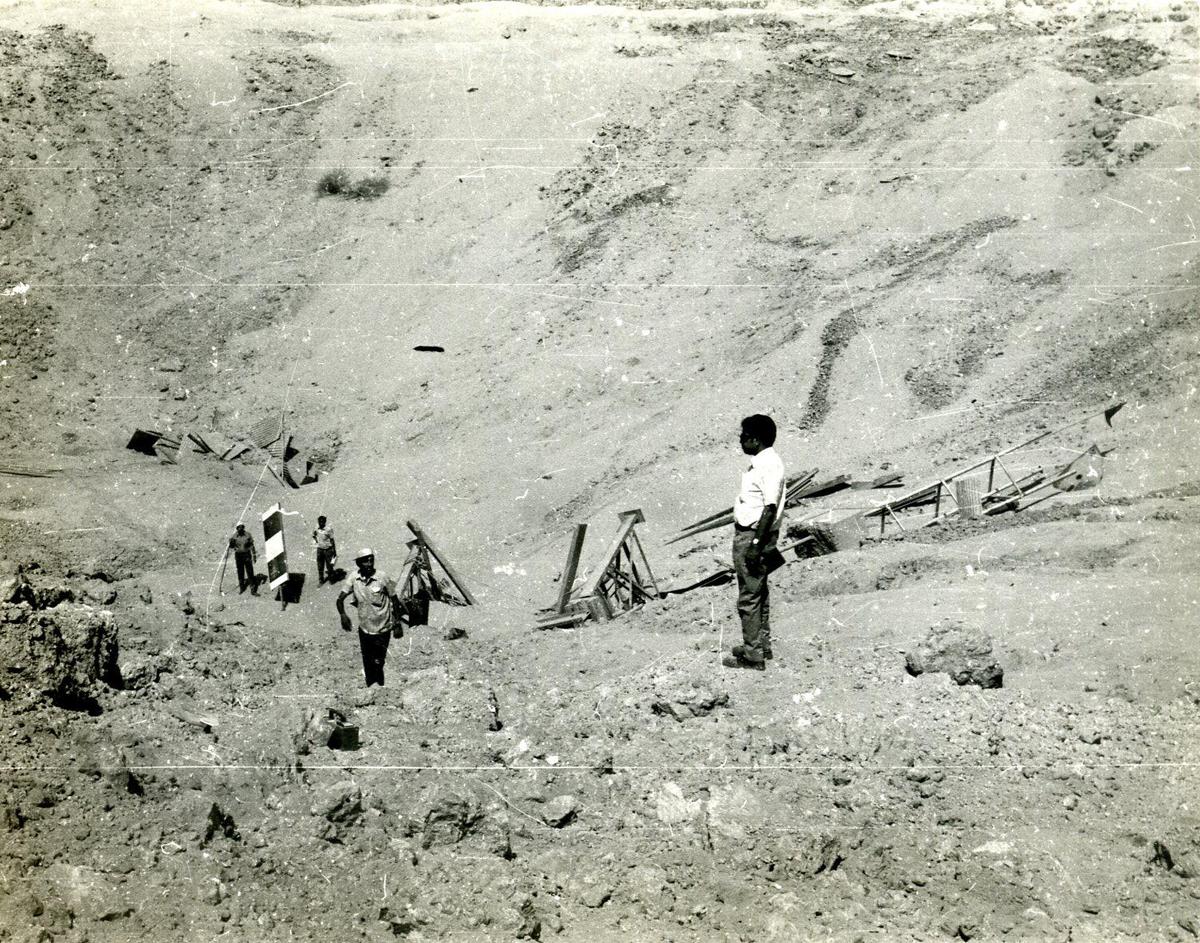
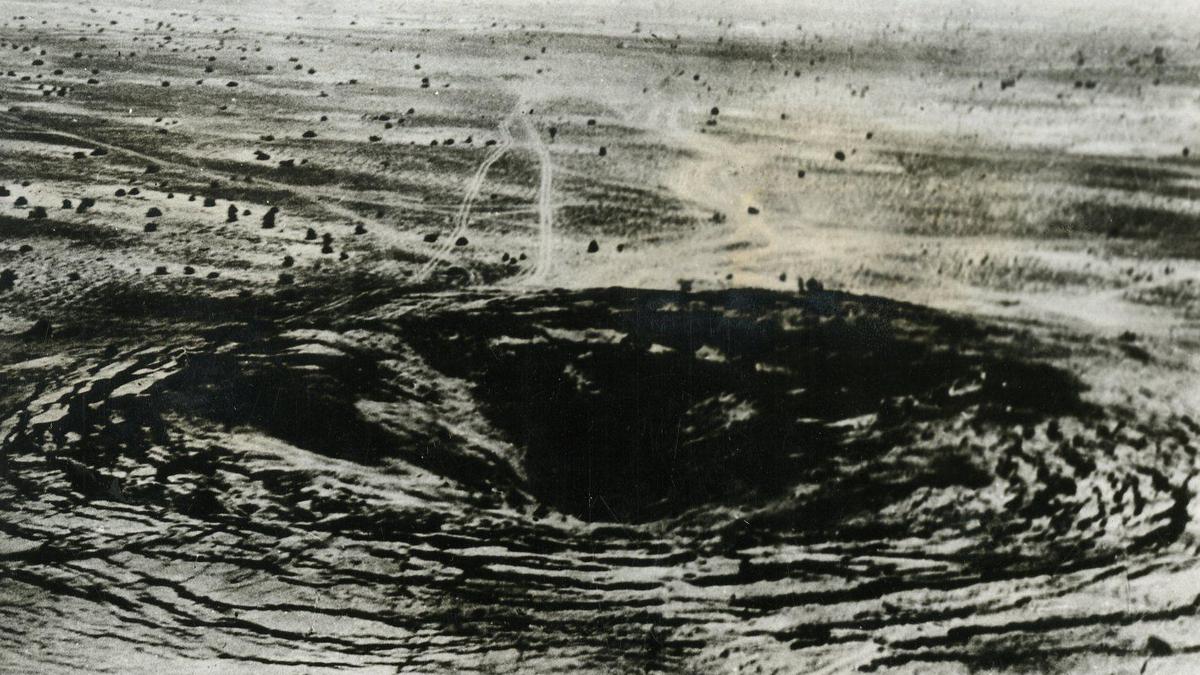
A close-up view of the centre of the crater created by the nuclear explosion at Pokhran in May 1974.
| Photo Credit:
The Hindu Archives
Codenamed “Smiling Buddha” (Ministry of External Affairs designation: Pokhran-I), India’s first successful nuclear weapon test was not a deliverable weapon. In fact, when it panned out, it wasn’t even acknowledged as a weapons test as India declared that the test was simply a “peaceful nuclear explosion” or PNE.
At 8:05 a.m. on May 18, 1974, the nuclear device was detonated in the arid sands of Rajasthan’s Pokhran. The explosion was felt in nearby villages as the ground shook, as if after an earthquake.
While the actual yield is still debatable, the official yield was set to 12 kiloton and the actual yield was likely lesser than 10 kilotons. India referred to the test as a PNE aimed at enhancing mining techniques and conducting other feats of large-scale underground engineering.
Following the successful test, Ramanna — with a direct line to the Prime Minister — is believed to have sent a secret message that simply said “The Buddha has finally smiled.”
This particular codename had been chosen to signal the peaceful, non-aggressive nature of the test, but it also turned out to be a nod to the day on which it was taking place. The test coincidentally was conducted on the Buddhist festival of Buddha Purnima, a day celebrating the birth and enlightenment of Gautama Buddha.
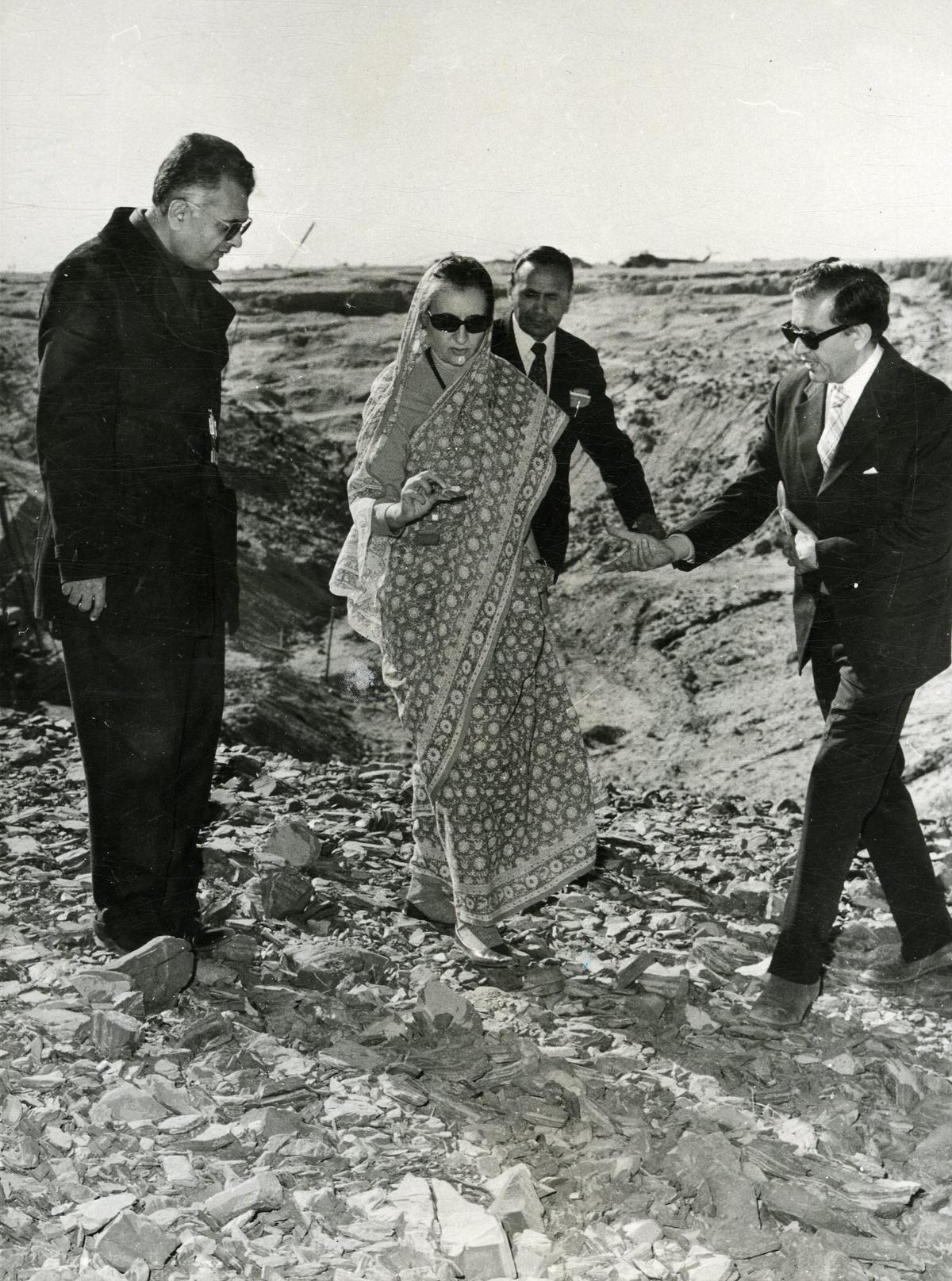
India’s then Prime Minister Indira Gandhi visited the site of the test in December 1974.
| Photo Credit:
The Hindu Archives
The dark side
Even though the test marked India’s entry as a nuclear power, the response wasn’t positive from across the globe. In fact, it was quite the contrary, as the global community unleashed a sharp backlash. Change was in the air with respect to how the world dealt with nuclear materials, with much stricter protocols and safeguards put into place.
As far as India was concerned, Canada cut off almost all the nuclear assistance that it had been providing. The U.S. too restricted such collaborations, and was even able to persuade India to not carry out further tests. India’s second series of nuclear explosions known as Operation Shakti or Pokhran-II was only carried out 24 years later in May 1998.
In addition to international reactions to the nuclear programme, there was also the health of those living in nearby villages. Following underground tests like these, radioactive particles can remain confined for a very long time. Even though there’s been a lack of epidemiological studies in the region, there’s likely a clear case of increased incidences of cancer and children born with deformities and disabilities in the area.
The man behind the smile
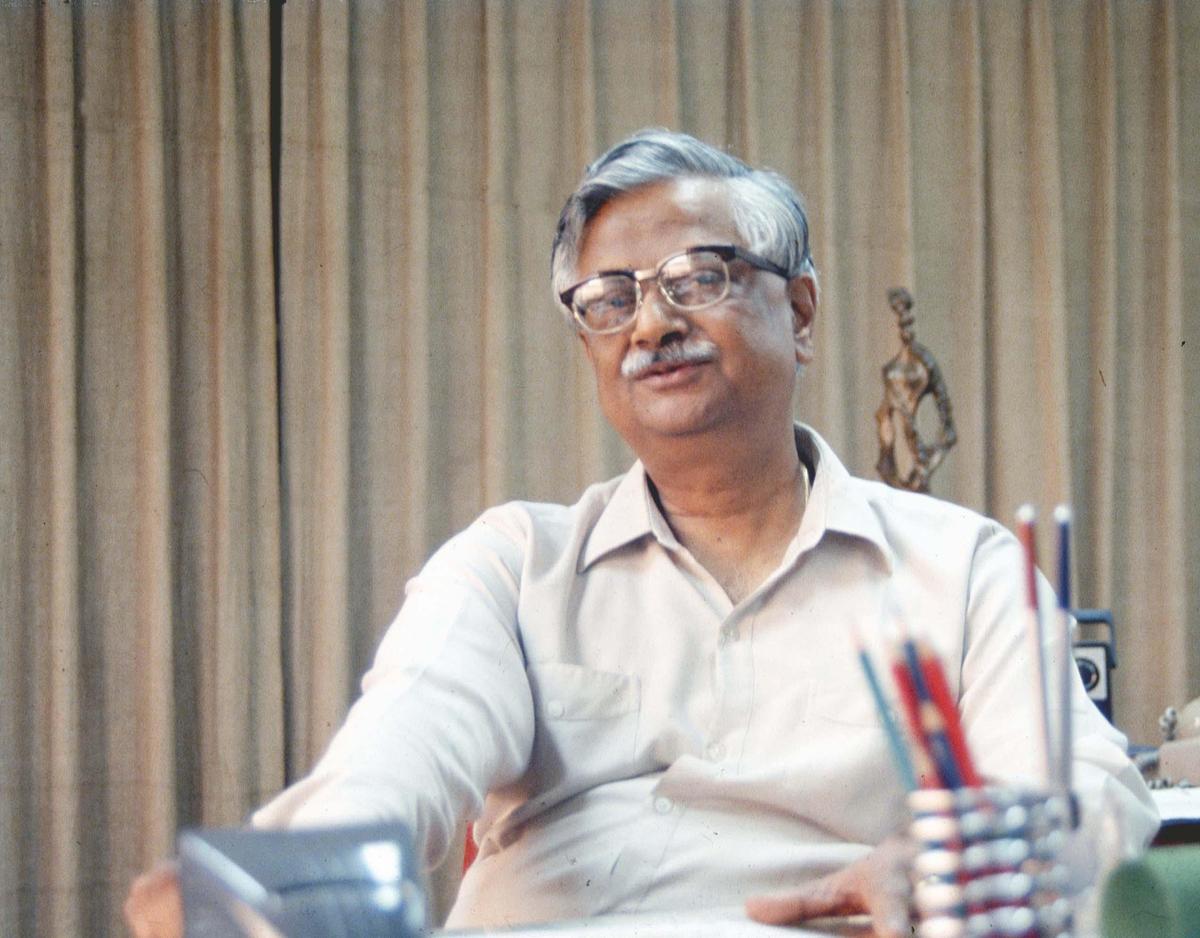
Raja Ramanna, the man behind the Smiling Buddha, was an internationally renowned nuclear physicist.
| Photo Credit:
Frontline
Raja Ramanna played a critical role in India’s development of nuclear weapons. Born in Tiptur (now in Karnataka) on January 28, 1925, Ramanna did his schooling at the Bishop Cotton Boys’ School in Bengaluru before graduating with a bachelor’s degree in physics from Madras Christian College. He went on to complete his doctoral degree in physics at King’s College London in 1949 and as a nuclear physicist, joined India’s nuclear programme the same year at the Atomic Energy Establishment in Trombay, Mumbai.
It was here that he worked with India’s theoretical physicist Homi Bhabha, who went on to lend his name to BARC. Ramanna himself rose to the position of BARC’s director and also oversaw the first nuclear test codenamed Smiling Buddha. Among other things, Ramanna served as the head of India’s Atomic Energy Commission (1983-87) and as the minister of state for defence in 1990.
Later in that decade, in 1997, during an interview with the Press Trust of India, Ramanna stated that “The Pokhran test was a bomb, I can tell you now… An explosion is an explosion, a gun is a gun, whether you shoot at someone or shoot at the ground… I just want to make clear that the test was not all that peaceful.”
Ramanna was conferred with many awards, including Shanti Swarup Bhatnagar Memorial Award (one of India’s highest multidisciplinary science award), Padma Shri, Padma Bhushan, Padma Vibhushan, Meghnad Saha Medal, and Om Prakash Bhasin Award.
Published – May 18, 2026 07:02 am IST