





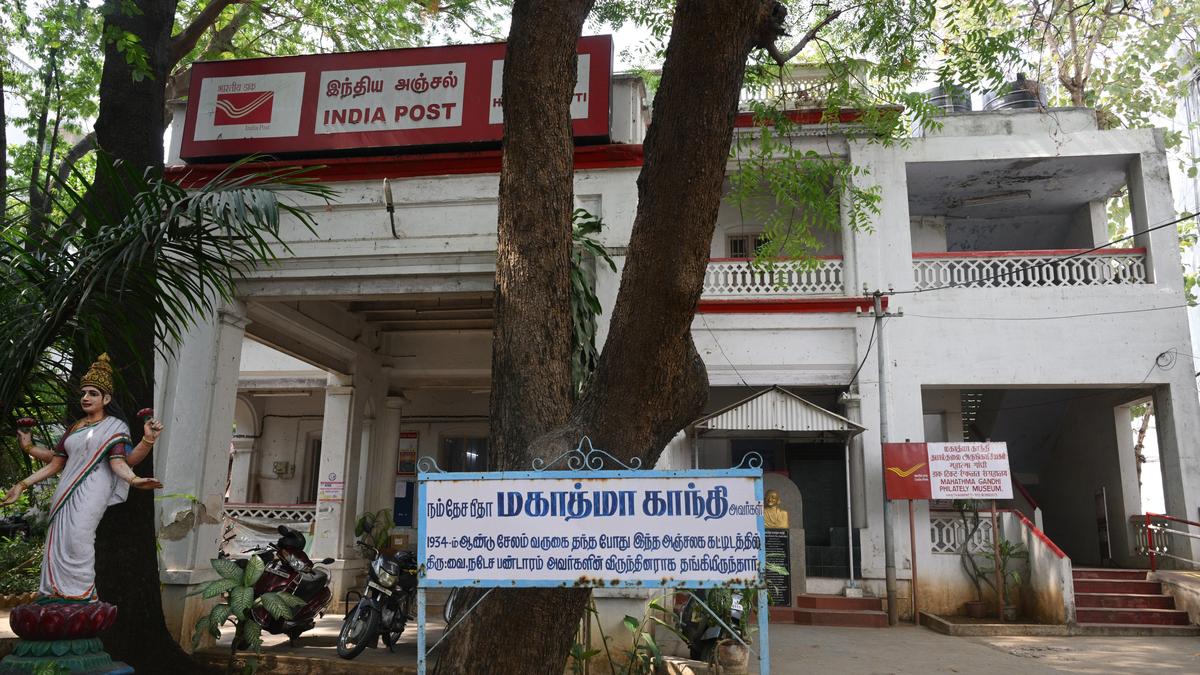
Hasthampatti in Salem district carries historical significance. It was at a single-storeyed house here that Mahatma Gandhi, as part of his countrywide tour for the abolition of untouchability, stayed during his eight-hour-long visit to Salem in February 1934. Since July 1962, the building has been accommodating the local post office, the place of which was then called Komarasamipatti. Nearly 35 years later, the postal authorities established a philatelic museum on Gandhiji at a room of about 170 sq.ft on the first floor of the building, which was owned by Natesa Pandaram about 90 years ago. Built in an architectural fashion that illustrated what was prevalent in the British era, the heritage structure has a bust of the Father of the Nation near the portico.
Salem held a special significance for him as it was the home town of two Congress stalwarts, C. Vijiaraghavachariar and P. Varadarajulu Naidu, who was lauded by C. Rajagopalachari ( Rajaji or CR) as “one of the most intelligent and imaginative brains we had in the early Congress in south India with a background of work among the masses.”
In August 1920, it was at the residence of Naidu that Gandhiji, Rajaji and their colleague in the Khilafat movement, Shaukat Ali, stayed before leaving for Bengaluru. Vijiaraghavachariar had encouraged Gandhi to persuade fellow Congress members to take to the route of non-cooperation from the traditional constitutional path. At a special session of the All India Congress Committee in Kolkata during September 1920, Vijiaraghavachariar and Motilal Nehru advised him to include the demand in his proposed resolution for “swaraj.”
Visitors taking a look at the stamp collection that was kept on display at the Mahatma Gandhi Philately Museum, India Post Office building, in Hasthampatti where Mahatma Gandhi stayed during his visit to Salem in 1934
| Photo Credit:
E. Lakshmi Narayanan
Of his dozen visits to the Madras State between 1896 and 1946, the Mahatma left his footprint in every part he visited. He went to Salem, currently one of the thriving tier-II cities, in 1920, 1923 and 1934. Of this, 1934 was of greater importance as it was then Gandhiji had gone around the country as part of his campaign for the abolition of untouchability. T.S.S. Rajan, who represented Tiruchi in the erstwhile Central Assembly; a prime member of the Rajaji camp in the Congress and Minister in charge of Health, Food and Public Works in the regimes of 1937-39 and 1947-51, in his first-hand account of Gandhiji’s 1934 tour, captured the Salem visit vividly and in his own characteristic way.
In a 1944 publication Tamizh Naattil Gandhi [Gandhi in Tamil Nadu], Rajan, who praised Natesa Pandaram and his family for the way they received Gandhiji at their bungalow, wrote that the town had a restaurant, known as ‘Gandhi Aiyar,’ and the owner of the eatery too was called by that name.
After getting involved in the Harijan movement, ‘Gandhi Aiyar’ had decided to throw open his restaurant to Scheduled Castes (SCs) and let them dine along with members of other communities. Within a week, he experienced an adverse fallout as the restaurant had started getting less and less customers and in no time, the owner virtually went broke. Yet, ‘Gandhi Aiyar’ had remained steadfast in the Gandhian path. Gradually, the people began backing him again. The Salem municipal council had adopted a resolution, calling upon all the restaurants, located in its territorial limits, to allow the SCs and cautioning them that it would cancel licenses in the case of erring eateries. This was approved by the British government too.
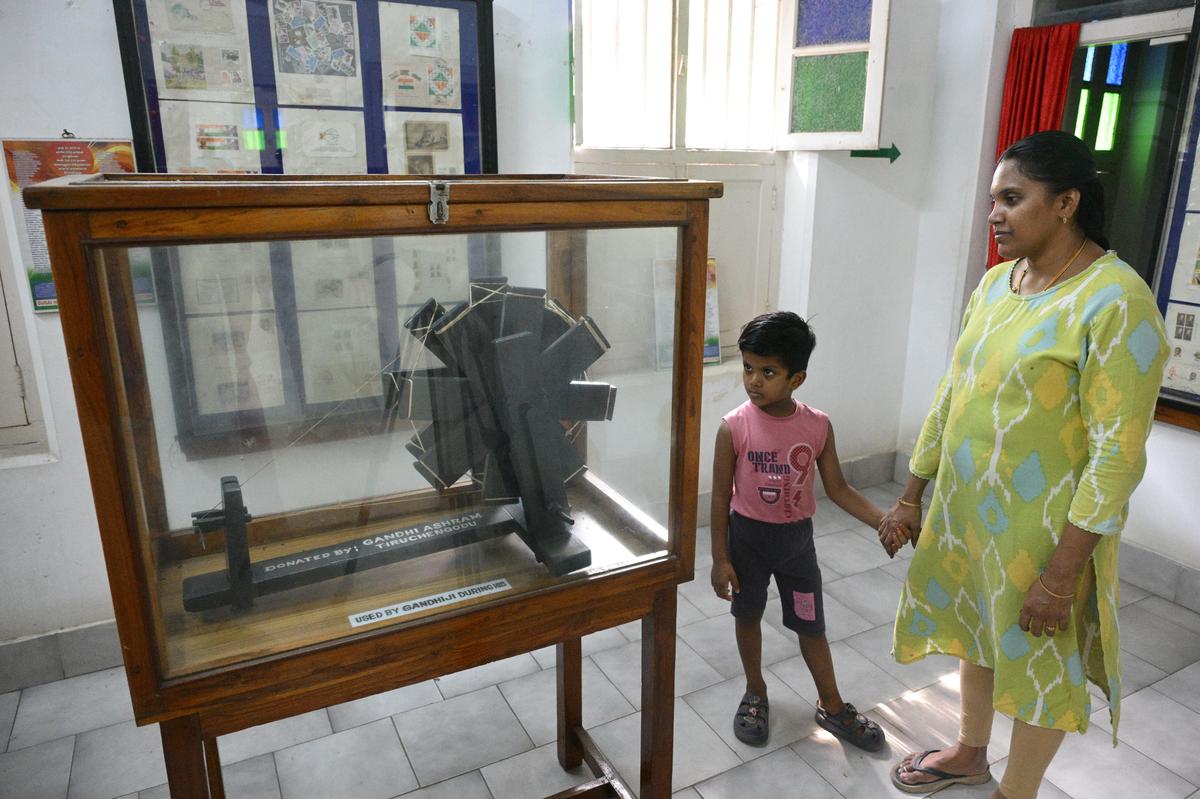
The charka (spinning wheel) which was used by Mahatma Gandhi during his visit to Salem in 1934 showcased at the philately museum in Hasthampatti
| Photo Credit:
E. Lakshmi Narayanan
When Gandhiji heard this account, he had agreed to visit the restaurant but, according to Rajan, the crowd was so much at the place on the day that the visitor could not even get out of his car. It was with great difficulty that ‘Gandhi Aiyar’ had approached the car to garland Gandhiji and present him a purse for the Harijan Fund. A report of The Hindu on February 16, 1934, identified the owner as Subba Aiyar and the restaurant, ‘Gandhi Motel,’ besides stating that Aiyar gave Gandhiji a purse of ₹151.
According to this newspaper, Gandhiji’s itinerary included an interaction with women at a college and visits to Vijiaraghavachariar’s house and the Harijan Labour League. He also addressed a public meeting on the college’s grounds. The Hindu reported: “Over fifty thousand people had assembled there to hear him. As many more had to stay on the roads for want of more [sic] accommodation in that maidan, which is the biggest open place this town can command, loud speakers had been installed.”
More than anything else, what made his visit memorable was his stirring speech at the public meeting. “In one sentence, I will say, that all castes must have equal rights. When we feel that we are all God’s creatures, there can be no untouchability in our mind. We are all Harijans. I think that caste-Hindus are not acceptable to God because we have not done our duty to the Harijans. If we are to get God’s blessings, we must elevate the Harijans. They must be given the same privileges as are enjoyed by caste Hindus,” stated this newspaper’s report, adding that Gandhiji had appealed to residents of Salem to contribute for the relief fund established for those affected by a massive earthquake in Bihar which occurred in January that year.
The philatelic museum, which was set up in January 1997 on the initiative of the then Chief Postmaster General (CPMG) of Tamil Nadu Circle, S. Theodore Baskaran, also a perceptive bilingual writer on a host of subjects including art, history, conservation and films, exhibits commemorative stamps and first day postal covers issued by India and a host of countries including those in African and Caribbean regions on Gandhiji.
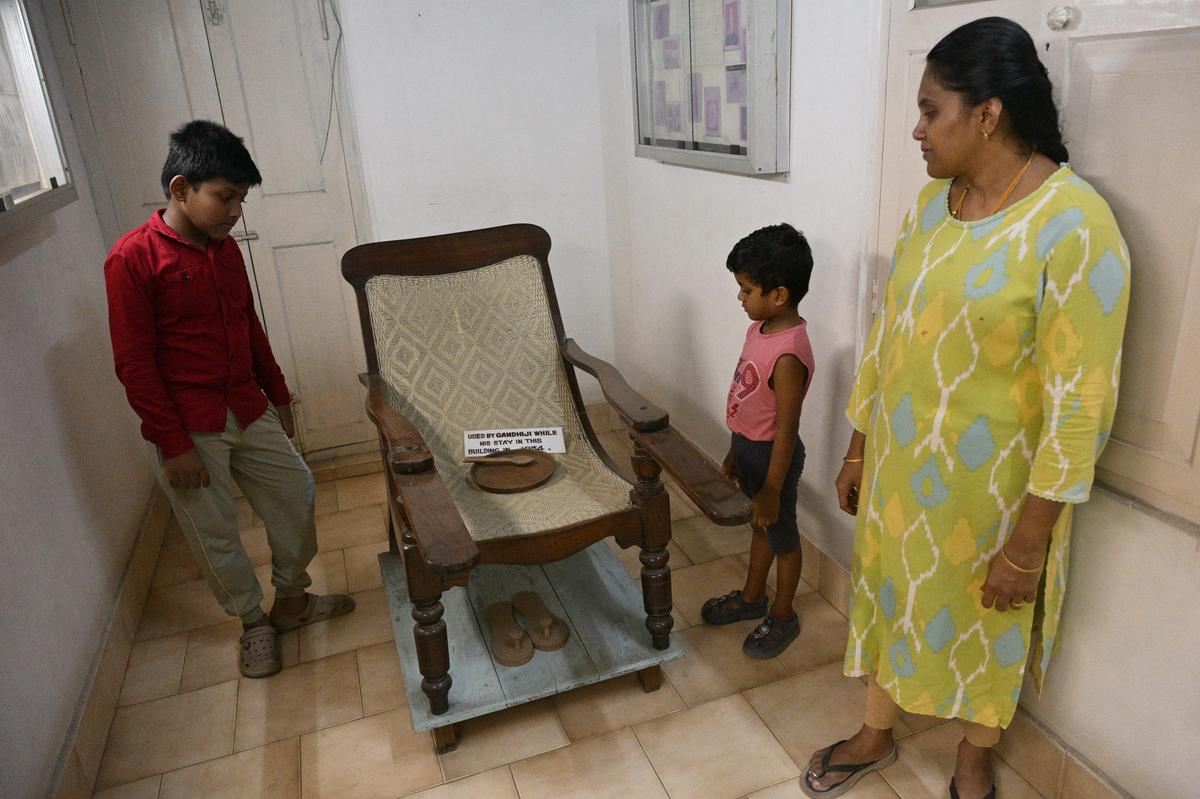
The reclining teakwood chair used by Gandhiji during his stay in Salem in 1934 as visitors to the Mahatma Gandhi Philately Museum in Hasthampatti look on
| Photo Credit:
E. Lakshmi Narayanan
It also showcases a reclining teakwood chair used by Gandhiji during his stay in Salem. A charka (spinning wheel), which he utilised at the Gandhi Ashram, Tiruchengode, not very far from Salem, is also on display, in addition to his photographs taken at the Sabarmati Ashram, Gujarat, with various leaders. In March 2003, the then Post Master General of Western Region, Shanthi Nair, (who later became CPMG) unveiled the bust.
Though the postal department in Salem has been using the museum to promote philately among students, there is scope for the improvement of upkeep and maintenance of the place. The authorities can utilise modern technology to attract the youth installing interactive devices.
Published – May 13, 2026 06:30 am IST