



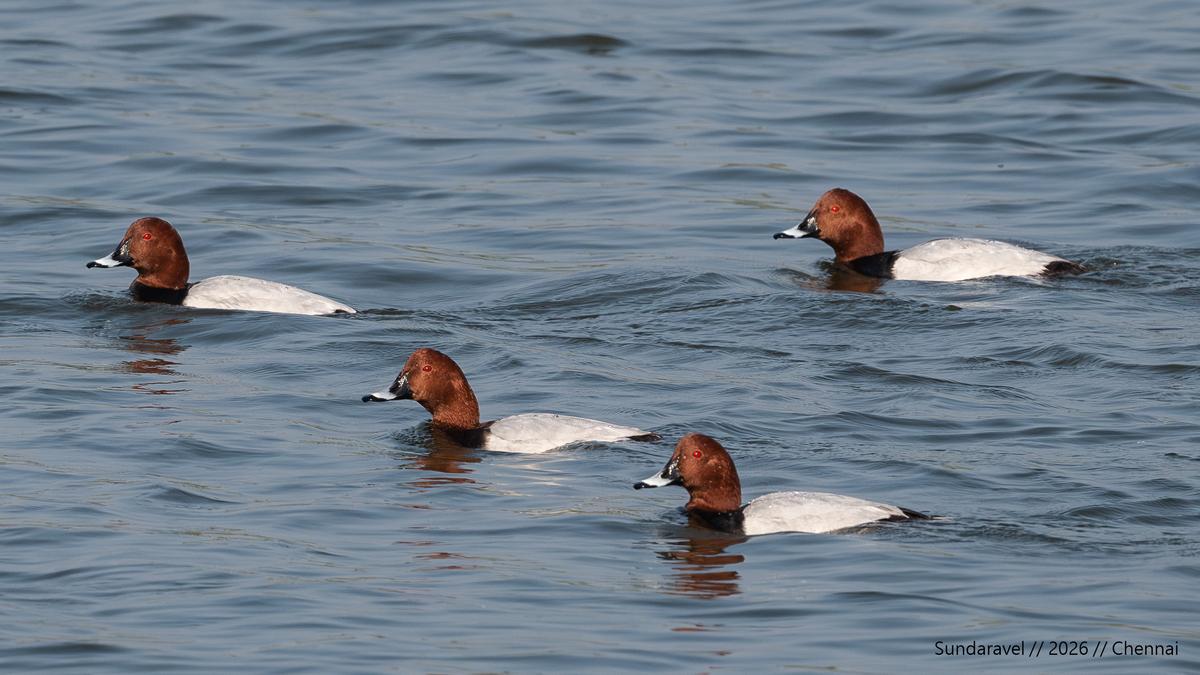
Common pochards at Amoor lake on Tiruporur-Thirukazhukundram Road, not too far from Chennai, in February 2026.
| Photo Credit: Sundaravel Palanivel
“Not even time for birds to fly to southern skies.” That is a line from Stevie Wonder’s “I Just Called To Say I Love You”, a song that has stood the shifting fads of time. And that line refers to an avian pattern that has persisted through time. It hints at birds migrating from the north, escaping its inclement winter to sojourn in the south. While the escape will continue winter after winter, the sojourn can undergo changes of address, depending on local factors, anthropogenic and climatic.
Welcome to the choices made by migratory birds: the how and why of it.
Dr. T. Badri Narayanan is an ophthalmologist with an eye for birds, an eye sharpened with some degree of formal training (a correspondence course from Bombay Natural History Society and an ornithology course offered by NPTEL during the pandemic) but largely on account of time spent on the field. He illustrates the possible causes of change in bird migration with his observations of the Common pochard in the Chennai Metropolitan Area and his regular stomping ground, Madurai.
Dr. Narayanan notes that the migratory Common pochard is sighted sporadically in the Chennai Metropolitan Area which includes patches of Kancheepuram and Chengalpet. It is also documented from time to time in other parts of southern Tamil Nadu. He recalls sightings of Common pochard flocks around 15 years ago at Aarpakkam tank near Kancheepuram as well as Ponnur lake, also set in the same geography. During the 2025-26 migratory season, the Common pochard showed up as a flock at Amoor lake, near Sirudhavur in Chengalpet district, not too far from Chennai.
In contrast, birders in Madurai are being stood up by this bird. For anyone who has birded in the 1980s and 90s, this could be startling as Madurai was a sure-fire destination in this bird’s winter itinerary. Dr. Badri Narayanan notes that a species can change its wintering address if it is up against habitat degradation. The reality in Madurai does not point in that direction, at least not on the surface, and he looks elsewhere for a possible cause.
He observes that globally, the Common pochard’s numbers are dwindling and the species has moved from “Least Concern” to “Near Threatened”, and therefore, fewer birds migrate deep into peninsular India. The suggestion is that they could be happily “hot-desked” with enough “seats” provided for them in the wetlands of central and northern India.
A migratory bird might change its wintering address for one or a combination of these reasons. One, habitat destruction. Two, food scarcity. Three, climatic changes. Four, population decline reducing migratory spread (the Common pochard’s situation in Madurai probably checks this box). Five, availability of suitable habitats earlier on in their migratory route. Dr. Badri Narayanan notes that a cause can be identified only with sufficient data gathered over a long period of time with observations, around 10 years or more. He points out that citizen-science platforms such as eBird can be source for that kind of data.
Published – May 10, 2026 04:27 am IST