




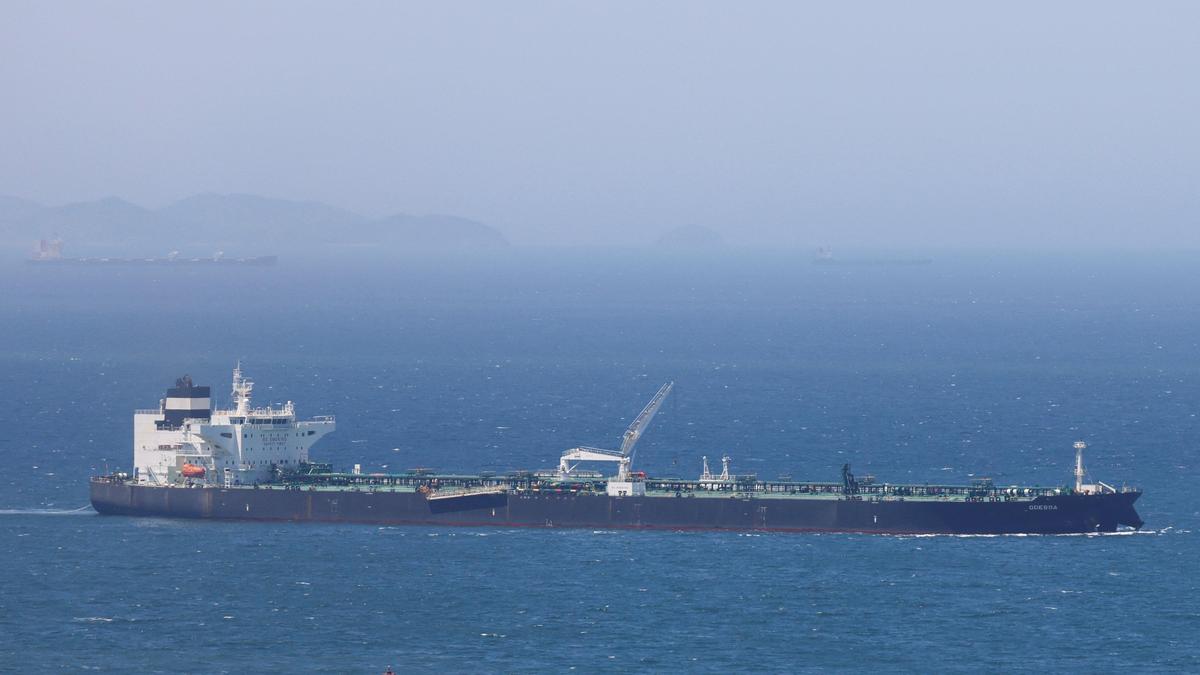
The crude oil tanker Odessa, carrying UAE crude after passing through the Strait of Hormuz with its Automatic Identification System transponder turned off, navigates the waters at Daesan port, where it is expected to discharge crude oil, in Seosan, South Korea, May 8, 2026.
| Photo Credit: Reuters
The U.S. announced Project Freedom on May 4 to end the Iranian blockade of the Strait of Hormuz. It was suspended the next day even as merchant ships and U.S. Navy craft came under attack.
Though U.S. President Donald Trump cited progress in negotiations with Iran as the reason for calling off the initiative project, Iran had shown it could escalate the situation if the U.S. persisted in its attempt to deny Iran stakes in the Strait of Hormuz and establish dominance in the Persian Gulf.
This was a far cry from 30 years ago, when the U.S. was able to intervene in the Tanker Wars and ensure a relatively smoother flow of ships in the region.
Iran-Israel war LIVE
Listing a range of advanced systems, including underwater drones and warships, the U.S. said multiple advanced military capabilities were being “harnessed” in Project Freedom to reopen safe navigation through the strait. As the initiative got underway, the U.S. claimed two U.S.-flagged merchant ships had crossed the strait freely, apparently not through the routes Iran had indicated, as a demonstration meant to encourage confidence. Iran had earlier indicated that only the area close to its coast was free of mines and marked a danger zone running almost the entire breadth of the strait towards Oman.
In a day, however, Mr. Trump declared Project Freedom was temporarily suspended. There were indications shipowners were not convinced to make the transit. The same day the project was announced, Hapag-Lloyd, one of the biggest container shipping companies in the world, said its risk assessment remained unchanged and that the Strait of Hormuz remained closed for its transits until further notice.

The industry sought more details since the U.S. indicated it was not going to escort ships individually, unlike 30 years ago when it largely succeeded in beating back Iranian initiatives to take control of the strait. Operation Earnest Will involved minesweepers, patrol boats and U.S. warships escorting merchant ship convoys with anti-missile batteries to counter Iranian attacks.
At the time, Iran had recently acquired Silkworm missiles that could be mounted on trucks and fired from land at merchant ships. It also had speedboats with machine guns and mines in its arsenal. Iran sought to attack Kuwaiti and Saudi ships because the two countries were supporting Iraq, its adversary.
During Operation Earnest Will, the U.S. Navy escorted nearly 130 fleets consisting of more than 250 ships in a 14-month period ending in September 1988. Though the Tanker Wars drove up insurance costs and reduced traffic, transits continued amid a few attacks and the strait remained open. After the U.S. launched a major operation destroying Iran’s Naval capabilities, Iran backed off and the Tanker Wars ceased.

Now, however, some experts say drones have changed the equation. A few low-cost weapons can inflict visible damage on merchant ships and even one hit from a swarm of drones could have a disproportionate impact, including on insurance costs that influence global ship movements. “The U.S. is still ahead of the game as far as countering Iranian surprises is concerned, especially if it is able to deploy its capabilities continuously,” said Commodore (retd.) R. Seshadri Vasan, defence expert.
But that commitment was not visible to the shipping industry since key operational details were missing. Meanwhile, at least two merchant ships, including a UAE tanker, were attacked and damaged. Two U.S. Navy destroyers were hit too, in a sign of Iranian firepower. “While a few ships made it out safely while Project Freedom was in place, it was clear that transits without coordination with Iran entailed significant risk,” said Jakob Larsen, chief safety and security officer of Bimco, a global industry body representing shipowners.
Published – May 09, 2026 07:16 am IST