




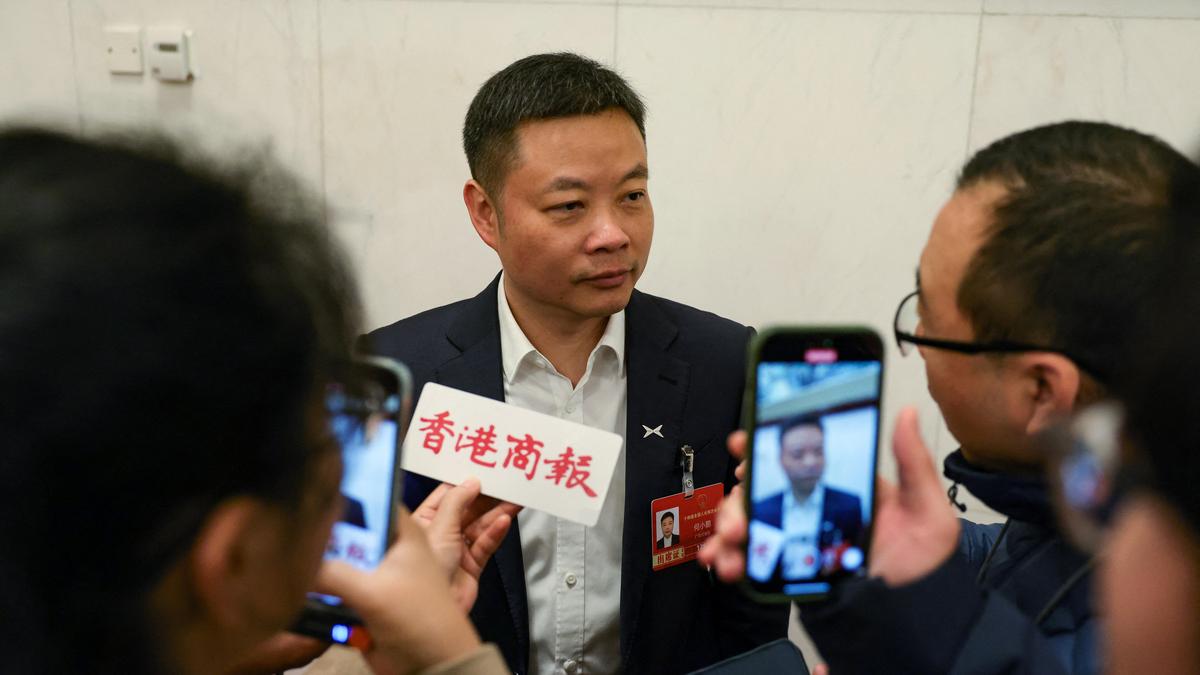
Since the launch of its first EV model in early 2019, XPeng Motors has emerged as a major domestic player making waves in China, with its AI-powered smart driving cars increasingly ubiquitous on the streets of Beijing, as it looks to challenge the dominance of Chinese giant BYD, now the world’s largest EV maker, and overseas competitors such as Tesla. The company delivered 4.3 lakh units in 2025, doubling its sales. Its founder, entrepreneur He Xiaopeng, in an interview, explains the factors behind his company’s — and China’s — EV success.
Its founder, entrepreneur He Xiaopeng, in an interview, explains the factors behind his company’s — and China’s — EV success.
How do you view the recent rapid growth of both XPeng and China’s EV market as a whole?

One key reason for our [XPeng’s] success is the popularisation of high-level intelligent driving. We stick to full-stack, in-house R&D for intelligent driving, including intelligent driving hardware, free software, and frequent over-the-air updates, making premium intelligent driving accessible to all users. The industry has seen intense competition over the past two years. But long-term price-only competition erodes profits and innovation capacity. Meaningful competition lies in capabilities, technology and systems. It is not only about price.
China’s EV production exceeded 16 million (1.6 crore) units in 2025, with a penetration rate of 57%. Consumer choices are no longer a simple switch from fuel to electric, but an upgrade from ordinary cars to smart vehicles. I believe the industry will enter a deep elimination phase over the next 3-5 years, with a sharp reduction in the number of brands. International giants are accelerating electrification and smart transformation, intensifying global competition. Meanwhile, Chinese brands are expanding their first-mover advantages. Internal competition will shift from homogeneous cutthroat rivalry to differentiated breakthroughs. Healthy industrial competition lifts overall technological standards. Only by shifting from price competition to competition in innovation, capabilities and long-term value can China’s smart mobility industry achieve high-quality development and maintain global leadership. Our [Xpeng’s] internationalisation is accelerating steadily. In 2025, our overseas deliveries totalled 45,008 units, up 96%. Europe performed strongly with 22,787 units delivered, up 126% year-on-year.

It’s not just carmakers but tech companies getting into EVs in China; smartphone maker Xiaomi is an example. What do you see as the advantages and disadvantages they have when compared with traditional automakers?
Based on years of practice, we believe success in EVs relies on two core capabilities. One is long-term in-house development of R&D for core technologies, with sustained investment in intelligent driving, physical AI and large models. The other is user-centric technology deployment, turning cutting-edge tech into tangible, trustworthy daily experiences.
The two types of companies have different origins, genes, and paths, but they will eventually converge with no absolute superiority, but only phased differences. Many new automakers come from the Internet, building from software to hardware, with an inherent DNA of software-defined vehicles, AI-driven experiences, and treating cars as intelligent terminals from the start. Traditional automakers are building from hardware to software, leveraging decades of automotive manufacturing to add intelligent and technological capabilities.
First, the strengths I see are native AI and software thinking, short decision-chains, fast product iteration, deep understanding of user experience, and more sensitivity to frontier tech, whether autonomous driving, robots, or flying cars. Their innovation boundaries are wider. Their weakness lies in needing time to accumulate automotive manufacturing and supply chain management expertise. For automakers, they have a deep manufacturing heritage, mature production, quality control and supply chain capabilities. Their weakness lies in being slow to build software and AI talent systems. They need to improve their rapid iteration capabilities.
In China, we are also seeing a big push by many EV firms, including yours, into robotics…
Humanoid robots are at a strategic inflection point, moving from technical validation to large-scale commercialisation, similar to EVs a decade ago. Humanoid robots share a strong commonality with cars. In my view, embodied intelligence includes both humanoid robots and automobiles. In the next decade, cars will evolve into automotive robots, with an overlap of around 90% software and 50-60% in hardware. However, not all automakers can successfully transition to humanoid robots, as most rely on integrated supplier-based R&D. Success in the next decade requires in-house hardware and software R&D, cross-domain integration, and commercial capabilities. Only strong tech companies can capture this convergence of technological innovation and industry.
Chinese and American robots are leading the global first tier, each with unique strengths. Humanoid robots, as physical carriers of embodied intelligence, are at the cusp of an explosion similar to EVs a decade ago. China launched over 300 models last year, more than half the global total. Humanoid robot R&D is an extremely complex hardware-software engineering project. Xpeng has taken a forward-looking path: building a fully integrated intelligent agent with extreme human likeness in form and intelligence [called IRON]. IRON’s core advantages lie in its human-like design, and 2026 will be Xpeng’s first year of mass production. IRON is a high-level humanoid robot, a fully integrated intelligent agent with extreme human likeness in both form and intelligence — a global first. It’s designed from the inside out, with a human-like spine, bionic muscles, and fully wrapped flexible skin. By the end of 2026, Xpeng aims to achieve large-scale mass production of high-level humanoid robots, which will first serve commercial scenarios such as guidance, shopping assistance, and patrol.
What do you see as the potential for the “flying cars” market and what’s being called “the low altitude economy” in China?
I am encouraged by the mention of the low-altitude economy in the Government Work Report [China’s official policy document released on March 5, 2026]. It is evolving into a major new pillar of the economy and will rise further in five years. Between 2030 and 2040, it will transform daily life and work. Policymakers have a clear long-term vision, which I welcome greatly.
In 2026, Xpeng’s first flying car, the Land Aircraft Carrier, will enter mass production and delivery. In March, batch trial production and multi-aircraft test flights of the AeroHT Land Aircraft Carrier were completed. The AeroHT plant is the world’s first modern assembly line for large-scale flying car production, integrating aviation and automotive manufacturing to meet strict aviation standards. It has a planned annual capacity of 10,000 units, and an initial capacity of 5,000 units with one aircraft rolling off the line every 30 minutes at full production. That is 10 times the efficiency of traditional aviation manufacturing.
The low-altitude economy will unlock three 1 trillion RMB ($145 billion) markets. The first trillion layer is manufacturing of light aircraft, helicopters, drones; the second is investment in infrastructure including general airports, helipads and low-altitude networks; the third is tech services, air mobility and consumption upgrading driven by innovation. This includes personal entertainment and tourism — flight experiences, sightseeing and training — urban commuting, and public services, such as emergency medical rescue, highway accident response and high-rise evacuations.
This article has been re-edited for clarity.