






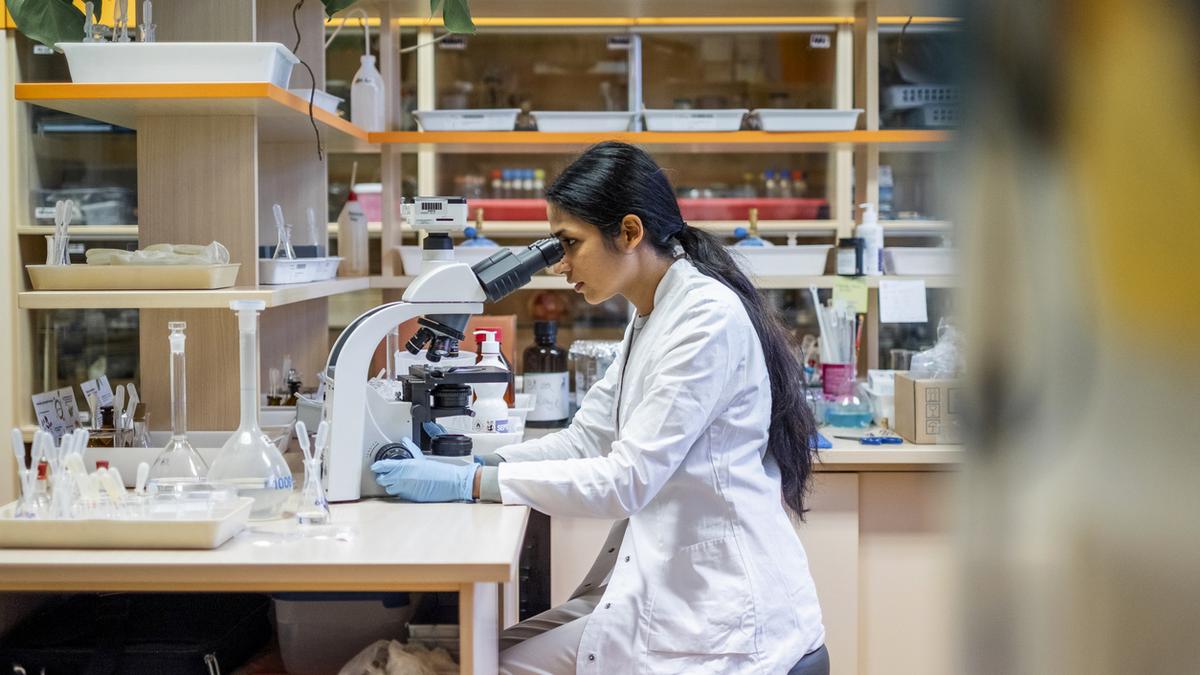
In India, the story of women and girls in science is organised around a mismatch between a widening pipeline and stubborn barriers. Put differently, the country is getting better at bringing girls and young women into STEM education but it has been much less consistent at converting those aspirations into long careers in scientific work. Why?
According to the All India Survey on Higher Education 2021-22, women constitute 43% of higher education enrolment in STEM disciplines. Recent reports from Gujarat have also indicated sharp hikes in the number of women seeking seats in mechanical and civil engineering, which are fields long coded masculine in Indian professional culture. On the other hand, a response in Parliament drawing on the Research and Development Statistics Report 2023 said women STEM researchers made up only 18.6% of the total workforce in 2021.
We know institutions are paying attention because their messages encouraging girls to choose science are increasingly accompanied by those to transform institutions so women can also stay and advance. The Department of Science and Technology’s Project GATI (‘Gender Advancement for Transforming Institutions’) positions gender equity as a reform agenda, for instance. Policy language is also becoming more explicit about allowing women to take “career breaks” and rejoin the scientific workforce. The Department of Science & Technology’s WISE-KIRAN effort has targeted women who have stepped away and want ways back into research work.
Then again, the existence of such schemes also exposes assumptions in many scientific workplaces that the better scientist is one who is continuously available, geographically mobile, and buffered from the responsibility to care for their families. Care work remains heavily feminised in India and childcare infrastructure is uneven, so these assumptions amount to a de facto sorting mechanism. And while they’re obviously exclusionary, people inside laboratories often rationalise them away as meritocracy at work.
Lived experiences
This story of metaphorical pipelines and barriers would also be incomplete if it remains only about gender in the abstract. In India, people live gender through caste, class, region, language, religion, disability, and sexuality. If the question is why a young person with scientific talent quits science, the answer is often about multiple structures selecting against them at once. A woman from a so-called “upper caste” metropolitan college and a woman from a marginalised caste in a small-town institution don’t face the same frictions even if they have the same degree. Their access to mentorship, internships, conferences, recommendations, laboratories, and patronage often differs long before they face their first interview or submit a grant application.
Like other elite professions, Indian science has long drawn its authority from institutions that say who gets to enter and who gets to belong. Even when students from Scheduled Castes, Scheduled Tribes, and OBC communities enter STEM programmes, they run into forms of exclusion that are hard to capture in official language, from being treated as a beneficiary rather than as a peer to being made to feel that they carry a permanent burden of proof. And this leads to fewer individuals continuing in science and, consequently, which questions and pursuits are allowed to animate the scientific enterprise.
In the same vein, the typical scientific workplace tends to assume identities it considers legible — including bodies that don’t create “administrative complications”. For trans scientists, the barriers begin at the level of paperwork and then spill into everything else, as the Beoncy Laishram’s tribulations last year illustrated. Trans people still have difficulties updating records, are expected to explain mismatches between publications and identities, face invasive scrutiny around facilities such as hostels and toilets, and are expected to endure workplace cultures that treat harassment as interpersonal ‘drama’ rather than as institutional failure. Cruelly, a single hostile department can stall a career and a single humiliating incident can make a workplace feel permanently unsafe.
Safety in STEM work
These issues can’t be separated from the broader labour question. Even when women get STEM degrees, the economy into which they graduate doesn’t reliably absorb them into secure jobs. India’s female labour force participation rate remains low by international standards, 31.7% in 2023-24. Public debates have also raised questions about the quality and stability of women’s work, especially how much the participation reflects secure jobs rather than low-paid work that women were forced to take up in times of distress. In STEM this is a question of whether India is creating enough positions in R&D and technical services to match the educational expansion. Contracts with uncertainty or informal hiring practices can also magnify the discrimination the so-called lower-caste and trans graduates face because they have fewer protections.

To be sure, safety and dignity are crucial in STEM work. None of fieldwork, night shifts in hospitals, late hours in labs, travel to conferences, and commuting across cities is a gender-neutral experience. In the course of any of them, women face harassment and institutional indifference. When there’s no systemic support either, how much women can progress becomes a question of how much they can endure — which is deeply undesirable. There is a further gradation here: a Dalit woman in the field may face vulnerabilities that her peers don’t, just as a trans person travelling for a workshop may have to weigh professional benefits together with the risk of violence or humiliation.
And even when women do remain in science, they’re not often recognised on time. Global discussions of the gender gap in science have repeatedly noted that women remain underrepresented in senior authorship (on research papers) and in leadership roles even after entry-level participation has increased. According to UNESCO, women make up less than 30% of top leadership roles in higher education and research institutions worldwide.
Scholarships and targeted funding are most effective when they allow more people to enter and then also help them stay. The IIT-Bombay WINGS scholarship initiative for example uses financial support to keep women from exiting the pipeline. However, the risk here is that India will end up with islands of excellence as a result.
Need for accountability
The case for inclusion in the name of fairness is well-made and well-known. STEM, however, is also concerned with the quality of knowledge. There’s no reason diversity, including of genders, shouldn’t produce better science, but crucially, it can also widen the range of questions that the scientific enterprise treats as legitimate and the social problems it deems worth solving. The importance of this point is impossible to overstate. India’s scientific agendas often intersect with public health, climate risk, water stress, agrarian livelihoods, and digital governance, with practical consequences.
A research system that systematically filters out women, and more so women from marginalised castes and/or rural backgrounds and from non-metropolitan institutions, will thus also filter out lived knowledge about how technologies exist in real settings. The same is true for trans people and other gender minorities, who are often early witnesses to how supposedly neutral technologies can reproduce discrimination.
If senior scientists use supervision, informal networks, documentation, housing, travel norms, conference cultures, and workplace humour to realise their biases and exclusionary ideas, metrics alone won’t solve them. More specifically, representation at the points of entry won’t automatically produce retention; retention won’t automatically produce authority; and authority won’t automatically produce institutional change. For any of this to happen accountability needs to be built into the system.
Reason and deliberate
A deliberative democracy depends on institutions that can absorb contests and convert them into legitimate public decisions in ways other than majoritarianism or technocratic fiat. In science, contests are also inevitable and, when properly institutionalised, healthy: how India should regulate air quality, vaccine awareness, AI in welfare, gene editing, climate adaptation or nuclear energy isn’t about scientific facts alone: it’s also about distributive justice and moral rectitude.
An inclusive science automatically strengthens deliberative democracy because it expands who can credibly participate in these arguments as experts and witnesses rather than as passive recipients of policy. And when women are present throughout the scientific hierarchy — as young students, as principal investigators, and as science administrators — they can help determine what counts as a problem, what counts as a solution, and what counts as an acceptable trade-off. The same is true when scientists from marginalised castes and trans scientists can participate without being turned into symbols.
mukunth.v@thehindu.co.in
Published – February 11, 2026 06:00 am IST