


As 2025 draws to a close, a highlight is that the United States has undertaken its largest troop mobilisation in the Caribbean in decades. Its Navy has deployed its most advanced aircraft carrier, along with fighter jets, amphibious vessels, attack submarines and tens of thousands of troops, as it intensifies its pressure on Venezuela in an effort to force President Nicolás Maduro from power.
The Trump administration’s National Security Strategy (NSS), released in early December 2025, identifies Latin America and the Caribbean as a strategic priority. Reviving the 19th century Monroe Doctrine, the document asserts that the U.S. must deny influence or control by outside powers (read China) in Latin America and ensure that the Western Hemisphere remains under American political, economic and military influence.
The push to reinforce American primacy in Latin America coincides with U.S. President Donald Trump’s waning interest in Europe, another long-standing U.S. sphere of influence. Since the end of the Second World War, the U.S. has served as Europe’s primary security guarantor. If Washington kept western Europe together through a tightly knit alliance during the Cold War, it expanded this security umbrella to eastern Europe after the disintegration of the Soviet Union, creating a large transatlantic bloc. Under Mr. Trump, however, the U.S. is no longer interested in shouldering the burden of European security — a position explicitly articulated in the NSS. Why is America, at a moment when Russia and China are seeking to overturn the U.S.-built and U.S.-led security and economic order, stepping back from Europe while moving to consolidate its influence in the Western Hemisphere?
It is difficult to discern a cohesive doctrine in Mr. Trump’s foreign policy, marked by the President’s impulses and unpredictability. Yet, even these impulses, this unpredictability and his ideological orientation rooted in Christian nationalism and America’s might cannot ignore the structural shifts reshaping the international order. Mr. Trump is not the ‘President of peace’ that he claims to be — he has already bombed six countries, even if he has stopped short of a full-scale war.
At the same time, Mr. Trump, despite his rhetoric about American military and economic dominance, recognises that he no longer lives in a unipolar world. His reluctant aggression and strategic recalibration are reflections of the changes now taking shape in the global balance of power.
Three great powers
When the Soviet Union disintegrated in 1991, a new order emerged with the U.S. at its centre. There was no other great power positioned to challenge American primacy. The unipolar moment, however, has since passed. While future historians may better identify the precise point of rupture, one such moment was Russia’s annexation of Crimea in 2014. The ensuing conflict in eastern Ukraine, the tepid western response, and Russia’s ability to endure despite sanctions reinforced the limits of the ‘rules-based order’.
The end of unipolarity, however, does not mean the end of American dominance. The U.S. remains, and will remain, for the foreseeable future, the world’s pre-eminent military and economic power. What has changed is that Washington is no longer the sole great power shaping geopolitical outcomes. China and Russia now occupy that space as well, deepening what Realist thinkers describe as the inherently anarchic nature of the international system.
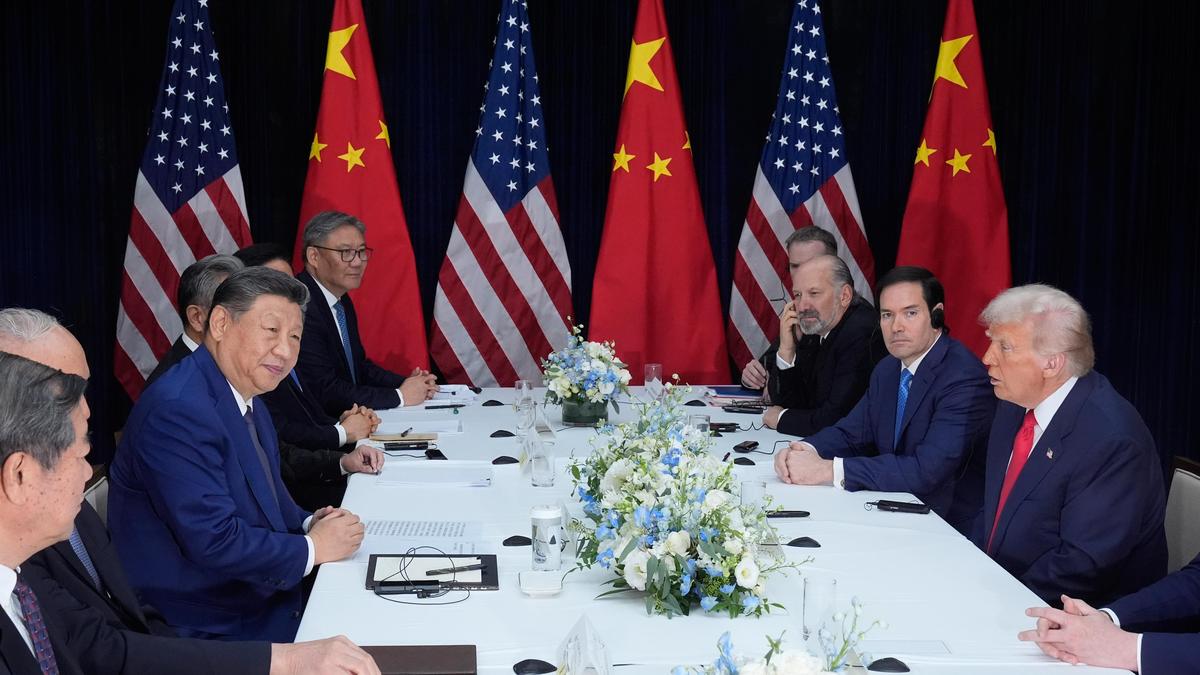
During the Cold War, the Soviet Union was America’s principal rival, and in the 1970s, Washington reached out to China to exploit fissures within the communist bloc. Today, the U.S. identifies China as its principal and systemic challenger. This, in turn, leaves open the possibility of a reset in ties with Russia — an idea embraced by Mr. Trump’s MAGA (Make America Great Again) ideologues, who frame Russia as part of a shared ‘Christian civilisation’.
The reigning power versus the rising power
The U.S. faces a unique challenge in China. The Soviet economy, in its prime in the early 1970s, reached about 57% of the U.S. GDP, before it began slowing down. China’s economy, now the world’s second largest, already amounts to about 66% of the U.S. economy. China continues to grow at a faster pace, steadily narrowing the gap.
As China’s economic power expands, it is being converted into military capability (it has already built the world’s largest Navy, by number of ships). Like other great powers, Beijing is seeking to establish regional hegemony and global dominance. So, a prolonged contest between the U.S., the reigning power, and China, the rising power, appears unavoidable. The situation is comparable to 19th century Europe, when a rising imperial Germany threatened to upstage Britain during Pax Britannica, unsettling the ‘Concert of Europe’.
Russia is the weakest link among the three powers. It is a relatively smaller economy with a shrinking sphere of influence. But Russia’s nuclear arsenals, expansive geography, abundant energy and mineral resources and its demonstrated willingness to use force to achieve its strategic objectives keep it in the great power constellation. From Moscow’s perspective, the country drifted into the wilderness in the 1990s before announcing its return in 2008 with the war in Georgia. Since then, it has sought to rewrite the post-Soviet security architecture in Europe. As the West, having expanded the North Atlantic Treaty Organization into the Russian sphere of influence, responded to Vladimir Putin’s war in Ukraine with sweeping sanctions on Russia and military support for Kyiv, Moscow moved ever closer to China. Russia and China have found common ground in opposing the western ‘rules-based order’ — Russia thinks that the order denies it its rightful place in the world and seeks to revise it accordingly, while China, by contrast, as Rush Doshi argues in The Long Game, wants to replace it with a China-centric order.
Fluid multipolarity
All three great powers today understand that the world is no longer organised around a single centre of authority. In that sense, the world is already multipolar. But unlike the post-Second World War and post-Cold War transitions, the structures of the new order have yet to fully emerge. During the Cold War, the world was divided into two ideological blocs and two largely separate economic systems. Today, China lacks the kind of satellite state networks that characterised the 20th century superpowers, while the U.S. is reassessing the sustainability of its alliance frameworks, including its commitment to Europe.
Russia, with its own great power ambitions, is wary of being seen as a Chinese ally irrespective of its close strategic partnership with Beijing. This opens a window for a Washington-Moscow reset. But the war in Ukraine remains a stumbling block. Russia may not want to challenge America’s global leadership, but it certainly wants to re-establish its primacy in its sphere of influence.
Thus, there are three great powers with divergent interests that are pulling the global order in different directions, rendering the emerging multipolarity fluid rather than as a structured system akin to the post-Second World War order. This also means that middle powers, including superpower allies such as Japan and Germany, and autonomous actors such as India and Brazil, would continue to hedge their bets.
Mr. Trump wants Europe to shoulder greater responsibility for its own security, reset relations with Russia and reassert American primacy in its immediate neighbourhood even as Washington prepares for a prolonged great power competition with China. The idea is to return to the classic offshore balancing. Even if Mr. Trump fails in executing it, future American Presidents may not be able to ignore the shifts that he has initiated. Russia, for its part, seeks to carve out a sphere of influence. China aims to preserve its close strategic partnership with Russia to keep the Eurasian landmass within its orbit, while establishing regional hegemony in East and Southeast Asia — moves that would cement its status as a long-term superpower, much as the U.S. did by asserting its hegemony in the Western Hemisphere in the 19th century, and across the Atlantic in the 20th century. In this fluid landscape, Russia has emerged as the new ‘swing great power’ between the two superpowers, paradoxically lending the emerging multipolar order a distinctly bipolar character.
Published – December 31, 2025 12:16 am IST