

Economists feel a prolonged conflict in West Asia could push crude oil prices beyond India’s comfort zone.
| Photo Credit: Getty Images/iStockphoto
The story so far: The Indian economy, measured in terms of the Gross Domestic Product (GDP) as well as Gross Value-Added (GVA), grew 7.8% between April and June (first quarter or Q1) this year, a four quarter-high. The Finance Ministry believes the momentum of economic activity was carried forward in the July-September quarter, despite retail inflation hardening to 6.4% from 4.7% in Q1 thanks to a spike in food prices. Growth estimates for Q2 will come in next month, but the Reserve Bank of India (RBI) expects GDP growth to moderate to 6.5%. A week into the second half of the year, the Israel-Palestine conflict erupted and a spate of fresh dark clouds now hover over the economy.
How have experts reacted to recent events?
Economists feel a prolonged conflict in West Asia could push crude oil prices beyond India’s comfort zone and if other countries join the fray, critical sea routes could face disruptions and spike transport and insurance costs. The government may not pass on higher petroleum prices to consumers ahead of critical elections, but producers’ costs may still rise. Airlines, for instance, have been hiking fares in line with aviation turbine fuel costs. Moreover, higher fuel import bills could pose implications on the exchequer as oil marketing companies may need support for under-recoveries. Finance Minister Nirmala Sitharaman, in her first remarks since the strife in Gaza, said it has brought concerns about fuel, food security and supply chains back to the forefront. She flagged concerns about the impact of any disruptions on inflation in the near future. In subsequent comments, she has also emphasised the need to ensure that global food, fertilizer and fuel supplies did not become an “instrument of war and disruption”.
The RBI Governor Shaktikanta Das, who chaired a monetary policy review hours before Hamas launched the first salvo in the conflict, summed up the emerging situation eloquently. “We all thought that the period of uncertainties is over, but as you would have seen in the last fortnight, new uncertainties have been thrown up while some that already existed, like oil prices and volatility in financial markets, have got more pronounced,” he said last Friday. Among the new uncertainties, he listed the spurt in U.S. bond yields that hit a 16-year high this month and mixed global data points amid fears of “higher for longer” interest rates. A cut in India’s interest rate is not on the cards, he emphasised. “Interest rates will remain high… how long… only time and the way the world is evolving, will tell.” Higher interest rates can impact investment flows in markets like India.
Is there a shift in the assessment of risks for the economy?
The International Monetary Fund (IMF) raised its 2023-24 GDP growth estimate for India to 6.3% this month from 6.1% estimated earlier. This is just slightly below the 6.5% GDP uptick the Finance Ministry and the RBI have penned in for this year, following last year’s 7.2% growth. In its monthly economic review report released last month, the Department of Economic Affairs (DEA) in the Finance Ministry said it was comfortable with the 6.5% hopes “with symmetric risks”. Bright spots of corporate profitability, private sector capital formation, bank credit growth and construction sector activity offset the risks at the time. These included steadily climbing crude oil prices (“but no alarms yet”) and an overdue global stock market correction, which it termed “an ever-present risk”. The RBI, this month, also asserted that risks from the uneven monsoon, geopolitical tensions, global market volatility and economic slowdown, were “evenly balanced”. The RBI expects GDP growth to slow to 6% in the current quarter, and further to 5.7% in January to March 2024 before picking up to 6.6% in Q1 of 2024-25. Governor Das has since exuded confidence in the overall macro fundamentals of the Indian economy, despite the uncertainties that have emerged this month.
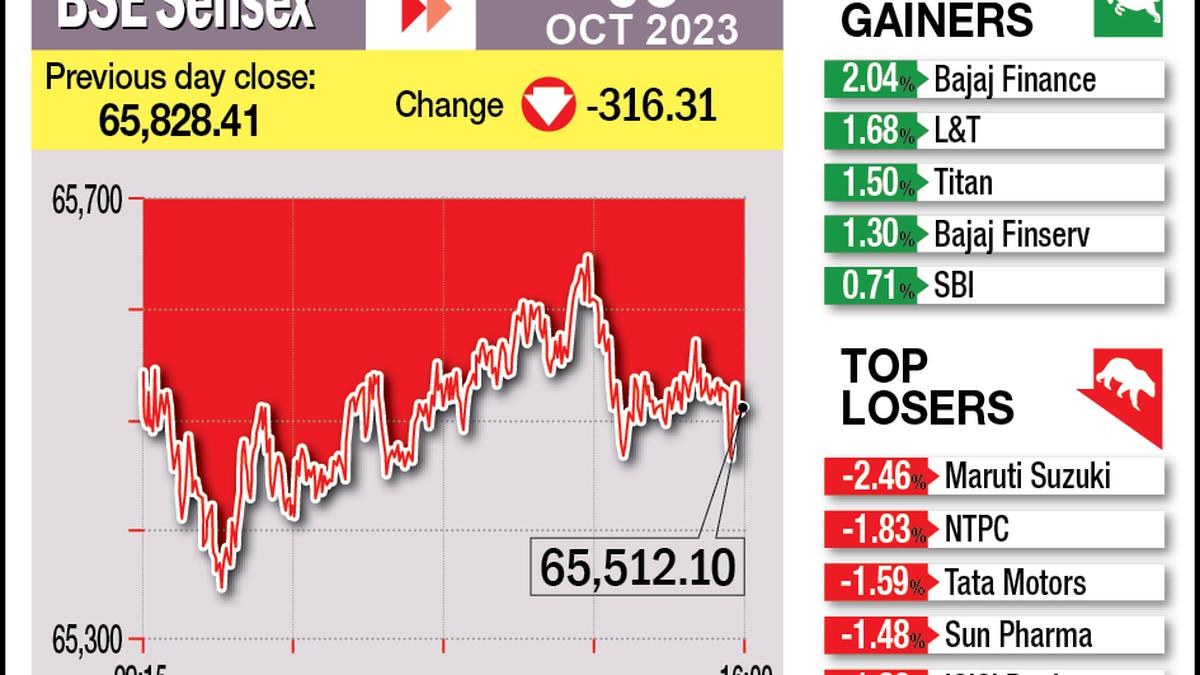
Last Monday, in its latest economy review, the DEA noted that though domestic fundamentals are strong and improving, downside risks arise from global headwinds that have been compounded by recent developments in the Persian Gulf, and uncertainties in weather conditions due to El Niño effects. “Depending on how the situation develops, crude oil prices may push higher. Further, the relentless supply of U.S. Treasuries and continued restrictive monetary policy in the U.S. (with further monetary policy tightening not ruled out) could cause financial conditions to be restrictive,” it said. It was also prescient about the U.S. stock markets having a greater correction risk, which would have spillover effects on other markets. India’s stock markets clocked six straight days of sharp declines before a marginal recovery was seen this Friday. The DEA has flagged a broader worry about fraught geopolitical conditions triggering a surge in risk aversion. “If these risks worsen and are sustained, they can affect economic activity in other countries, including India,” it noted, even as it averred that India’s growth story remained on track. Inflation had eased to 5% in September from a 15-month high of 7.4% in July and the department highlighted higher upticks in industrial capacity utilisation levels, private consumption and investment, retail loans extended for vehicles and housing as bright spots in its economic outlook. The report also cited ‘optimistic’ findings from RBI’s forwarding-looking surveys on manufacturing, consumer confidence, employment and inflation expectations to stress all is well.
What are domestic factors to watch out for?
Inflation may have subsided last month, but could creep back up. The RBI, which expects average inflation of 5.4% through 2023-24, has penned in a 5.6% average uptick in prices for the October to December quarter and 5.2% for the first six months of 2024. While some vegetable prices have corrected, inflation in onions has shot up while for pulses and some cereals, prices are likely to stay high for a while. The IMF and World Bank expect inflation to average even higher at 5.5% and 5.9%, respectively. The RBI’s preferred 4% inflation mark remains elusive as do prospects of interest rate cuts. This doesn’t bode well for a sustained rise in consumption demand that is vital to revive private investments. A Bank of Baroda study on consumption trends shows that production of readymade garments, mobile phones, hair dye, shampoo, cookers and even ice cream, had declined between 12% to 20% in the first five months of this year. “Normally when inflation is high households tend to cut back on discretionary spending which is what is being seen today,” it noted. With pent-up demand effects fading, the next couple of months will determine whether consumption has actually picked up, the Bank’s economists said. Rural demand which has been lagging, will be important, and may come under more pressure if some crops’ output is affected. Last but not the least, an economist from a rating firm said, the upcoming election season could imply some slowdown in public capex in infrastructure that revved up the economy in recent quarters.