



Skip to content
  • Facebook
  • X
  • Linkedin
  • WhatsApp
  • YouTube
  • Associate Journalism
  • About Us
  • Privacy Policy
  • 033-46046046
  • editor@artifex.news
Artifex.News

Artifex.News

Stay Connected. Stay Informed.

  • Breaking News
  • World
  • Nation
  • Sports
  • Business
  • Science
  • Entertainment
  • Lifestyle
  • Toggle search form
  • ‘I had God on my side’: Trump describes assassination attempt in personal detail as he accepts Republican nomination
    ‘I had God on my side’: Trump describes assassination attempt in personal detail as he accepts Republican nomination World
  • World Cup 2023: Afghanistan Stun England In Battle Of David vs Goliath
    World Cup 2023: Afghanistan Stun England In Battle Of David vs Goliath Sports
  • India’s space economy has potential to reach  billion by 2033 with about 8% global share
    India’s space economy has potential to reach $44 billion by 2033 with about 8% global share Science
  • Trump to sign barrage of executive orders on immigration, border security, energy
    Trump to sign barrage of executive orders on immigration, border security, energy World
  • Biden approves largest offshore wind project in U.S. history
    Biden approves largest offshore wind project in U.S. history World
  • Access Denied Sports
  • Toyota to build three assembly plants in Maharashtra: report
    Toyota to build three assembly plants in Maharashtra: report Business
  • India’s Likely XI vs New Zealand: Three Pace Attack In 1st Test? Gautam Gambhir Says This
    India’s Likely XI vs New Zealand: Three Pace Attack In 1st Test? Gautam Gambhir Says This Sports
Tetrapod-shaped nanoparticles could make plastics easier to process, finds IIT study

Tetrapod-shaped nanoparticles could make plastics easier to process, finds IIT study

Posted on November 25, 2025 By admin


An image of concrete tetrapods used as wave breakers to prevent beach erosion.
| Photo Credit: Special Arrangement

A collaborative study by researchers from three Indian Institutes of Technology (IITs) has found that adding tetrapod-shaped nanoparticles to certain synthetic plastics can significantly reduce their viscosity, making them easier and less energy-intensive to process.

Plastics owe their versatility to long molecular chains called polymers, which make them moldable and stretchable. However, many synthetic plastics with heavy, long chains become extremely thick when molten—a property scientists call high viscosity—making them difficult and costly to process.

A recent collaborative study titled, ‘Nanotetrapods promote polymer flow through confinement induced packing frustration’ by researchers from IIT Bombay, IIT Madras, and IIT Kanpur demonstrated that mixing tetrapod-shaped nanoparticles, tiny particles resembling the four-armed concrete structures used as sea wave breakers, into polymers can improve their flow. The effect was tested on polystyrene (PS), a polymer whose physical and rheological properties are well understood.

The research was led by Professor Mithun Chowdhury, who heads the Lab of Soft Interfaces at IIT Bombay, with collaborations from Professors Anindya Datta (IIT Bombay), Tarak K. Patra (IIT Madras), and Sivasurender Chandran (IIT Kanpur). The experimental work and analysis were done by Jotypriya Sarkar, Mithun Madhusudanan, Harshit Yadav, Dr. Fariyad Ali from IIT Bombay, and Dr. Sachin M. B. Gautham from IIT Madras.

“This study opens a pathway to potentially lower processing energy in the future, if we can mass synthesise precisely shaped sustainable nanoparticles,” said Mr. Chowdhury, who heads the Lab of Soft Interfaces at IIT Bombay and led the research.

The idea, he said, came from a casual observation, “During a walk along Marine Drive, we saw the large concrete tetrapods used to break waves. That sparked a question: what if we used tiny versions of these shapes in thick polymer fluids?” Mr. Chowdhury thought of testing out tetrapods because of their unusual geometry. Nanoparticles of other shapes, such as spheres or rods, are known to increase viscosity rather than reduce it, he said.

Unlike spherical or rod-shaped nanoparticles, which typically increase viscosity, tetrapods reduced it. “The simulations showed that the inner curvatures of a tetrapod create regions that long polymer chains find unfavourable to enter,” he explained. “This causes the lowering of the number of polymers around the nanotetrapod and thereby lets polymer chains slide past one another more easily,” he added.
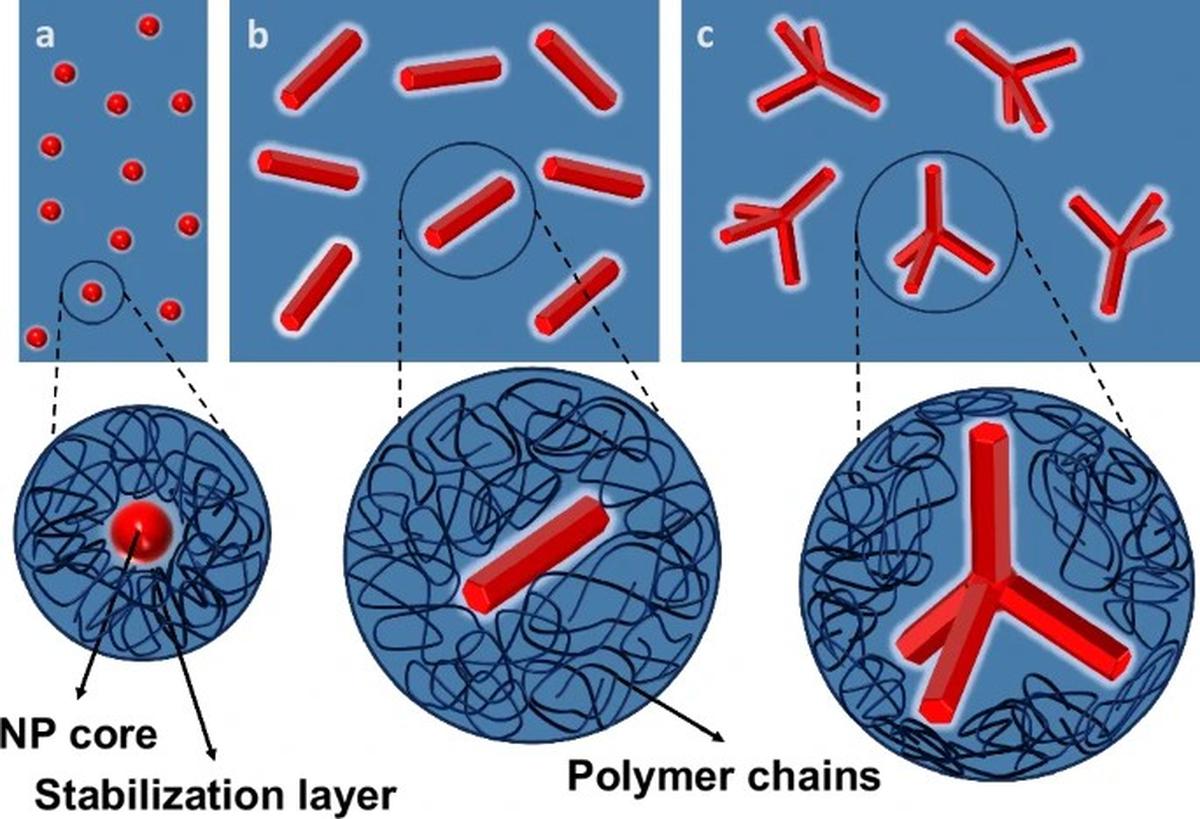
A visualisation of how polymer molecules behave differently around different nanoparticle shapes; the threads are polymer chains, and the red shapes are nanoparticles. Notice the lower density around tetrapods.

A visualisation of how polymer molecules behave differently around different nanoparticle shapes; the threads are polymer chains, and the red shapes are nanoparticles. Notice the lower density around tetrapods.
| Photo Credit:
Authors of the study

The team sourced cadmium-selenium (CdSe) tetrapods from Professor Anindya Datta’s lab at IIT Bombay and incorporated them into polystyrene. Control experiments with spherical and rod-shaped CdSe nanoparticles confirmed that only tetrapods improved flow. Importantly, the addition did not compromise the polymer’s mechanical or thermal integrity. 

The findings also suggest that nanoparticle shape could potentially be used to tune how plastics flow. “Many applications, like coatings, adhesives, or 3D printing resins, require specific viscosity for shape retention or load bearing. There are plenty of examples of nanoparticles increasing viscosity, but our study shows it can go both ways. Compact particles like spheres or roads can thicken, Mr. Chowdhury explained.

The team is currently exploring ways to scale up the process for preparing polymer-nanoparticle composites and adapt it to different types of polymers. Key challenges remain, including large-scale nanoparticle synthesis and replacing toxic materials such as cadmium with more environmentally friendly alternatives.

“Future work will extend this to other polymers and more complex nanoparticle geometries,” added Mr. Chowdhury. In the future, the group aims to develop models, using AI or machine learning techniques, to predict the behaviour and flow patterns of polymer-nanoparticle composites based on nanoparticle geometry.

Published – November 26, 2025 04:30 am IST


Source link

Science Tags:Reducing plastic viscosity, tetrapod-shaped nanoparticles

Post navigation

Previous Post: Japan scrambles aircraft over suspected China drone near Taiwan
Next Post: Access Denied

Related Posts

  • Science Snapshots: March 1, 2026
    Science Snapshots: March 1, 2026 Science
  • Why is it colder at higher altitudes?
    Why is it colder at higher altitudes? Science
  • SpaceX’s Falcon-9 deploys India’s GSAT-N2 satellite into orbit
    SpaceX’s Falcon-9 deploys India’s GSAT-N2 satellite into orbit Science
  • If anxiety is in my brain, why is my heart pounding? A psychiatrist explains the neuroscience and physiology of fear
    If anxiety is in my brain, why is my heart pounding? A psychiatrist explains the neuroscience and physiology of fear Science
  • IIT Madras finds aerosols transported from north India worsen air quality over Chennai, southeast coast
    IIT Madras finds aerosols transported from north India worsen air quality over Chennai, southeast coast Science
  • Crocodiles yield to flower power, study finds 
    Crocodiles yield to flower power, study finds  Science

More Related Articles

SpaDeX docking: Spacecrafts are at distance of 1.5 km, to come closer on January 11 SpaDeX docking: Spacecrafts are at distance of 1.5 km, to come closer on January 11 Science
India’s reservoirs can host 102 GW of floating solar, says first national assessment India’s reservoirs can host 102 GW of floating solar, says first national assessment Science
What makes the NASA-ISRO NISAR satellite so special? | Explained What makes the NASA-ISRO NISAR satellite so special? | Explained Science
Eye care diagnosis from a distance Eye care diagnosis from a distance Science
 Global project ‘paints’ evidence of air pollution in India  Global project ‘paints’ evidence of air pollution in India Science
ISRO staff bodies seek clarification on the trajectory of privatisation ISRO staff bodies seek clarification on the trajectory of privatisation Science
SiteLock

Archives

  • October 2026
  • September 2026
  • August 2026
  • July 2026
  • June 2026
  • May 2026
  • April 2026
  • March 2026
  • February 2026
  • January 2026
  • December 2025
  • November 2025
  • October 2025
  • September 2025
  • August 2025
  • July 2025
  • June 2025
  • May 2025
  • April 2025
  • March 2025
  • February 2025
  • January 2025
  • December 2024
  • November 2024
  • October 2024
  • September 2024
  • August 2024
  • July 2024
  • June 2024
  • May 2024
  • April 2024
  • March 2024
  • February 2024
  • January 2024
  • December 2023
  • November 2023
  • October 2023
  • September 2023
  • August 2023
  • July 2023
  • June 2023
  • May 2023
  • April 2023
  • March 2023
  • February 2023
  • January 2023
  • December 2022
  • November 2022
  • October 2022
  • September 2022
  • August 2022
  • July 2022
  • June 2022
  • May 2022

Categories

  • Business
  • Nation
  • Science
  • Sports
  • World

Recent Posts

  • Women stage silent demonstration at Kathipara against police action on anti-CEC protesters in Delhi
  • DGCA bans specific power banks on flights
  • Saudi Supreme Court sets aside Sri Lankan migrant worker’s death penalty
  • Nedumbassery accident: CPI(M) stages protest march to police station over ‘indifference’ in handling of case
  • Why CJI Surya Kant said ‘no’ to Rahul Gandhi’s request to meet | Explained

Recent Comments

  1. RobertTes on UP Teacher Who Asked Students To Slap Muslim Classmate
  2. Manuelret on UP Teacher Who Asked Students To Slap Muslim Classmate
  3. RobertTes on UP Teacher Who Asked Students To Slap Muslim Classmate
  4. RobertTes on UP Teacher Who Asked Students To Slap Muslim Classmate
  5. BrentWes on UP Teacher Who Asked Students To Slap Muslim Classmate
  • Access Denied Business
  • Access Denied
    Access Denied Nation
  • Donald Trump adds RFK Jr. and Tulsi Gabbard to transition team
    Donald Trump adds RFK Jr. and Tulsi Gabbard to transition team World
  • Access Denied World
  • Woman dies, buildings damaged in Ukrainian drone attack on Russia’s Voronezh, governor says
    Woman dies, buildings damaged in Ukrainian drone attack on Russia’s Voronezh, governor says World
  • 30 killed in drone attack on hospital in Sudan’s Darfur: medical source
    30 killed in drone attack on hospital in Sudan’s Darfur: medical source World
  • Access Denied World
  • Girl Bitten By Dog In Lift At Noida Apartment
    Girl Bitten By Dog In Lift At Noida Apartment Nation

Editor-in-Chief:
Mohammad Ariff,
MSW, MAJMC, BSW, DTL, CTS, CNM, CCR, CAL, RSL, ASOC.
editor@artifex.news

Associate Editors:
1. Zenellis R. Tuba,
zenelis@artifex.news
2. Haris Daniyel
daniyel@artifex.news

Photograher:
Rohan Das
rohan@artifex.news

Associate Journalists
1. Subrata Paul - AN/2020/01
2. Quamruz Zaman - AN/2021/22
3. Ahmed Sha - AN/2021/035
4. Ajay Kumar Shaw - AN/2021/39
5. Tahqiqul Hoda - AN/2021/21

Artifex.News offers Online Paid Internships to college students from India and Abroad. Interns will get a PRESS CARD and other online offers.
Send your CV (Subjectline: Paid Internship) to internship@artifex.news

Links:
Associate Journalism
About Us
Privacy Policy

News Links:
Breaking News
World
Nation
Sports
Business
Entertainment
Lifestyle

Registered Office:
72/A, Elliot Road, Kolkata - 700016
Tel: 033-22277777, 033-22172217
Email: office@artifex.news

Editorial Office / News Desk:
No. 13, Mezzanine Floor, Esplanade Metro Rail Station,
12 J. L. Nehru Road, Kolkata - 700069.
(Entry from Gate No. 5)
Tel: 033-46011099, 033-46046046
Email: editor@artifex.news

Copyright © 2023 Artifex.News Newsportal designed by Artifex Infotech.